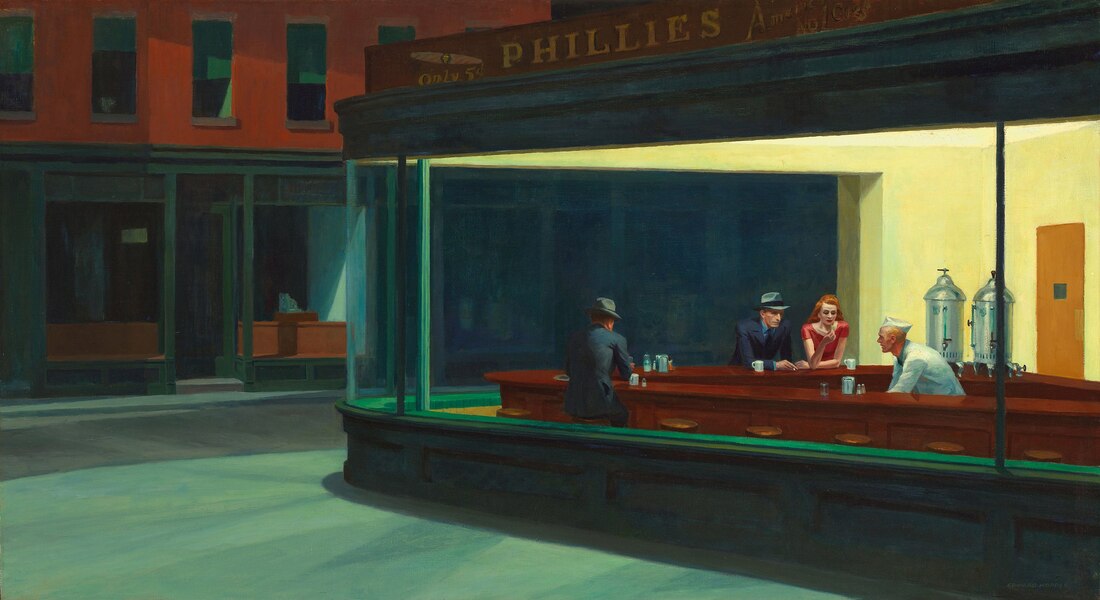
 Nighthawks, by Edward Hopper (USA) 1942 Nighthawks Midnight again. I came here last Thursday, and the Thursday before, and so to my grave. The couple—lady of crimson and man of gray—talk only about their latest purchases: new washing machine, teal fridge; not about their foreclosure. And I, bowler hat propped just above eyes and ears, sink into hours when light evades dawn and dusk. Now silent, the couple gives vacant witness to the server stacking plates. I hear the street’s murmurs, the ragged sigh of the man… At one point, my wife and I would swim by our lake house, water lacquered like this cherry wood counter. No stale air: the cigarette smoke that lingers here; no empty shopfront. We had rural New York, our property that spread capacious across lake and lush hills. But that was years ago. Here in the diner, a pane of glass seals us off. Soft light dissolves before it can touch night. Alexander Lazarus Wolff Alexander Lazarus Wolff's writing appears online in The Best American Poetry website and Poets.org, and in the North American Review, Pithead Chapel, and elsewhere. A recipient of an Academy of American Poets prize, he teaches at the University of Houston where he is the Inprint MD Anderson Foundation Fellow and assistant poetry editor for Gulf Coast. You can read more of his work at www.alexanderlazaruswolff.com.
0 Comments
 The Rocks at Fountainblue, by Paul Cezanne (France) 1890s Cézanne’s The Rocks at Fontainebleau You’d get nowhere among those purple slabs (boulders, walruses or buttocks, who knows which?) but thick: nothing you could walk between or through. Amazing how those slim Aleppo pines squeeze in. My only friends are trees, Cézanne said. Such grace in their reach toward that grayish-purple sky. But I feel fallen, looking: decked in green scruff with granite feet; and then I’m ten again and numb, staring at the print I’ve hung on my wall, imagining the cool of it, the dark, while downstairs giants squabble. All foreground and stumbling, the world then.  In the Bebemus Quarry, by Paul Cezanne (France) 1900-1904 Cézanne at Bibémus Quarry Limestone suits me-- the way it rumbles on about scale and time-- fissured, fallen, gouged, but not done. My thin washes stave nothing off, brushstrokes broken by green broken by broken ochre rock. The quarryman, that tiny slip of flesh, bakes in earth’s red oven. I forget what formal need he fills. His neck must ache like mine from staring up. At what? The soil’s persistence, the chaos of gray in those clouds, a few streaks of shrubbery, rosemary, thyme. Thank god for the Aleppo pines. Twisted and pulled by sun, they scorn me with such an air of distinction. Ruth Hoberman Ruth Hoberman lives in Newtonville, Massachusetts. Since her 2015 retirement from Eastern Illinois University, she has published poems and essays in various journals, most recently in Salamander, RHINO, Mezzo Cammin, and SWWIM Every Day.
A Professional Beauty (Madame X) It was the strap that aroused ire, not a sartorial slippage, but a moral one. Sargent fixed it and kept you in his studio an artist scalded by bad reviews. He could stand before you sighing, admiring the curve of your right arm, lithe as the neck of a swan. He could sink into the depths of your dress, tease the fine chestnut curls at your neck, admire your white skin, pearl-soft as inner conch. You were his, at least on canvas. Like Sargent, I stand before you, transfixed by your sharp nose, sharp enough to scent out social opportunity. Sargent set your pose, which seems to refuse the viewer, offering no more than the sight of you. That might be enough, but I see a professional beauty leaning back, one swift glance over her shoulder before she lifts the inky skirts gathered in her sinister hand. Karen G. Berry Karen G. Berry lives in Portland, Oregon, and works as a professional copywriter. She is interested in micro-societies, the strange and secret lives of children, and the heroic nature of everyday living. Karen's poetry has been published by Rust & Moth, Parks & Points, The Gilded Weathervane, Hot Pot Magazine, Subprimal, Panorama, Ekphrastic Review, and many other journals and anthologies, online and in print.  Black Hole in the Universe, by NASA (USA) contemporary Blind Night night has a hollow interior where everything's soaked in absorbent black ink every particle of air that clamors against light's abandonment night looks for light any glimmer in an oil stain or in black glossy fabric and the tip of a match that causes and ends in ash banked in a fire pit night catches the glint of an old watch's hour hand painted decades ago with radium that was wet from the lips of girls moistening their brushes some nights streaking lights form dots in a puzzle shape to be connected by lines drawn by the eyeless mind but all of these with us fall in a cosmic black hole night looks for what is light not knowing what it is like the eye's black pupil even the lashes are black night gasps and blinks startled by recurring dawn Royal Rhodes Royal Rhodes is a poet and retired educator who lives in a small village in rural Ohio. He enjoys listening to Classical music and reading poetry, ancient and modern. His poems have appeared in numerous literary journals, including previously The Ekphrastic Review and its challenges, for which he is grateful.  The Yellow Umbrella, by Jacob Berghoef (Denmark) 2024 In the Unspecified City Caught in traffic, with the oncoming night erasing the street signs. Shopkeepers locking their doors, stepping out onto sidewalks strewn with stark headlines and grime. Carving the air, the blade of a siren. The purple-black biblical sky like the city’s inverted shadow. Under a yellow umbrella, two passers-by are laughing. Longing, such extravagant longing for that kind of banter. It occurs to me that we are still circling the sun. Laura Ann Reed Laura Ann Reed is a Contributing Editor with The Montréal Review. Her poems have appeared in seven anthologies, including Poetry of Presence II, as well as in numerous journals. Her most recent work is forthcoming in Illuminations. Her forthcoming chapbook, Homage to Kafka, will be published in July, 2025. https://lauraannreed.net/  The Unequal Marriage, by Vasily Pukirev (Russia) 1862 Stained Gown Eyes rimmed and rosy, shimmering with tears. Her comely beauty luminesce, dimmed under watchful eyes. White roses yet to bloom, tiara of bud spring. Misery too sinking, heed the whispering masses. The languid bride held out a pale hand, doomed to her fate of bonded rings. A corset of rope constricting her, As candle wax dripped onto her stained gown. Caitlin Suol Walenciak Caitlin Walenciak is a young writer and student living in Michigan, US with her family and two dogs. She enjoys long runs on trails and reading books in her free time. Caitlin hopes to publish more of her creative writing.  Jesus and the Woman at the Well, by Lu Hongnian (China) before 1989 At the Well Beneath a water-hued landscape that distracts the way the thirsts of life pull our eyes from God, the Samaritan woman, stopped while filling her water jar by Jesus, his unusual request for a drink, stares at the ground in front of her full bucket, considering his words, the living water. Jesus sits by the old well, two fingers raised as if blessing her bowed head. Oh, to be her, to recognize the glory of God in a basic request. I also say Lord, give me this water, for the world makes me thirst managing many demands and I too, long to be blessed. Elisa A. Garza Elisa A. Garza is a poet, editor, and writing teacher of students from elementary age to senior citizens. She is now teaching writing workshops for cancer patients and survivors. Her full-length collection Regalos (Lamar University Literary Press) was a finalist for the National Poetry Series. Elisa’s chapbooks include Between the Light / entre la claridad, and The Body, Cancerous, forthcoming in 2025 (both from Mouthfeel Press). Her poems have recently appeared in Southern Humanities Review, Ars Medica, and Huizache and one was recently on exhibit at The Health Museum in Houston.  Weight of the Carapace, by Sarah Petruziello (USA) 2018. Click image for artist site. The Weight of the Carapace Heavy, and the colour of lead, my body is spine-fused to an amber carapace. I am startled by threats in murk, and my eyes, bulging like a turtle’s, hear the rustling brush like curses on wind, words snagged in Gambel Oak. I thrash like panicked wings. I crawl close low-slung things, dirt and fern and ivy. Behind bound tree roots, I am naked beneath the weight of my shell, and I wear it, not my Achille’s shield, but host’s gold charger, aware of the looming fracture to each scute. With a free hand, I serve fruits: mangos, grapes, pomegranates, and pears— All are fed, living and dead, as my prayer— holy, holy—rises from my mouth’s censer— pieces me away, unafraid. Lindsey Royce Lindsey Royce’s poems have appeared in periodicals and anthologies, including the Aeolian Harp #10 (forthcoming), #8, #7, and #5 anthologies; Cutthroat: A Journal of the Arts (periodicals and anthologies); The Hampton-Sydney Review; The New York Quarterly, Poet Lore, and The Washington Square Review. Her poems have been nominated for several Pushcart Prizes. Royce’s first poetry collection, Bare Hands, was published by Turning Point in September of 2016, and her second collection, Play Me a Revolution, was published by Press 53 in September of 2019 and placed for an IPPY Award. Her third collection, The Book of John, was published in April 2023 and was a finalist in The Feathered Quill Book Awards. Also, The Book of John received an excellent Kirkus review. She lives in beautiful northwest Colorado.  Gallery of Antique Art, by Paul Hetherington, Recent Work Press, Australia, 2016. Editor's Note: We recently discovered that a favourite writer, Paul Hetherington, widely known for his prose poetry and prose poetry scholarship, has a wonderful ekphrastic prose poetry collection from 2016. Ekphrasis is a recurring literary interest of Paul's, and this gem of a book imagines a gallery and a variety of experiences there. Paul says, "the gallery that the book walks the reader through is a notional construct rather than an actual place, drawing on artworks from various countries and art museums." He wrote it during a residency in Trastevere, Rome. Paul references a range of artworks in these poems, often multiple pieces inside each one, as well as the general experience of the museum. The images shown have been chosen by TER, drawing from the many possibilities in the poetry. Some have been curated from Paul's general descriptions as illustrations, for example, one poem references Dutch still life in general and we show a particular piece by Floris van Dyck. We are grateful for the chance to show a selection of the poems in The Ekphrastic Review.  Sarcophagus of the Spouses from Caere, now in the National Etruscan Museum at Villa Giulia in Rome, by Etruscan artists (Italy) late 500s. Photo by Sailko, CC BY-SA 4.0 Second Room (Perambulation) For minutes at a time we stand in different postures, trying them on for size. Anonymous men and women look back with oddly captivating eyes, yet they do not see us. In Caravaggio’s rendering, John the Baptist sits inside an abstract dream. Young though he is, he might be considering Salome. As he does so, lovers’ portraits beguile old walls like a confusion of memories. Hundreds of beautiful gazes and clothes. The Etruscan Sarcophagus of the Spouses is delicate in its reassembled terracotta. The figures look towards eternity, reaching for vanished wine.  Salome, by Titian (Italy) 1515 Main Corridor The meandering feeling in these corridors suggests there are too many depictions of the ideal—religious iconography supported by kneeling donors; courtly love; chivalric and civil grace. The poor are almost nowhere, performing bit parts in fields or as dark- faced executioners. Or they’re an aside in someone else’s conversation—servants who wait on the princely couple; witnesses to the righteous who have declined to ruin them. Fragility is the contrast between varnished gazes, damasked finery and the Baptist’s severed head. Salome looks puzzled. What is it to stand in perpetuity proffering an image of the famous dead?  Still Life with Cheese, by Floris van Dyck (Netherlands) 1615 Eighth Room (Special Exhibition of Dutch Paintings) When you stumble on flagstones I seize your arm. We climb marble steps, feeling their old weight in our legs. As we enter, there are a hundred crowded Dutch paintings showing seventeenth-century fruit and meat. The ticket seller’s playing Bach’s inimitable Cello Suites, but the sound’s so low I query what it is. The largo speaks of Spain, where we listened and were entranced; where we sat on a balcony as you offered counsel. I’m reminded that affection’s often like this—a helping hand, music no-one expects. Someone says right words and the aftermath enthralls—like a painting one could eat.  Pieta, by Giovanni Bellini (Italy) 1505 Ninth Room (Perambulation) I’m standing quietly and a painting speaks—of how there were floods for nearly a week and not far from here the Tiber rose. But, after all, a tour’s arrived and a guide’s instructing her group: "It’s neat how he’s painted her feet." They move on and I examine again the Virgin with crucified child. Desert sun bakes the blue of her grief—it’s almost all she knows. And grace she carries; divinity that dies; the world’s long heaviness. She’d hold him forever if time would stand still. She’d let him go if she could.  The Tempest, by Giorgione (Italy) 1508 Tenth Room (Perambulation) Believing in this past is no longer possible. Not with so many depictions of Saint Catherine’s broken wheel or the painterly zeal of righteous crusades—the meek inheriting loss’s deep umber. It’s a visual hagiography writ large, that afterwards our dreams irritatingly repeat. Yet Giorgione’s tempest makes of today’s storm an urgent poiesis and parable and the suffering Madonna strangely understands contemporary grief. Everywhere we look—implausible lies, improbable truth.  The Conversion on the Way to Damascus, by Caravaggio (Italy) 1601 Postcard: Santa Maria del Popolo In Santa Maria del Popolo Saul is gasping on his back. Words enter his body like creatures; he embraces his interrogator in armfuls of puzzled air. Belief, knowledge, trust collide as light is taken from his eyes. His groom looks on uncertainly; his horse steps forwards, exiting the frame. Caravaggio suggests there’s no way back from such extremity—which his crucified Saint Peter underlines. "Beware of what you know," the paintings say.  Capuchin Crypt, Rome (Italy) 1630s. Photo by Dnalor 01, CC BY-SA 3.0 Postcard: Capuchin Crypt The crypt is a delicacy of design; air remembers blood that lodged here. Shrugged dances of shoulder blades are Angels ceaselessly trying ascent. Rooms are full of smiles, each one a death’s head. Sing they say. Drive to eternal love via bony congregations. Take a hand that aggregates phalanges and metacarpals; feel its broken hold, leading into byways of knowledge; enshrinements of the body’s first geography. That bay of the skull; this coastline of rib. These bones stood up, fixed by intention. Now they are white noise.  Scene from The Scroll of Genji, 1130 AD. Imperial Court in Kyoto - Genji Monogatari Emaki Published by the Tokugawa Museum in Nagoya (Japan) 1937 Eleventh Room (Small Annex) A twelfth-century scroll shows The Tale of Genji in aristocratic red and gold—and green "like sea grass steeped in brine." Outside in a Japanese Garden a thousand watery fingers are tapping on stone, as if counting centuries. Congregating koi are bundled scarves; autumn leaves spread like brocade. Genji’s thoughts are constellating pines and a sleeved river’s foam. At Nijo the Lady of the Orange Blossoms has moved into the east lodge. Genji remembers the speech of Akashi fishermen, as incomprehensible as birds. Paul Hetherington Paul Hetherington is a distinguished poet and Professor Emeritus at the University of Canberra, Australia. Among his 47 creative and critical books, edited books, chapbooks and artist books, and numerous scholarly chapters and articles, he has previously published 18 full-length collections of poetry. His poetry has appeared in more than 70 anthologies and has won or been nominated for over 50 national and international awards and competitions, including Pushcart Prize nominations. He won the 2021 Bruce Dawe National Poetry Prize and the inaugural The Marion Halligan Award (2024) for Sleeplessness. He is co-founding editor of the international online journal Axon: Creative Exploration. With Cassandra Atherton he co-authored the authoritative Prose Poetry: An Introduction (Princeton University Press, 2020). On Opportunity, by Niccolò Machiavelli (Florence, 1469 - 1527), translated by Julie Steiner2/10/2025  Opportunity and Regret, by School of Andrea Mantegna (Italy) 1500 On Opportunity, by Niccolò Machiavelli (Florence, 1469 - 1527) “Who are you, endowed and adorned with more heavenly grace than mortal woman’s due? Why fidget? And your feet have wings. What for?” “I’m Opportunity, perceived by few. The reason I keep moving? I’m on one foot. (And stand atop a wheel -- that, too.) My flying can’t compete with how I run; my wings, though, boost my feet’s efficiency to blinding speed -- en route, I’m seen by none. I keep my hair in front, where it can be spread out to cover me from chest to face, so when I come, none recognizes me. The back part of my head lacks any trace of hair, so people scrabble uselessly when I’ve passed by -- or turned, if that’s the case.” “But tell me: coming after you, who’s she?” “Regret. Take careful note! Get this down pat! She’s kept by those who can’t keep hold of me. And you yourself, while wasting time in chat and occupied with idle thoughts’ demands, don’t see, poor soul, and don’t yet fathom that already I have slipped right through your hands!” Niccolò Machiavelli, translated by Julie Steiner ** Capìtolo dell’ Occasïone “ Chi sei tu, che non par donna mortale, di tanta grazia il ciel t’ adorna e dota ? perchè non posi ? e perchè a’ piedi hai l’ ale ? ” “ Io son l’ Occasïone, a pochi nota ; e la cagion che sempre mi travagli è perchè io tengo un piè sopra una rota. Volar non è ch’ al mio correr s’ agguagli ; e però l’ ale a’ piedi mi mantengo, acciò nel corso mio ciascuno abbagli. Gli sparsi miei capei dinanzi io tengo ; con essi mi ricopro il petto e ’l volto, perch’ un non mi conosca quando io vengo. Dietro dal capo ogni capel m’ è tolto, onde in van si affatica un, se gli avviene ch’ io l’ abbia trapassato, o s’ io mi volto.” “Dimmi : chi è colei che teco viene ? ” “ È Penitenza ; e però nota e intendi : chi non sa prender me, costei ritiene. E tu, mentre parlando il tempo spendi, occupato da molti pensier vani, già non t’ avvedi, lasso ! e non comprendi com’ io ti son fuggita tra le mani ! ” Niccolò Machiavelli ** Author's note: "The Florentine diplomat and philosopher Niccolò di Bernardo dei Machiavelli (1469 - 1527 CE) is best known for authoring a primer for opportunistic, non-hereditary “princes” to seize and maintain power. But in addition to his political analyses in prose, he composed plays, songs, sonnets, and capìtoli (poems that imitate or parody Dante’s terza rima meditations). Machiavelli’s “Capìtolo dell’ Occasïone,” translated here, is an adaptation of Epigram 33 by Decimus Magnus Ausonius (c. 310 - c. 395 CE), but Machiavelli omitted the introductory lines that establish Ausonius’s Latin version as the ekphrasis of a statue. The grisaille image of Opportunity and Regret (a.k.a. Occasion and Penitence) depicted by Andrea Mantegna’s school in Mantua (https://thumb.tildacdn.com/tild3862-6664-4466-a265-333236656233/-/resize/920x/-/format/webp/opportunity_01.jpg) was painted around 1500, as a recreation of the artwork that inspired Ausonius." Julie Steiner is a pseudonym in San Diego, California. Her poetry has appeared in Literary Matters, The New Verse News, The Able Muse Review, Rattle, Light, The Asses of Parnassus, and American Arts Quarterly, among other venues. She recently embarked on her third decade as an active participant in the Eratosphere online poetry workshop (www.ablemuse.com/erato). |
The Ekphrastic Review

COOKIES/PRIVACY


October 2026
|

