 Untitled, Number 61, by Mark Rothko (USA, b. Vitebsk Governorate). 1953. A Vivid Portrait in Black and White
I see colours whisper names, ghosts of Henrietta Marie inside the planks of wood from sunken ships—murals. Magenta smiles warp deep blue, ocean blue where ship’s bell lays still. Clanging. Clanging loud cries of men whose darkened shadows have been replaced. Finally. Their fettered souls ascend through blue sky lesser blue where anger has been washed to muted gray. John C. Mannone This poem was first published in Rose & Thorn Journal. John C. Mannone has work in Blue Fifth Review, New England Journal of Medicine, Peacock Journal, Plough, Windhover, Gyroscope Review, Baltimore Review, Pedestal, Pirene's Fountain, Poetica Magazine and others. He’s the winner of the 2017 Jean Ritchie Fellowship in Appalachian literature and the recipient of two Weymouth writing residencies. He has three poetry collections: Apocalypse (Alban Lake Publishing), nominated for the 2017 Elgin Book Award; Disabled Monsters (The Linnet’s Wings Press) featured at the 2016 Southern Festival of Books; and Flux Lines (Celtic Cat Publishing). He’s been awarded two Joy Margrave Awards for Nonfiction and nominated for several Pushcart, Rhysling, and Best of the Net awards. He edits poetry for Abyss & Apex and other venues. He’s professor of physics near Knoxville, TN. http://jcmannone.wordpress.com
0 Comments
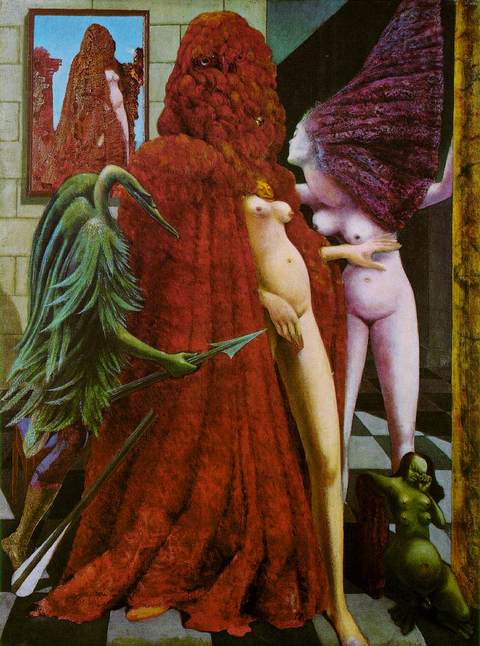 The Robing of the Bride, by Max Ernst (Germany), 1940. The Robing of the Bride
I will not be the world’s bride. I will not have their tongues on my pale skin tracing the path of veins underneath – they touch without touching, they feel without feeling. It only takes an unmasked voice to make them flee. I would rather be the red bird of prey and push away the handmaiden with the fashionable hair. Then, I would snatch the silly lance the green cormorant has pointing at my crotch. He makes me laugh with his pathetic lecherous grin He must be thinking he’s frightening me. I would kiss the crying monster on the top of its head and say, “Goodbye, my friend – you were always free.” They only called it ugly because they were jealous of its completeness. And you – I’m looking at you. Do I make you uneasy with my bloodied feathers? Does my wrongness offend you? Did you think I would cower? For a second I thought so myself. I’m still talking to you. I’m waiting for your answer. If it’s three times “no,” then come in. Anca Rotar Anca Rotar is a Romanian-born writer of poetry and fiction. She was driven to writing by her love of stories and verse, as well as by an ever-increasing fascination with mysteries and the unknown. Her biggest complaint is that there are too many interesting things in the world and hardly enough time to discover them all. 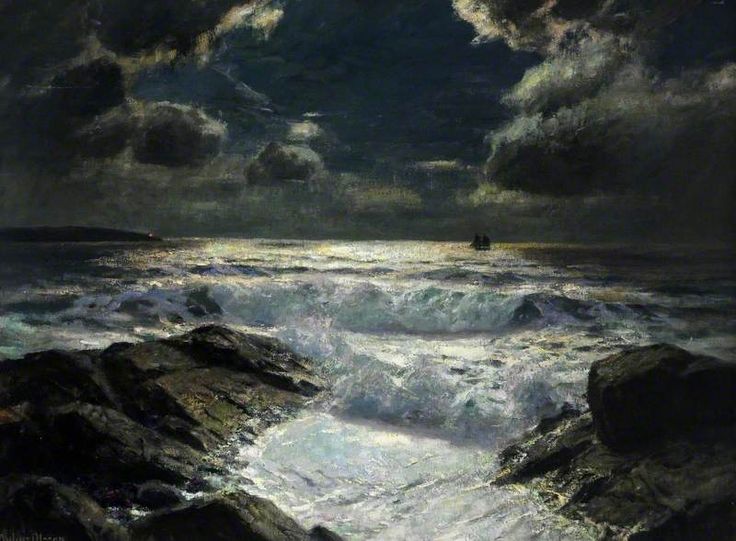 Cloudy Moonlight, by Albert Julius Olsson (UK), 1900. Moonlight and Melancholy
In a short time, Bemis grew to hate the painting. He had bought it at one of those art auctions on a cruise ship, and only later did he learn that the auction house was under indictment for peddling forgeries. Carol had told him he was crazy to spend that kind of money on shipboard, where it was impossible to verify anything. They were sitting ducks, didn’t he see that? Now it turned out she had been right, and the painting hadn’t even arrived yet. When it did, he unwrapped it and took a good, hard look. It was a painting of a clown sitting on a bull’s back, right up behind the horns. The clown had a sad face and was looking off to his right, as if listening for something. The bull had lowered its head slightly and was staring straight ahead at the viewer, looking like it was about to charge. Its horns flared out and up, one of them traversing a large, round moon the painter had hung in the corner of the painting. The whole thing was washed in blue, to suggest moonlight. Bemis remembered reading the identifying label on the ship a fraction of a second before looking at the painting itself, and being charmed by its name, “Moonlight and Melancholy.” Even then, he thought it predisposed him to like the painting. But what did that matter? What mattered was whether you could live with it on your wall, and as he stared at the bull with its sad voyager in the bright moonlight that seemed beyond question. The label had a red dot on it, which meant that a bid had already come in. It was for forty-seven hundred dollars, the auction agent told him when he asked. He would have to do better than that. Carol was not there. She had left after lunch with the snorkeling party in a zodiac that zoomed off into the distance and then disappeared. She wasn’t interested in second-rate art, as she called it. She wanted to see the coral and tropical fish the area was so famous for. Bemis felt exactly the opposite way. He didn’t care if he never saw what was under the sea. At the auction, the agent told him all about the artist, whose work was beginning to turn up in museums in the States and Europe. It usually sold for a lot more than forty-seven hundred dollars. The agent had papers to show that. Bemis put a bid in for forty-seven fifty, figuring that someone else would better that and he’d be off the hook. But no one bid any higher, and when Carol came back she told him he was a sap, and when he showed her the painting she just stared at him. He could tell she was trying not to say anything hurtful. Bemis had been so excited about the painting, but now it seemed a dead thing, now that he had it home. It had no light, it was blue, and mottled, like fish skin. He wondered if it was even the same painting he had seen aboard the ship. He propped it on the hall table, turned toward the wall, and only then did he see the sticker on the back that said “Studio 23,” and the phone number. He dialed it, and a woman who identified herself as Brenda answered on the other end. “How can I help you?” she asked, in a beguiling voice. “I have a painting,” Bemis began. “I think it’s yours. It has a sticker on the back that says Studio 23.” “Could you describe the painting to me?” the woman asked, and when Bemis did she said, “Oh yes. Moonlight and Melancholy. A fine work by”—and here she mentioned the artist whose name Bemis already knew. “Is there a problem?” “I’m not sure,” Bemis said. “I bought it on a cruise ship. I think it may be a forgery.” He could hear a crackling sound on the line when he said the word “forgery.” It sounded like the signal might be fading. “Oh no, sir,” the woman said when she came back. “Studio 23 stands behind all of its paintings one hundred percent.” “What is Studio 23, anyway?” Bemis asked. “We are a clearing house for fine reproduction oil paintings,” she answered, reeling off the words with practiced fluency. “Our artists copy only the best of what is licensed for copying. If you like, I can put a brochure in the mail to you.” “What about”—and here Bemis mentioned the artist’s name. “Did he paint this or not?” “Oh yes, of course. The original,” the woman answered. Bemis felt like an idiot as he asked, “The original? This is not the original?” “Oh no,” the woman said, her voice deepening with what sounded like genuine compassion. “I hope no one misrepresented Studio 23 to you. We handle fine reproduction oil paintings.” No one had said a damn thing about Studio 23, Bemis wanted to tell her. He never heard of it until he turned the painting over at home and saw the sticker. And even the sticker didn’t say anything about reproduction oil paintings or licensed copies. Just “Studio 23” and the phone number. “Sir,” Brenda was saying. “Sir?” “Yes,” Bemis managed to say. He felt groggy and half-drowned. “Sir, I want to assure you that you are in possession of a first-rate work of art. Hardly anyone owns an original, you know. Almost everything you see is a copy. If you’d just let me send you our brochure.” “No, thank you,” Bemis said, because he didn’t want to be rude, and then he hung up. He had a lot to think about. In the meantime, he was not going to look at the painting. There were so many things he didn’t care if he never saw again, things riding out into oblivion away from his caring. Here was another. Only, he thought perhaps if he left the painting on the hall table, where no one would disturb it, turned toward the wall, he might see the Studio 23 sticker with the phone number whenever he passed, and hear Brenda’s beautiful voice saying, “No one owns an original, sir. Everything is a copy.” Michele Stepto Michele Stepto lives in Connecticut, where she has taught literature and writing at Yale University for many years. In the summers, she teaches at the Bread Loaf School of English in Vermont. Her stories have appeared in NatureWriting, Mirror Dance Fantasy and Lacuna Journal. She is the translator, along with her son Gabriel, of Lieutenant Nun: Memoir of a Basque Transvestite in the New World. Editor's Note: This image was chosen by the editor to illustrate the story. The inspiration for the writer's story was an imaginary painting, not this one. 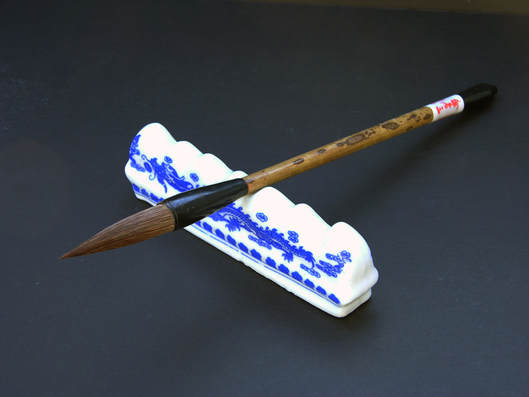 Brush Made from Baby Wolf Hair
This is a traditional Chinese pen, an artifact Combining a wolf’s wildness with a baby’s Innocence. It is soft but strong enough to Write dark history in rice fields, or draw Black pictures on ricepaper. All in black And white. Unlike the feather from a swan That can fly up from an alphabetic epic Yes, it is a colourless feeling the painter Or the writer gets, from his inky strokes Yuan Changming Yuan Changming, nine-time Pushcart and two-time Best of the Net nominee, published monographs on translation before moving out of China. With a Canadian PhD in English, Yuan currently edits Poetry Pacific with Allen Yuan in Vancouver; credits include seven chapbooks (including Dark Phantasms [2017]), Best of the Best Canadian Poetry: 10th Anniv. Ed., BestNewPoemsOnline, Threepenny Review and 1319 across 40 countries.      David Huddle
 teaches at the Bread Loaf School of English and in the Rainier Writing Workshop. His fiction, poetry, and essays have appeared in The American Scholar, Esquire, The New Yorker, Harper’s, Poetry, Shenandoah, Agni, Plume, The Hollins Critic, and The Georgia Review. His most recent books are Dream Sender, a poetry collection, and My Immaculate Assassin, a novel. With Meighan Sharp, Huddle has co-authored a book of poems, Effusive Greetings to Friends, forthcoming from Groundhog Poetry Press in the fall of 2017, and his new novel, Hazel, is forthcoming from Tupelo Press in 2018. 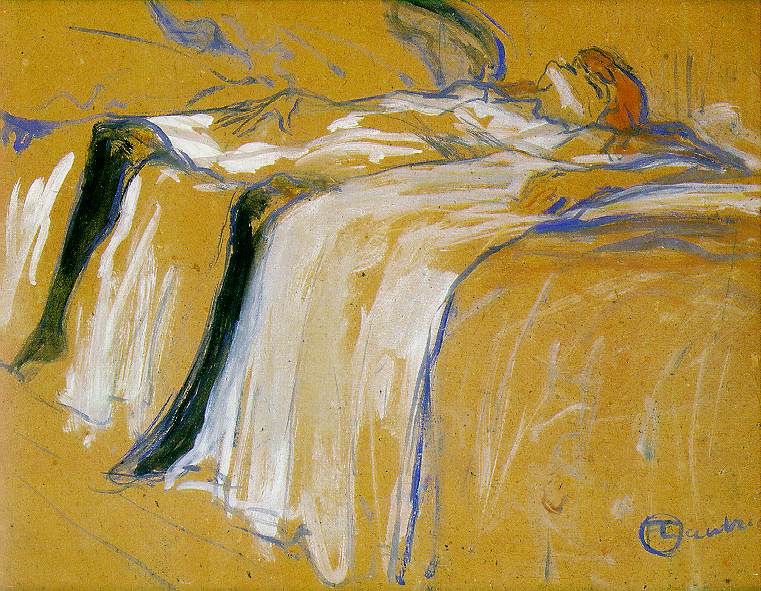 Alone
What do I care for the company of men, I, who would sentence them all to hard labour, death, for the price of a fuck? Now I hear you making your excuses, you leave nothing out, except the price of hope, as if hope could save you from God’s opprobrium. Shame me with your godless words, I am a girl alone, a girl without God, a girl without a mate. I have inured myself against love, against men, and I’m too exhausted to pose. Leave me be. Leave me be. Leave me be. "But my darling," says Tolouse, "I will love you, my black stockinged girl, as if you were all mine, as if our love was always meant to be." Mark A. Murphy Mark A. Murphy’s first full length collection, Night-watch Man & Muse, was published in 2013 by Salmon Poetry, Eire. 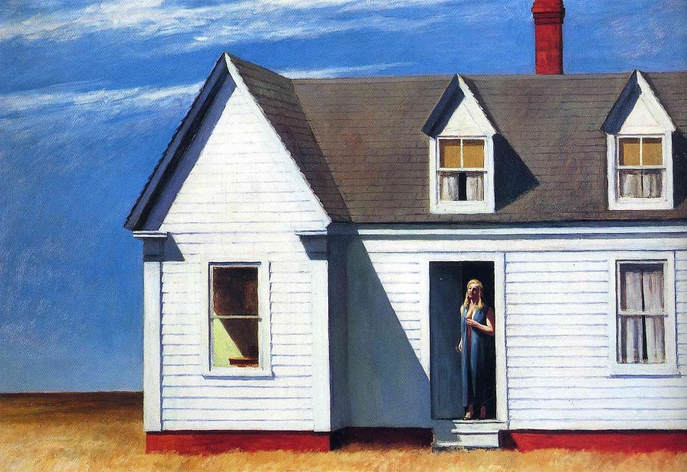 High Noon, by Edward Hopper (USA), 1949. High Noon, 1949
A woman alone in a doorway, her sheer robe parted. A shrug would drop it to her feet. The loose gown is mirrored by the window above where curtains sway half open and a yellow shade is half way down. We wonder if the woman looks for the one coming or watches someone leave. Like her saltbox house, she’s caught between whites and grays, the Cape Cod scene stilled except for the red flare of foundation and chimney. What has happened before she gave her beauty to a sun that bathes her features, golds the fair hair. Shadows play on the half-naked body. In this moment when morning becomes afternoon, when the hero steps into the street to meet his fate, a woman moves into the light. Behind her darkness waits. Diana Pinckney Diana Pinckney is the winner of the 2010 Ekphrasis Prize and Atlanta Review’s 2012 International Poetry Prize. She has been nominated for a Pushcart Prize 5 times. Cream City Review, Crucible and Persimmon Tree are among the journals that have given her awards. Published in RHINO, Cave Wall, Arroyo, Green Mountains Review, Tar River Poetry, The Pedestal Magazine, Nine Mile Magazine, Still Point Arts Quarterly, & other journals and anthologies, Pinckney has five books of poetry, including 2015’s The Beast and The Innocent. 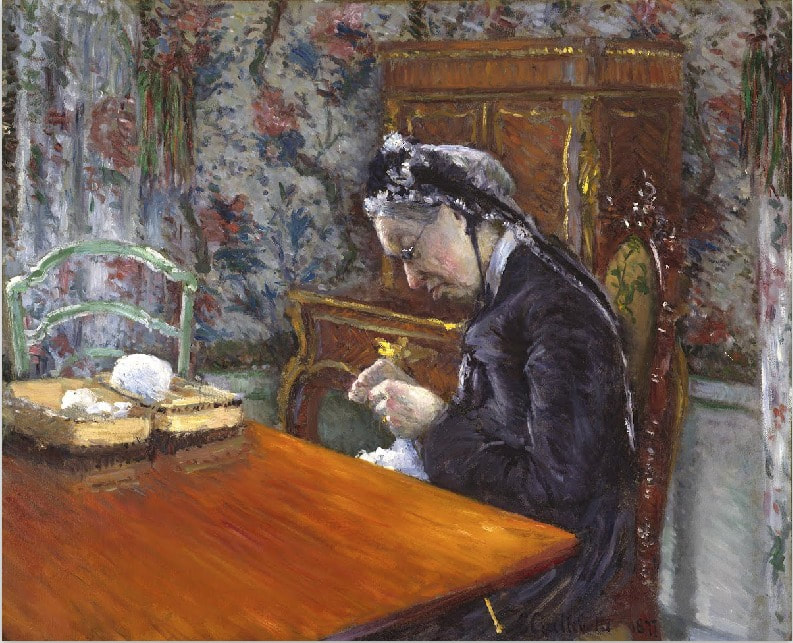 Mademoiselle Boissière Knitting, by Gustave Caillebotte (France), 1877. Shadow of a Bird
The fission of your breath from mine, our union fleeting like the shadow of a bird climbing the rock wall that sheltered our love. A shadow goes where a bird cannot, and so our farewell was wrenched in disdain, crafting a crystal cage around my breast, the embers lost from my hearth. The passing of years has slackened my face, cast glow on memories like ripened dust. My chance to hold fast to your love skipped over like a puddle, because I believed elders to be enforcers of a virtuous truth, not inured to society’s patrons of continuum. Time perhaps imagined failed to chisel me down to prejudice as it did those who refuted the passion of youth— street drains allowing love that didn’t belong to fall discarded. Seek, if you will, my reflection in the waters of the fall, music for our lavender kiss. Keep with you the girl wearing the skin of youth, aimée pour toujours. Hilary Hauck www.hilaryhauck.com Hilary Hauck lives on a small patch of woods in rural Pennsylvania, far from her native London. She writes to explore the vulnerability and strength of the human condition, particularly through cultural identity, life lessons, and the food we eat. Absalom
Oh, Absalom, Absalom, Beautiful Absalom, Announced by a throng of runners. A chariot’s spectacle. From crown to sandals, no defect. And your hair, your hair, weighed like revenge. Your charm was your decoy, Your charisma, a magnet for the young. Kissing their feet, you Hid your agenda and Stole their hearts. They made you king, realizing not Your treachery manifested itself In arson, In murder, In lies. But pride goes before a fall. You chanced upon your enemy. Seeking escape, You caught your locks in the forest’s terebinth. Unhorsed, You dangled like a broken bough until Your heart was lanced, your body beaten. They threw you into a shallow place, Stones, a scant pile, To mark your grave. Oh Absalom, Absalom! How dangerous to sow strife, To root bitterness, To erect monuments to Self. Would God your legacy were written in water, Not on your father’s heart. Jo Taylor Jo has been an English teacher for over thirty years, and poetry has always been her favorite genre to teach. In recent years, her students' success with publishing has motivated her to relinquish her writing, and the experience has been rewarding. She is one of nine children born and raised by tenant farmers in Middle Georgia, and much of her poetry reflects that family heritage. 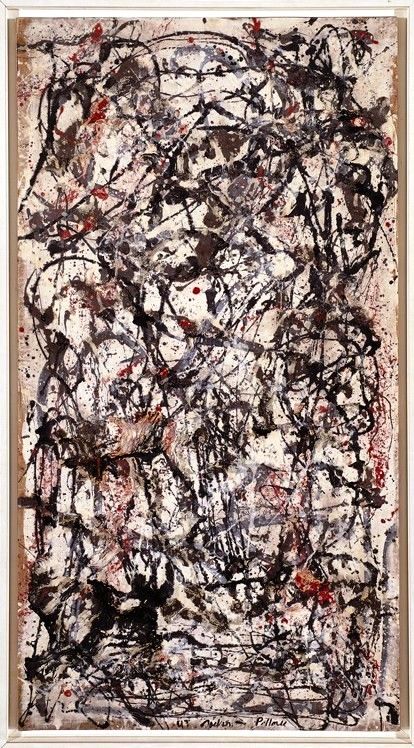 Enchanted Forest, by Jackson Pollock (USA), 1947. Entering Pollock’s Enchanted Forest
Resist the urge to run. Don’t be deceived by the lack of fresh air and pine. Push past the brambles, sit against a tree, and wait. Forests only pretend to be empty. Feel the ground trembling, hear your imagination cawing overhead. Horses gallop through, then a bison escaped from the caves of Lascaux. Do not fear the Cossack. He wants to play his accordion for you, nothing more. Keep going and you may come across my father, looking amused that you found him. Alarie Tennille Alarie’s latest poetry book, Waking on the Moon, contains many poems first published by The Ekphrastic Review. Please visit her at alariepoet.com. |
The Ekphrastic Review

COOKIES/PRIVACY
This site uses cookies to deliver your best navigation experience this time and next. Continuing here means you consent to cookies. Thank you. Join us on Facebook:
Tickled Pink Contest


April 2024
|