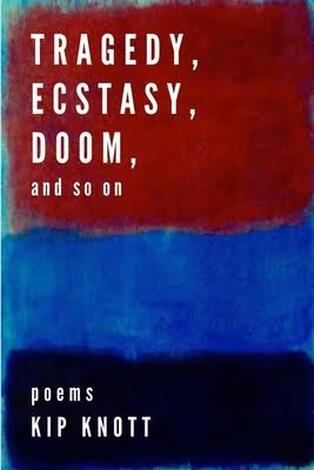
 Click book cover to view or purchase at Amazon. Tragedy, Ecstasy, Doom, and so on, by Kip Knott Reviewed by Steve Abbott If you’ve ever noted the arresting cheerfulness of local newscasters as they segue seamlessly from murders to March Madness, you already have some of the understanding necessary to appreciate the contrasts and contradictions illuminated in Kip Knott’s Tragedy, Ecstasy, Doom, and so on, recently released by Kelsay Books. It’s a thoughtful and moving set of responses to the paintings and artistic themes of Mark Rothko, using imagery that invokes Rothko’s influences—Jung, Freud, and Nietzsche (in particular, his concept of tragedy as a form of redemption)—to explore complexities of the human psyche. The book’s title comes from Rothko’s own description of his art: “I’m not interested in the relationship of color or form or anything else. I’m interested only in expressing basic human emotions: tragedy, ecstasy, doom, and so on.” This collection takes those emotions and the hazy borders between them beyond its ekphrastic poems to examine the yin-yang of living: who we are, and who we think we are; what is public, and what is private (and perhaps unconscious); what is dream, and what is reality; surfaces, and what lies below them; events, and our memories of them; the differing natures of the natural and supernatural; the inescapable suffering of life, and the joy of enlightenment. As with any visual or literary art, the poems employ images that suggest light (fire, sun, moon, joy), darkness (caves, a subway tunnel, a cellar, sadness), and the unavoidable shadows in between. Less interested in answers than in probing questions, the book offers multiple opportunities for reflection. The first of Tragedy, Ecstasy, Doom’s three sections, “The Biography of Fire” serves as a prelude to ekphrastic responses to Rothko’s work. It opens with “Creation Myth,” in which a dreamer “slip[s] into a hollow oak to hide” and slowly becomes part of the tree. The poem’s meshing of the human with the natural world establishes dualities where themes in Rothko’s work emerge. Anticipation and anxiety face off in “One Day,” in which the speaker “sent two letters,” one inviting that day to come quickly, the other hoping it will “take its time.” Mirrors and reflections appear throughout the collection, presenting a through-the-looking-glass dive into appearances, dreams, the real and surreal that readers will recognize. A reflection “with a hundred smiles / as sharp as the shards of the mirror he broke / one morning when he didn’t recognize his own face” surprises one narrator (“Self-Portrait in a Broken Mirror”). In “One Sunday,” the “other self” appears as a bird attacking its reflection in a window. Yet there is transcendence. By the end of this section, the speaker arrives in a clearing where looking at both the path behind and the path ahead are “the same as looking into my grave”—a sense of resolution in the present moment (“Vanishing Point”). We expect art to open our minds and senses, offering representations of, or providing insights into, the world. Nonetheless, acknowledgment of life’s pain allows for a sense of common experience that places us in the shoes of others. This collection accepts tragedy, doom and, yes, ecstasy as part of what it is to be human. These poems, like Rothko’s work, are a vehicle for self-examination. They don’t wallow in sadness and darkness; rather, they embrace them as part of being alive, tempering their impact into a larger understanding of the full range of feelings that living provides. This willingness to accept emotional darkness does not ignore that it can sometimes be overwhelming to the point of self-destruction. In “Institutional,” the poet mentions artists (Vincent Van Gogh, Kurt Cobain, Anne Sexton) who, like Rothko, ended their own lives. Even so, the poem does not succumb to despair, noting how Van Gogh’s “hollow eyes stare out into a light.” In the face of these tragic deaths, the poet affirms, “I, however, look to Van Gogh for sight” and concludes by describing himself as “a smoking wick, a small white light / glowing where purple irises bloom.” The poem, which could easily be broken into tercets, uses a beautiful repeating rhyme scheme to hold the lines—and the poet—together. In the same way, the dichotomy of light and darkness, what is visible and what isn’t, threads throughout the collection as it examines concepts that make up both art and poetry: that you can “learn to love / the absolute primary brightness of the world” (“21st Century Vesper”), and how “If you look deep into those caves, / you might find what I’m really hiding” (“Self-Portrait with a Smile”). Similarly, the difference between the public/apparent self and the inner self (what we might be “really hiding”) is reinforced as poems explore the complexities of mixed feelings. In Knott’s poems, this reaching below the surface—inside oneself—can nonetheless become redemptive rather than depressing or destructive. The centerpiece of the book, “Rothko’s Gospels” (“good news”), consists of two parts in which 19 poems respond to specific Rothko paintings, organized chronologically over a period of decades. Given Rothko’s style of composing large pieces that consist of contrasting blocks of color, classic ekphrasis—vivid description of an artwork—would not do justice to the painter’s art. Rather, the poems here exist in an emotional space divided into two sections. The first part, “The Twelve Stations of Mark Rothko,” explores how the painter’s psychological state was reflected in his artwork as it developed. Rothko’s artistic palette evolved from bright hues to darker ones that reflected his increasing willingness to examine how the personal “darkness” or “tragedy” that mark any individual’s life as just as worthy of representation in art as any other emotion or experience. The title refers to the Stations of the Cross, part of Catholic liturgy that provides meditations on the suffering that marked the Passion of Christ, and Knott uses 12 of Rothko’s works to go below the surface of things. Here is where Knott truly surprises. Offering the possibilities of both-this-and-that and either-or, these poems delve into various forms of “darkness” where light or hope unexpectedly appear. Rothko’s “III: Entrance to Subway, 1938” encounters the underworld as transformation: “the only way out is down / where something unseen… / …leads us, below // into incandescence.” Similarly, “VII. Black in Deep Red, 1957” postulates how circumstances “could be night / descending // or the morning / sun rising” or “the apocalypse blooming.” Elsewhere, “the light, though not heavenly / becomes a transitory oasis” (“X. Horizontals, White over Darks, 1961”). Throughout, the poems find hope, or the possibility of it, beyond suffering. An epigraph quoting Rothko opens “Seven Sadnesses,” the second part of the “Gospels.” It describes how each of us has our own sorrows and how the painter’s works are “places where the two sadnesses can meet.” Shared sadness is a form of healing, and this set of monologues illuminates this fact, addressing Rothko directly. One states, “Even you knew that sometimes / there is safety in numbers” (“VII. No. 4, 1964”). The comfort available in sharing griefs appears in “IV. Four Darks in Red, 1958”: “What was darkest and heaviest now floats / unrefrained above // an incandescent landscape / illuminated by a wholly unnatural light.” The poems in the collection’s third section provide other explorations of how contradictory perceptions can exist simultaneously. The three poems that conclude the book involve in Knott’s relationship with his son. The power of hope reappears as Knott explains, when his son asks if anything in the world can bring people together, that “the sky has many faces— / light and dark and shades falling / somewhere between those two absolutes.” In “Temporary Agnostic,” Knott finds momentary belief in “something / beyond this life” in “tiny bones of dandelions / clinging” to his son’s hair. The same dandelion fluff in the closing poem (“Breaking Home Ties”) captures the dualities of life in a parent’s mixed feelings as he sends a grown son off to college. The book is not without humour. Flashes of self-deprecation and irony leaven some poems with smiles of recognition. This humour includes the entirety of “Salvador Dali’s Typical Nightmare,” in which the surrealist painter finds himself a suburban professional heading to an office job in an Oldsmobile Cutlass, one more disorienting conundrum in a brand-name world. Although Kip Knott has been producing admirable work for decades and has published three noteworthy chapbooks, Tragedy, Ecstasy, Doom, and so on is his first full-length collection. Its combination of skill, insight, depth, and artistic awareness makes me wonder why it has taken so long to appear and, more importantly, how long we’ll have to wait for another. Steve Abbott Steve Abbott is a former alternative press editor/writer, criminal defendant, delivery truck driver, courtroom bailiff, private investigator, information director for a social service agency, and college professor. He is founder and remains a co-host of The Poetry Forum, a weekly reading series now in its 34th year in Columbus, Ohio. He has edited two anthologies and published five chapbooks and a live CD. His full-length collection A Green Line Between Green Fields (Kattywompus Press) was released in 2018. He has never danced the macarena.
0 Comments
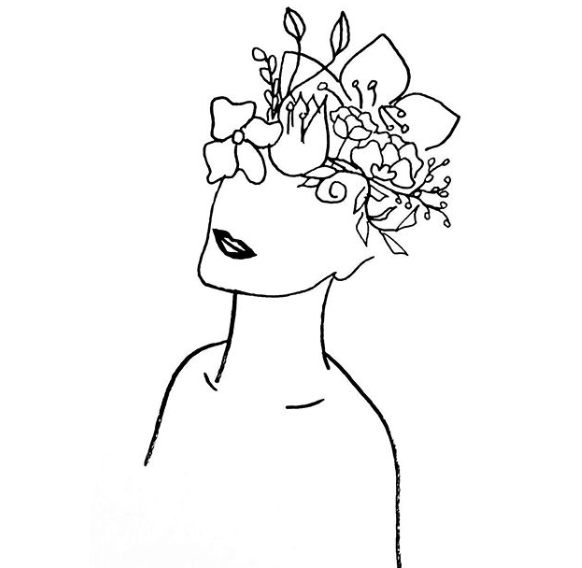 artwork by Courtney Millslagle (USA) contemporary Open Mind Drawn from the ether of an open mind, beauty blooms in lines of fine, floral hair. Follow each strand, each fearless, earthen vine drawn from the ether of an open mind, until your wandꞌring eyes are nearly blind -- speak fondly of every bud you find there, drawn from the ether of an open mind, lest life’s fine lines cut back any wild hair. Caitlin M.S. Buxbaum Caitlin M.S. Buxbaum is a poet, teacher and “former” journalist born and raised in Alaska. She has a Master of Arts in Teaching and a B.A. in English and Japanese Studies with an emphasis in Creative Writing. She wrote more than 600 stories as a reporter for the Mat-Su Valley Frontiersman, and recently published her seventh book, Interstitials, through Red Sweater Press. She currently serves as the Mat-Su Vice President of the Alaska Writers Guild. 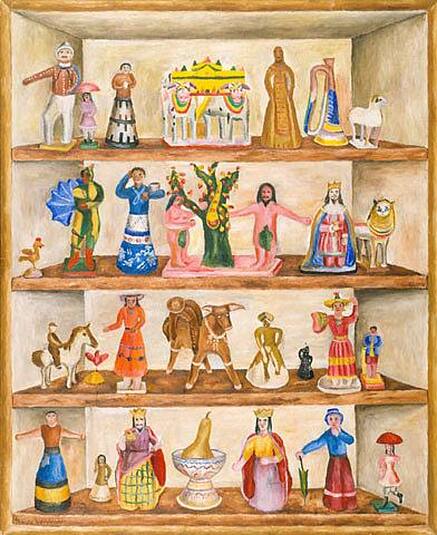 Alacena, by Maria Izquierdo (Mexico) 1942 Join us for biweekly ekphrastic writing challenges. See why so many writers are hooked on ekphrastic! We feature some of the most accomplished, influential poets writing today, and we also welcome emerging or first time writers and those who simply want to experience art in a deeper way or try something creative.
The prompt this time is Alacena, by Maria Izquierdo. Deadline is October 30, 2020. We would especially like to see more fiction or creative nonfiction stories this time, 200-800 words. Poetry is always welcome- we love poetry! We are simply hoping to attract more fiction writers and fiction readers. The Rules 1. Use this visual art prompt as a springboard for your writing. It can be a poem or short prose (fiction or nonfiction.) You can research the artwork or artist and use your discoveries to fuel your writing, or you can let the image alone provoke your imagination. 2. Write as many poems and stories as you like. Send only your best works or final draft, not everything you wrote down. (Please note, experimental formats are difficult to publish online. We will consider them but they present technical difficulties with web software that may not be easily resolved.) Please copy and paste your submission into the body of the email, even if you include an attachment such as Word or PDF. 3. Have fun. 4. USE THIS EMAIL ONLY. Send your work to ekphrasticchallenge@gmail.com. Challenge submissions sent to the other inboxes will most likely be lost as those are read in chronological order of receipt, weeks or longer behind, and are not seen at all by guest editors. They will be discarded. Sorry. 5.Include IZQUIERDO WRITING CHALLENGE in the subject line. 6. Include your name and a brief bio. If you do not include your bio, it will not be included with your work, if accepted. Even if you have already written for The Ekphrastic Review or submitted other works and your bio is "on file" you must include it in your challenge submission. Do not send it after acceptance or later; it will not be added to your poem. Guest editors may not be familiar with your bio or have access to archives. We are sorry about these technicalities, but have found that following up, requesting, adding, and changing later takes too much time and is very confusing. 7. Late submissions will be discarded. Sorry. 8. Deadline is midnight, October 30, 2020. 9. Please do not send revisions, corrections, or changes to your poetry or your biography after the fact. If it's not ready yet, hang on to it until it is. 10. Selected submissions will be published together, with the prompt, one week after the deadline. 11. Rinse and repeat with upcoming ekphrastic writing challenges! 12. Please share this prompt with your writing groups, Facebook groups, social media circles, and anywhere else you can. The simple act of sharing brings readers to The Ekphrastic Review, and that is the best way to support the poets and writers on our pages! 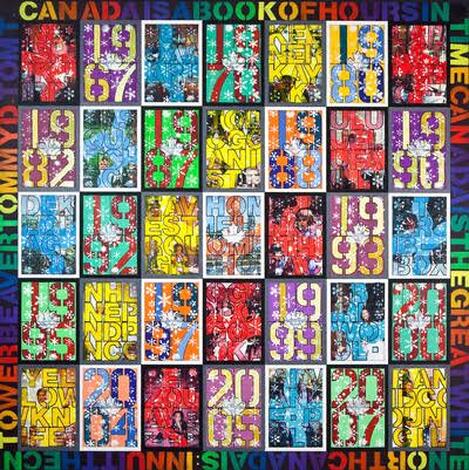 Canada, triptych, by John Di Leonardo (Canada) 2007 The Ekphrastic Review is delighted to chat with Canadian artist and ekphrastic poet John Di Leonardo. He will also be a guest editor for one of our upcoming challenges! The Ekphrastic Review: The first thing I notice about your visual artwork is that we share an attraction towards words, letters, and numbers as a natural aspect of our subject matter. Can you comment on how and why language and letters play such an important role in your paintings? Words, letters and numbers have a long relationship in the history of eastern and western art, and have always been a natural aspect of visual expression. We see this ekphrastic connection in Egyptian tombs, Greek vases, Roman triumphal arches, medieval manuscripts, up to postmodern/conceptual art. We are so used to reading for meaning that we tend to forget that each letter and number is a beautiful shape in and of itself especially if we look at the history of typography. I enjoy the aesthetic dimension of a single letter, its shape, negative spaces created, the composition of each word. Visual artists have used letters not only to transmit Feminist ideology or protest as seen in the works by the Guerrilla Girls, or Barbra Kruger, but also philosophical ideas, as in Rene Magritte’s work Ceci n’est pas une pipe. (This is not a pipe.) We also see words as elemental shapes in paintings and collages by Picasso and many other contemporary visual artists. One of my favourite is John Baldassari’s work, I Will Not Make Any More Boring Art. Baldessari repeats the same phrase over and over again, good advice for any serious artist. Conversely, the history of ekphrastic poetry, words embracing art, is also a very long one. An early example where the sound of poetry embraces the silence of art can be seen when Homer describes the blacksmith god Hephaestus forging the shield of Achilles, in chapter eighteen of The Iliad. This poetic tradition is alive and well to this day as reflected in the wonderful poetry found in The Ekphrastic Review. To quote Simonides of Ceos: “ Painting is silent poetry; poetry is painting that speaks.” The Ekphrastic Review: What came first, painting or poetry? My primary form of creative expression has always been visual, though I have always had a keen interest in reading and writing poetry over the years. I recall during a creative dry spell spending time reading, meditating, collecting and writing hundreds of definitions on “what is art?” This hiatus and research led me to my first large format series of paintings, Book of Hours (2000-2005). This series used text as an important aspect of subject matter. These works explore the nature and meanings of art through various historical and social contexts. This was followed by my next series, Prayers (2005-2010). These paintings were composed with text only, exploring the relationship of power, politics, and prayer. 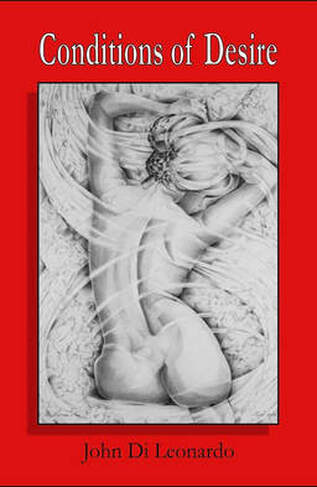 Conditions of Desire, by John D. Leonardo, The John B. Lee Signature Series, Hidden Brook Press, 2018 The Ekphrastic Review: In addition to your ekphrastic collection, Conditions of Desire, you have published in a range of journals and anthologies. Is all of your poetry ekphrastic? Prior to my publication of Conditions of Desire I had been writing and publishing a variety of poetry forms for about seven years. At that time I was also involved with many poetry groups with executive duties, newsletter writing, judging, editing anthologies, entering contests, and of course learning the important lessons of coping with rejections. After an attempt or two at a full length book, I decided to follow the old adage “ write what you know.” I know art, and an ekphrastic poetry collection flowed from experience. The Ekphrastic Review: What is the purpose, in your opinion, of ekphrastic writing? I feel ekphrastic writing engages art and poetry lovers in a creative way. This type of writing has the ability to extend the gallery experience, which is usually a personal one, quiet and reflective. Also, ekphrastic poetry invites consumers of poetry and art to feel in multiple sensory experiences, with word, image, and the music in a poetic line, much like opera. The Ekphrastic Review: How do you choose what paintings to write poetry about? I don’t usually choose the paintings, they choose me by resonating in some way. The artwork might ignite a strong feeling, an idea, or it might look like a good fit for a line of poetry floating in my mind, or for an old poem I’m reworking. It’s really a mystery how it all works. 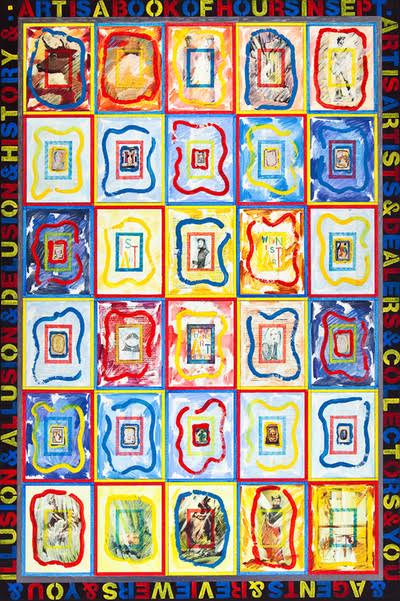 September, by John Di Leonardo (Canada) 2004 The Ekphrastic Review: As a longtime teacher of art, what have you learned about understanding art? Yes, I have taught visual arts at the secondary and post secondary level for thirty years. The one thing that strikes me most about understanding the arts is that the human imagination is boundless, untarnished by age, time, or culture. Imagination is our freedom and hope. Talent is not enough! Cézanne, Modigliani, Van Gogh, three giants of modern art, all three artists were not academically gifted painters, they began their art careers late in life but their immense work ethic, imagination, and inner need led them to express in new ways for us to view and appreciate the world we inhabit. The Ekphrastic Review: What is the best way to approach a painting and really see it? I think the best way to access any work of art is to approach it without any expectations or judgement, just consider it, just feel it. If still confused, research will give you some context, then try again. To really seeing a painting? All art is subjective, in painting or poetry a viewer or reader will sometimes be moved by elements in the work not intended or even considered by the artist. The Ekphrastic Review: How has your taste in paintings changed over the years? Who are your favourite artists and why? Early in my career, like many young visual artists I was motivated, excited, and rewarded by great realistic technique. Life experience and efforts to perfect the craft and finding one’s voice led me to experiment with a variety of styles over the years. That said, the one constant in my studio practice has been the human figure, so my taste has always gravitated toward the figurative, no matter the style used. I do not have a favourite artist. I love Michelangelo for his anatomy, Rembrandt for his light, Matisse for his colour, Van Gogh for his textures and energy, Picasso for his imagination, the Guerrilla Girls for their courage! 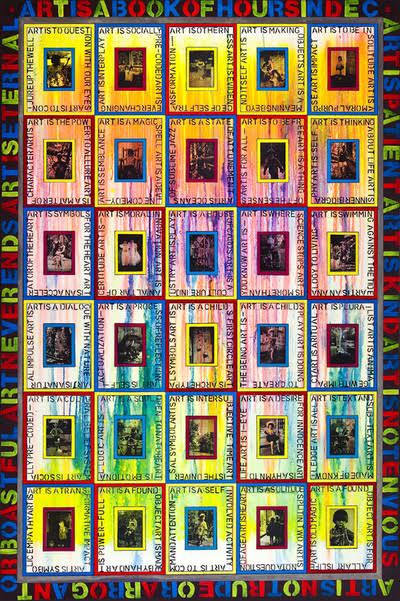 December, by John Di Leonardo (Canada) 2005 The Ekphrastic Review: What about poetry? What writers do you love to read? What turns you off? I enjoy reading Dante, Homer, Wallace Stevens, Paul Verlaine, Arthur Rimbaud, and ancient Chinese poets, Du Fu, Li Po, Wang Wai. I suppose because of my visual arts background, I prefer a poetry of precise images, sharp, clear, compressed language, and elliptical image patterns where the reader gleans a personal understanding from contextual clues. This type of verse requires a few careful readings to absorb the subtle, sometimes dense layers of meaning in the poem. My earlier poems were more narrative in tone, but over time I came to feel what Ann Carson called “combatting the boredom of storytelling.” I read poetry daily; the majority of poems I come across seem to be in the narrative/confessional tradition. I find that I rarely go back and re-read these types of poems, for me they tend to give away too much imagination for story sake. That being said, I think, we all love reading genuine words that surprise and fly us off the page no matter the form or style of poetry. I feel all artists need to take imaginative risks, especially when they become comfortable with a current manner of expression. I feel that when you begin to copy yourself, you begin to die artistically. The Ekphrastic Review: What literary journals excite you? I have been reading Poetry magazine for quite a few years, I think it launched in 1956, it has history, and it is interesting to notice the changing voices over the decades. I also read The Iowa Review, The American Poetry Review, and Poetry International centrally edited in Rotterdam. The site presents poetry from many countries in English translation, it is wonderful to read current poets from around the world, and The Ekphrastic Review, of course! 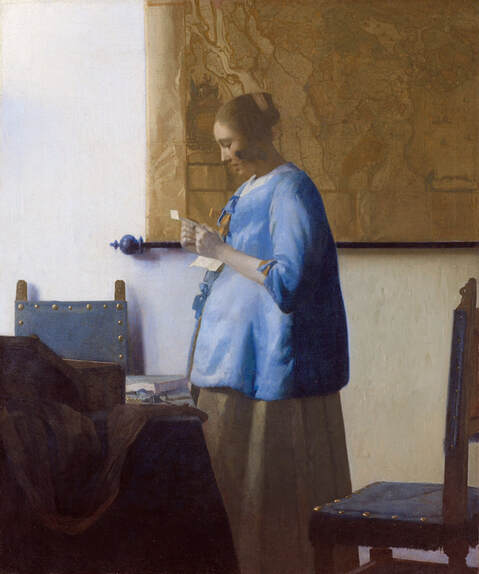 Woman in Blue Reading a Letter, by Johannes Vermeer (Netherlands) 1663 Conditions of Desire When you are gone, I pace kitchen tiles, roam living room walls hunger for the stars in your eyes nibble self pity in the blue flicker of a fridge door. Among cold things, I whisper your name in the sweetness of morning jams, evening fruits and the Atlantic that draws me towards you. When you are away, I stalk the cell under cuticle moons until its notes ring me a moonlight sonata. I sleepwalk horizons, tip-toe a collage of love’s smallest details. Your sunny whispers between parting lips the twist of wind-blond hair – and my breadth a little shy from the lovely depth of your eyes the delicious tones of a moaning kiss. When you’re not here, my pulse stumbles on bleached moonlight stands thresholds, in a dead man’s embrace listens to dogs bark at my shadow and Sirius my favourite star. When you’re gone I puzzle how to say, I miss you, love you, like a poem in a shoebox, loving against its will. In your absence let me be your sweetheart, moonflower -- the white butterfly in your infinite sleep the rainbow dreaming our night song, east to west my love. John Di Leonardo This poem originally appeared in Conditions of Desire, Hidden Brook Press, 2018. 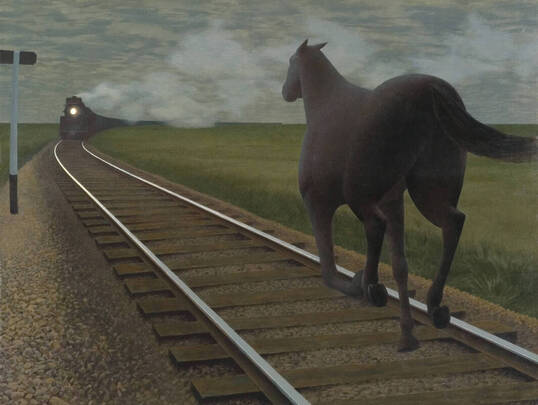 Horse and Train, by Alex Colville (Canada) 1954 Horse and Train A black horse hangs fixed on a white wall she is ill, gone wild. It is Spring, past starlight in Sackville below an elaborate cobweb of clouds. A wild horse gallops towards the steamy light to a sleepless train. In minutes the broken mare will die again – With a kind of beauty that invades our dreams colliding each morning on waking alone in the dark, lower lip quivering against the passage of light. John Di Leonardo This poem originally appeared in Conditions of Desire, Hidden Brook Press, 2018. 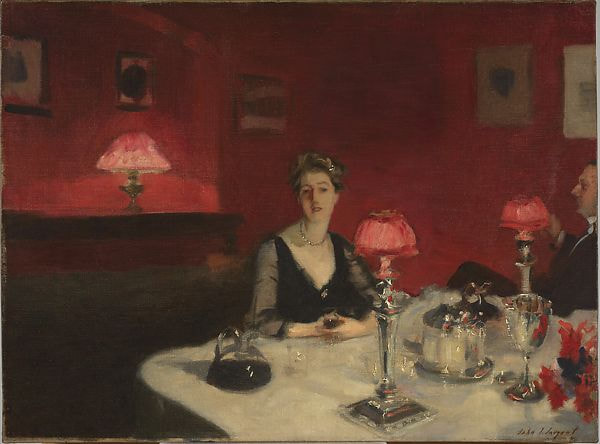 A Dinner Table at Night, by John Singer Sargent (USA) 1884 Anniversary Dinner You could tell they were married. Silence between them heavy – like a coffin lowered nightly. He sliced blue-rare steak with bobs and weaves catapulting ox-blood red on the tongue. The wife raked salad, julienned dark leafy china, stabbing edges organizing greens to the familiar sigh of candlelight assembling an exacting order of a once sunny home as though she could harvest forgotten tenderness, chewable words to ward off the hurl of fate, the blur of blue, the black embrace, loneliness that ushered them here to celebrate. John Di Leonardo This poem originally appeared in Conditions of Desire, Hidden Brook Press, 2018. To purchase John's book, Conditions of Desire, email Hidden Brook Press. hiddenbrookpress@gmail.com 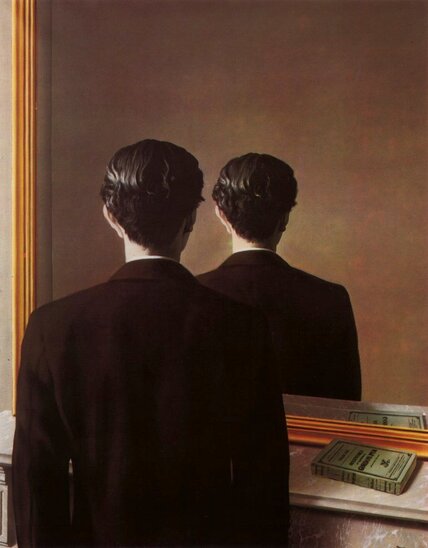 Not to Be Reproduced, by Rene Magritte (Belgium) 1937 In a Bar in Brussels René, I thought I saw you yesterday. You were wearing your bowler hat and entertaining the barmaid with the same old mirror trick. Did you tell that joke about your pipe, give her a picture as a keepsake? Black-suited men that once drizzled from the clouds, have gone, and places we knew have faded into dreams. All you left me was your little dog and a bottle painted like a summer sky. O René, it would be good to see you again. Yvonne Baker Yvonne Baker has been published in numerous magazines, including Orbis, South Bank Poetry, Artemis, Acumen and The Frogmore Papers. Her poems have been included in several anthologies. Emma Press — The Sea, 2016 Second light — Fanfare, 2015 Paper Swans — The Chronicles of Eve 2016, The Best of British 2017, The Pocket Poetry Book of Love 2018, The Pocket Poetry Book of Weddings 2018, Poetry Space — She has recently had a poem accepted for an anthology about the lockdown. She has had poems commended twice in Second Light Competition. 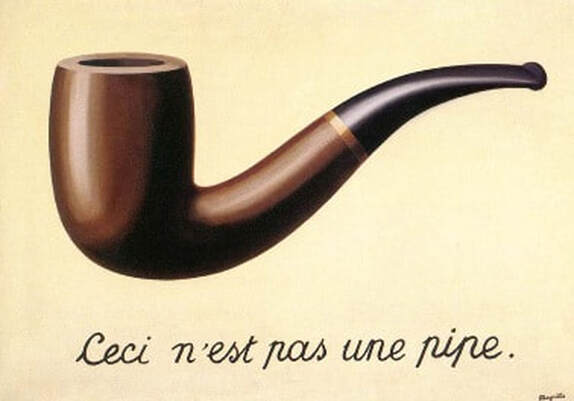 The Treachery of Images, by Rene Magritte (Belgium) 1929 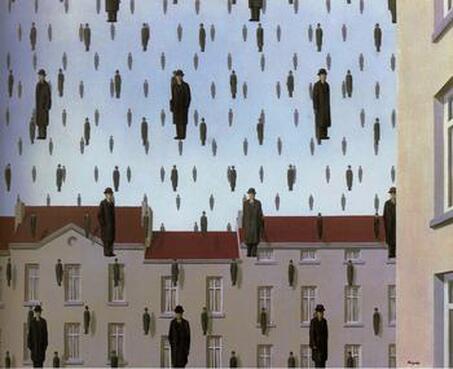 Golconda, by Rene Magritte (Belgium) 1953 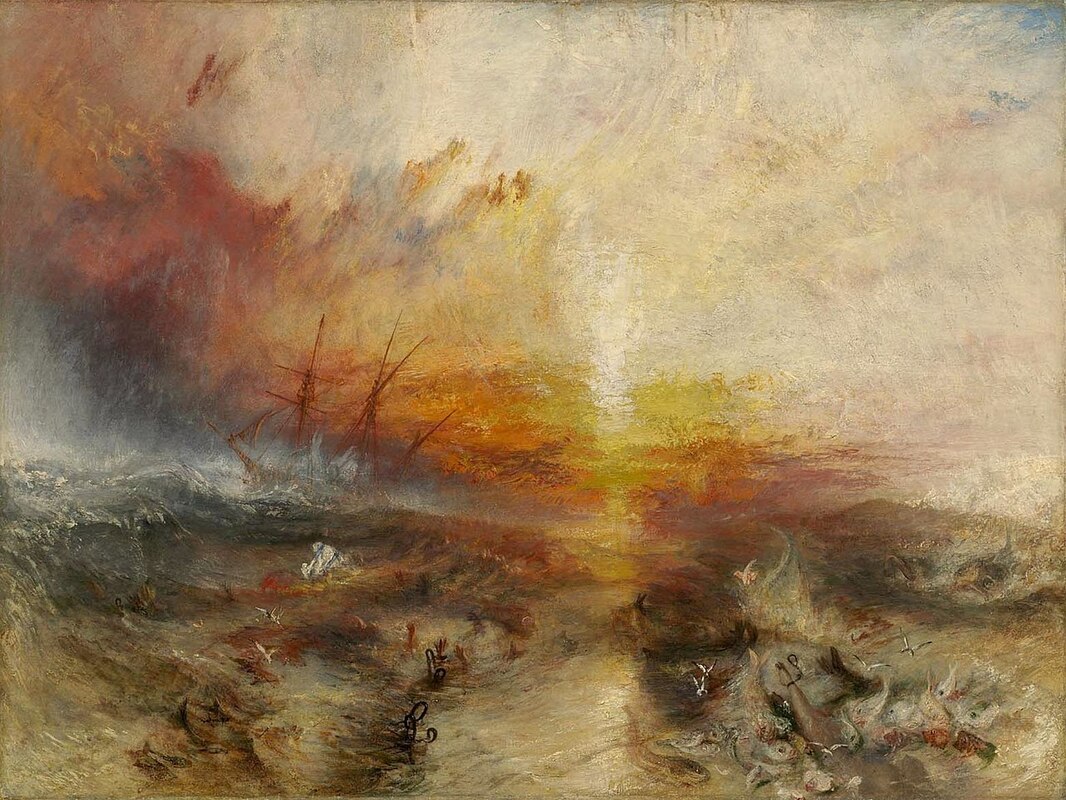 The Slave Ship, by J.M.W. Turner (Britain) 1840 J.M. W. Turner, The Slave Ship I believe, if I were reduced to rest Turner’s immortality upon any single work, I would choose this. John Ruskin Try the full title. Slavers throwing overboard the Dead and Dying – Typhoon coming on. The anger presses into brush stroke, the billow of image. Before you the painter’s confirming motion of sky, ocean, light. You see your way into the picture only dimly. A storm of color, blurring wave and surge. Almost abstract, but the senses sharpen. Each viewing sifts detail from mass, specificity. The three-master rises, spectrally, upon a background crest. Spray roars, foam rises, curls of ocean clash. Fish monsters, open-eyed and slack of jaw, approach in opportunity. Sea-fowl fly low, avian ocean raveners. The bodies float, tied leg, raised arm, reaching fingers. Dangled manacles keep company into death. Centre runs a white-yellow ray of light, sky to water. It almost mocks the desperation, the lost cries. If illumination it descends upon vital brutality. Enslavement figured, men, women, reduced to bait. The picture’s motion becomes a shared drowning. How not to see with Turner the world overboard? A. Robert Lee This poem first appeared in Imaginarium: Sightings, Galleries, Sightlines, 2Leaf Press, 2013. A. Robert Lee was Professor in the English department at Nihon University Tokyo, 1997-2011. British-born, he previously taught at the University of Kent, UK. His creative work includes Japan Textures: Sight and Word, with Mark Gresham (2007), Tokyo Commute: Japanese Customs and Way of Life Viewed from the Odakyu Line (2011), and the collections Ars Geographica: Maps and Compasses (2012), Portrait and Landscape: Further Geographies (2013), Imaginarium: Sightings, Galleries, Sightlines (2013), Off Course: Roundabouts and Deviations (2016), Passsword: A Book of Locks and Keys (2016), Written Eye: Visuals/Verse (2017), Alunizaje/Lunar Landings, with Blas Miras (2019), Writer Directory: A Book of Encounters (2019) and Suspicious Circumstances. What? (2020). Among his academic publications are Multicultural American Literature: Comparative Black, Native, Latino/a and Asian American Fictions (2003), which won the American Book Award in 2004, Modern American Counter Writing: Beats Outriders, Ethnics (2010) and The Beats: Authorships, Legacies (2019). Currently he lives in Murcia, Spain.  Want some gruesome, grisly art prompts that contemplate evil, terror, pestilence and death?
Trigger Warning: An Ekphrastic Halloween dark art prompts for your writing practice Here is an ebook of 20 dark prompts. Warning- some viewers may find the art inside extremely disturbing. If these prompts inspire you, submit up to six poems to ekphrasticchallenge@gmail.com by October 25, 2020 for a special ekphrastic Halloween showcase! 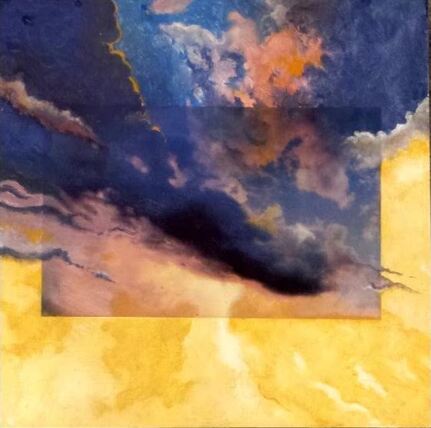 Cloud Series on Wood, by Gillian Frazier (USA) circa 2015 Dark Matter Vision Strange clouds, these, lit like dayglow velvet under black light, where thirsty men ogled curves hung on walls like stuffed trophies in the daytime night of the dive bar, while their hands slid up sweating long necks, that first beer going down smooth after a day of breathing concrete dust that left powdered fingerprints hardening on the label, no matter how often they washed their hands. These men have questions that beer puts off as they head home, stars poking out of the night at them like Hubble’s pictures of cosmic rubble, flattened out on LED’s by celestial brushes that painted galactic sky in astronomical units, hard to believe what’s out there really matters when foundations wait to be poured. The problem with beer, a young man with a fuzzy face notes as he washes up, frees his feet from fouled boots that lay fine silt scratches over the hard wood, sits down to dinner with his pregnant wife, pouring a large glass of water, is that it makes him even thirstier. So he stays up late reading until his eyes burn, long after they finish dishes together, way after his wife’s long-asleep head first lay cradled in his lap, looking for something he can say, some way to get his children-to-be to look up, beyond the clay they would stand upon, the way he and his wife-to-be did that day, two sophomores in college cruising the art gallery like people so rich they could dress down, the day they conceived, stopping in front of that painting, clouds on wood, seeing farther outward even as the painting drew them in like they were sliding up and down a telescopic cylinder, trying to focus, eyes forever drawn, even now in night-time memory as he closed a book, full of humanity’s frail frames falling as they raised up a house of God, like someone who can’t stop watching, drawn toward that dark tear in the bright, nebulous dust, full of dark energy that kept the universe expanding, like hope. Joe Nardoni Joseph Nardoni is a poet and professor of English and Creative Writing at Middlesex Community College, in Lowell, Massachusetts. He has had his poems published in Memoryhouse, The Syzygy Poetry Journal, and the anthology, Vagabonds: An Anthology of the Mad, by Weasel Press. He is one of the faculty founding editors of Dead River Review, the online magazine of MCC, whose first issue was released in May, 2015, on WordPress. His forthcoming book of ekphrastic poetry is entitled, Pictures of an Exhibition: A Poet’s Harvest. 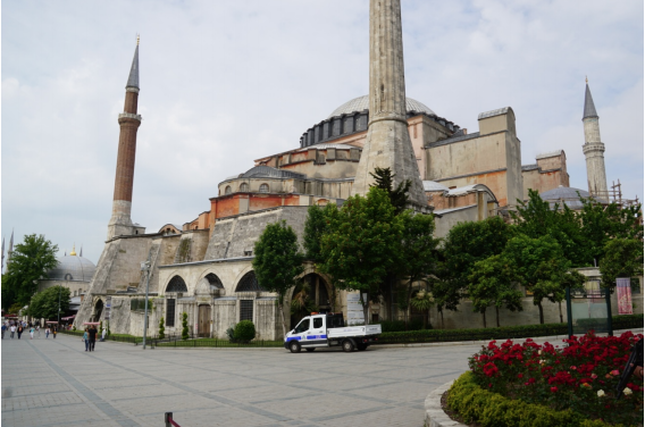 Visual Arguments at the Hagia Sophia It is in the nature of religion to stake a claim for its own eternity, omnipotence, and permanence, yet paradoxically, since its initial construction in 360 A.D. the Hagia Sophia has been the site of fires, collapse, revolts, rioting, and earthquakes. It was ransacked by the Latin Christians during the fourth crusade, and indeed, its looted relics can still be seen in the museums of Western Europe. But perhaps the most radical event in its history was its transmutation into a mosque, in 1453, by Mehmet II, the Sultan of the Ottoman Empire, who conquered the city after a 54 day siege. 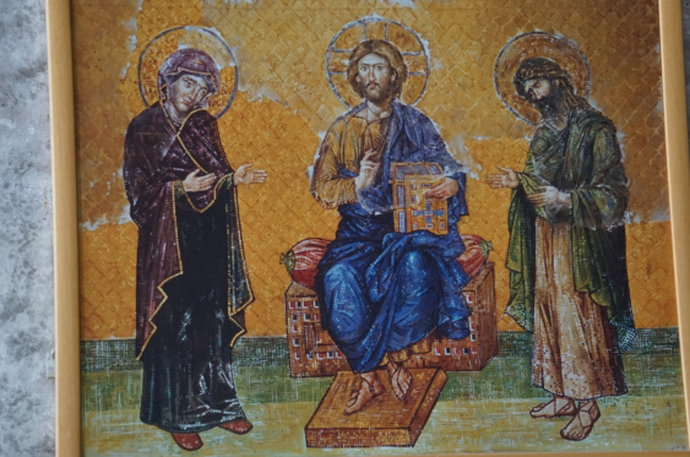 The taking of the church was, as befits a medieval religious conflict, horrifyingly bloody and barbaric. When the Ottoman invaders battered down the doors, they found the women and children, as well as the elderly and the ill, all of whom had taken shelter from the invading forces, participating in the Divine Liturgy and Prayer of the Hours as they prayed for deliverance. The elderly and the sick were killed, the women were raped and older boys and teenage males were chained and sold into slavery. The church itself was ransacked and desecrated. One imagines that the Muslim looters recalled hearing about the previous desecration of the church during the capture of Constantinople by Latin Crusaders in 1204, when Enrico Dandolo, the Doge of Venice, commanded that the city be sacked and invaded, and all items of value, including the golden mosaics of the Hagia Sophia, were taken from the Byzantine buildings of the city and shipped to Venice. The treasure surely had tremendous symbolic value, as the building had been the focal point of the Eastern Orthodox Church for nearly one thousand years. *** Ataturk, the founder of the modern Turkish republic, had zero patience for the claims of religion. He secularized the building and re-inaugurated it as a museum in 1935. But the Hagia Sopha has not been a typical museum. It is more like a locus of confrontation, a visual iteration of the debates once staged in the Middle Ages, where sages of different religions would hold public debates in order to demonstrate the superiority of their faith. *** 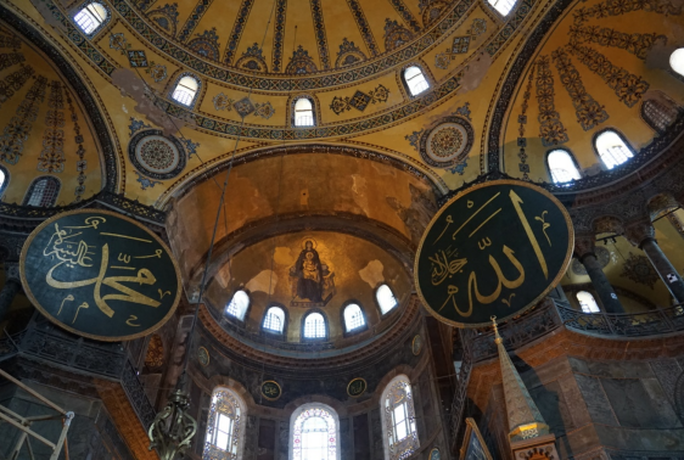 What a visitor to the Hagia Sophia in fact observes is a theological conflict playing out amongst the domes and mosaics, as well as the humble nooks and curious crannies, of the building. *** 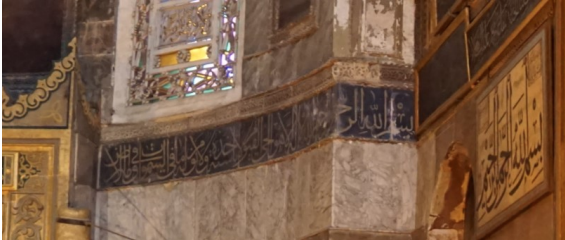 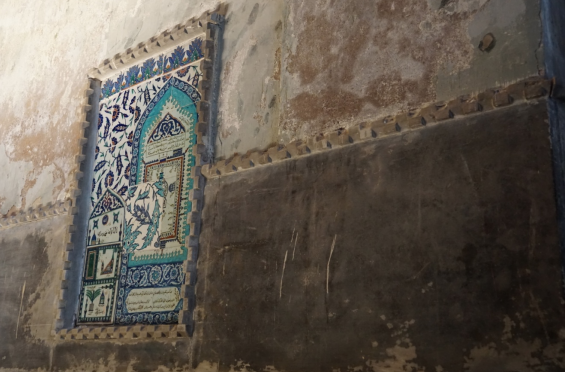 Wherever one turns, there is the uneasy juxtaposition of those who have claimed the place as their own. The two candlesticks, for example, that adorn the mihrab, placed facing Mecca in the spot where an altar once stood, were brought by the Ottoman Sultan Sulimet the Magnificent from the Cathedral of Buda, following his conquest of Belgrade, Rhodes and most of Hungary before being checked at the siege of Vienna in 1529. They stand in uneasy proximity to the two alabaster Helenistic urns brought by Murad III from Pergamon, in Western Turkey. *** 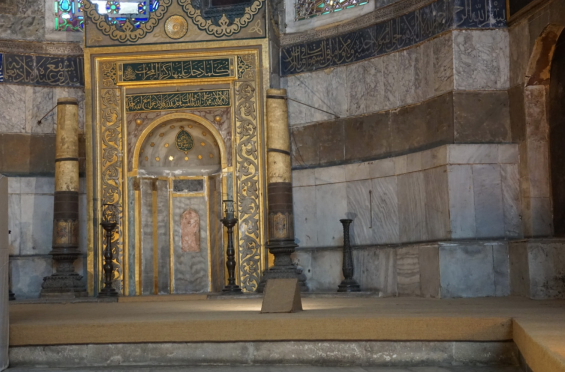 Islam forbids the display of human likenesses on the walls of a mosque, so when the Church was converted, the Christian mosaics, with their explicit theological, philosophical and political messages, were deemed inaporpriate, and like troublesome children, the images peering from the walls of the building were covered up and put to sleep. When, in the 1930s the plaster was removed and the mosaics were revealed, it was as though long forgotten ancestors had returned to share their ideas about what beauty is, what power looks like and how the universe works. The faces on the walls that stare down at us suggest disturbing truths about the links between political influence and religion, and how these compliment and serve each other. Here for example, is a detail from the Comnenus mosaic, created in 1122. The Hungarian-born Empress Irene is offering a document to the Virgin (her blue robe is visible on the left side of the photo). Her son, Alexius, stands beside her. 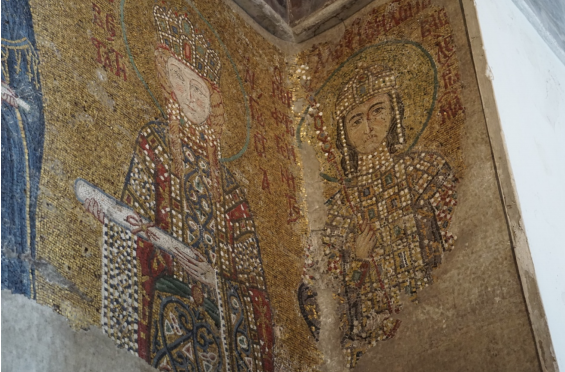 *** The Deesis, or "Entreaty" mosaic is said to date from 1261. It was commissioned to mark the return of Greek Orthodox control of the church after fifty-seven years of Roman Catholic hegemony. The scene shows the Virgin and John the Baptist imploring Christ Pantocrator to intercede for humanity on the Judgement Day. *** 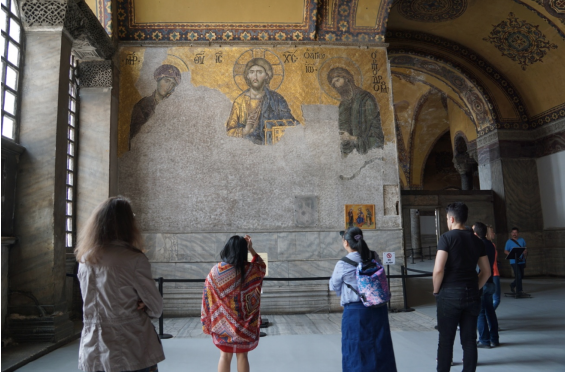 Wikipedia informs that the restorers tried to maintain a balance between Christian and Islamic elements. Of particular debate is the Arabic calligraphy in the center of the building’s dome, which is said to cover the Pantocrator mosaic portraying Christ as Master of the world. The Arabic script that may or may not conceal the mosaic speaks of God as the light of the universe. Pantocrator is a Greek term, a translation from the Hebrew terms YHWH, one of the names of God. It was the term used in the Septuagint, the first Greek translation of the Hebrew bible in the 3rd century BCE. The meaning of the word is “omnipotent” or “sustainer of the world." It is uncertain whether the mosaic still exists. 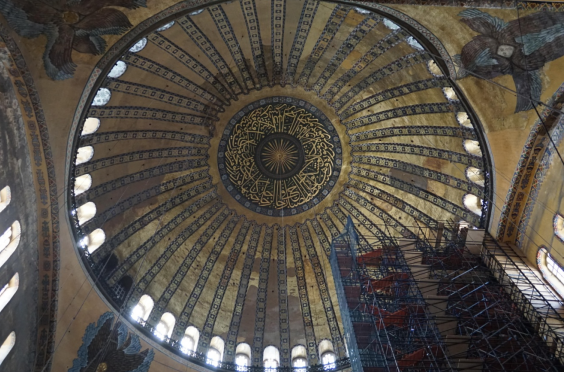 The Fossarti brothers, Swiss-Italian restorers brought in to supervise work on the building from 1847-49, documented, repaired and then plastered over the faces of the four angels that surround the dome. The angels are considered to be seraphim, a Hebrew biblical term meaning “burning ones”, so named for their proximity to the throne of God. In 2009, Turkish restorers uncovered the face of one of these angels. Today, it looks down gloomily on the throngs of visitors who come from every corner of the earth, its features oddly human. *** When the mosque was converted to a museum in 1935, the carpets were lifted, revealing parts of the building that had been hidden for centuries, like this Omphalion, believed to be the sight of the coronation of the Byzantine emperors. Omphalos is a Greek word originating in ancient Hellenic mythology, meaning navel, as in the meeting place for two eagles sent across the world by Zeus to meet at its center, or the spot in the Church of the Holy Sepulcher in Jerusalem, where, according to Jewish tradition, God revealed himself. 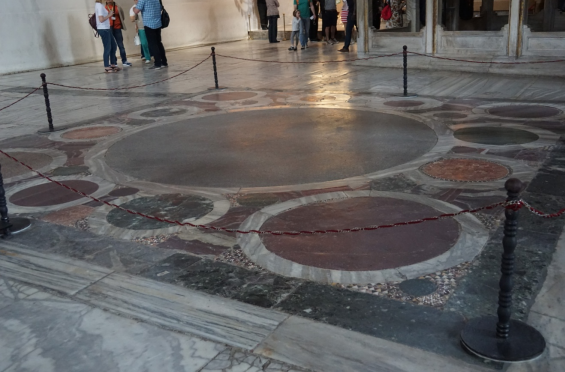 *** Ataturk’s agenda of political, economic, and cultural reforms aimed to replace the institutions and workings of the Ottoman Empire with a modern, secular nation-state. He forbade that the Hagia Sophia be used as a place of worship. Suddenly there was a quieting, a calming of what was once shrill and insistent. The Byzantine and Christian mosaics relaxed into art. The energetic swirls across the large cellular discs on which are inscribed the names of Allah, Mohamed, the first four caliphs and Mohamed’s grandsons, could make their point as though partaking in an academic discussion. 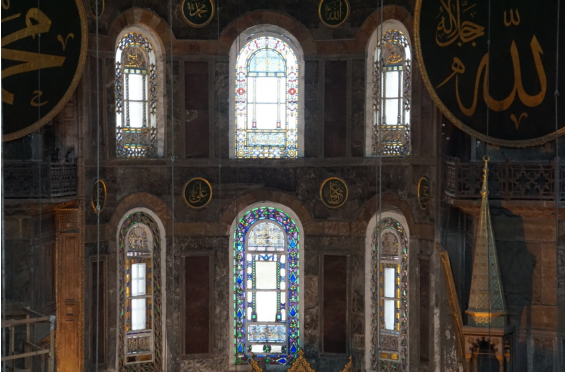 The space morphed into an edifice proclaiming not the superiority of one belief system over another, but a temple of human endeavor. After all, centuries of physicists, mathematicians, architects, artisans, laborers, and restorers had given the best of their gifts to it. Dynasties of Emperors and Sultans financed it. And the believers − first Christians and later Muslims − had vested it with the power of faith. To enter into it today is to bear witness to the struggle to bestow meaning on the brevity and horror of existence. It is to feel the comforting promise that watching over us is a power that is orderly, moral, and compassionate. That it is possible to achieve a collective existence that is honorable, truthful, righteous and worthy. That however imperfect we are, these things are somehow in reach. 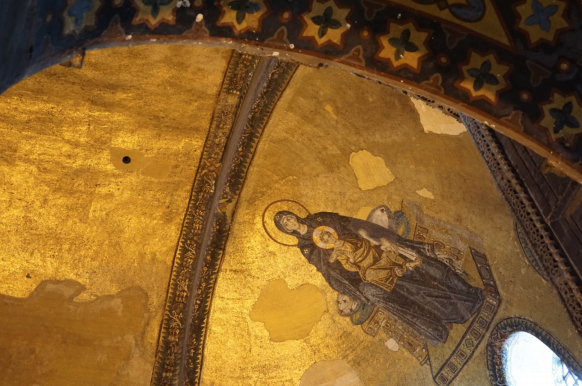 *** In 2006 the Turkish government under Erdogan allowed a small room in the museum to be used as a prayer room for both the Christian and the Moslem staff. In 2007, Greek American politician Chris Spirou created an international organization dedicated to restoring the Hagia Sophia to its original function as a church, while officials in the Turkish government started demanding that it revert back to functioning as a mosque. On July 1, 2016, Muslim prayers were held again in the Hagia Sophia for the first time in eighty-five years. In July 2020, a Turkish court revoked the building’s status as a museum. Under its new classification, despite condemnation from the Turkish opposition, UNESCO, and the World Council of Churches, the Hagia Sophia is once again a Muslim house of prayer. Janice Weizman Photos courtesy of the author. Janice Weizman is the author of the award winning historical novel, The Wayward Moon. Her writing has appeared in World Literature Today, Ha'aretz, Queen’s Quarterly, and many other places. 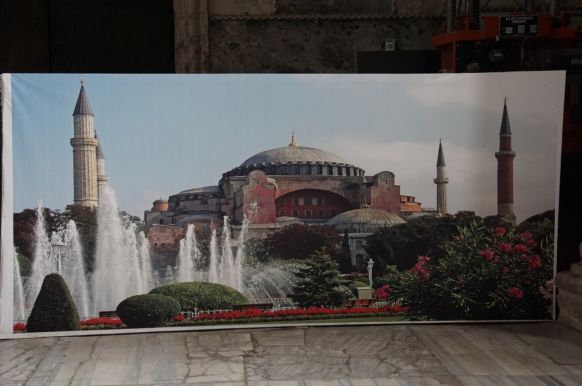 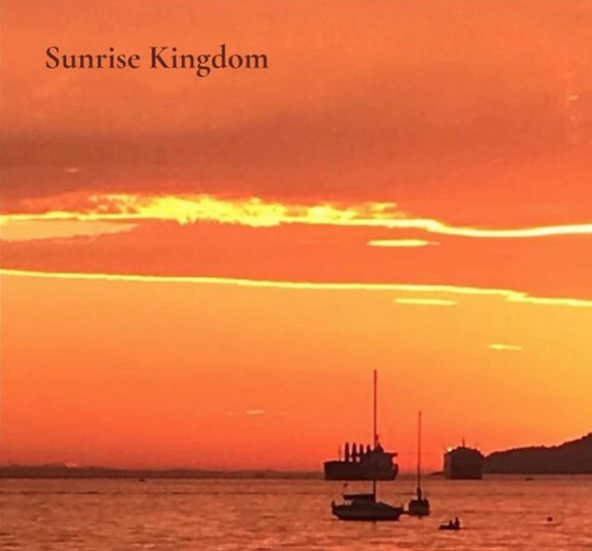 Sunrise Kingdom, by Emma Miao (Canada) 2020 Sunrise Kingdom The summer air flattens me like a leaf pressed against a window in a storm. The veins curling, as if extending through the glass; a pin burrowing on a whim into a stranger’s life. The days are wilting. The nights. Diving into a lake to find it has turned into glass, and then to realize it isn’t a lake at all, but a mirror, reflecting my secrets like moths to a wound. My thoughts echo into the crisscross of stars. I can hear my voice, speaking, as if to say what you are looking for is out there, find it. The shivering first breath upon surfacing the water. A flurry of doves into a pair of lungs. A dandelion breaking topsoil. Come fall, it will scatter to the wind, its existence lost in the folds of time. Still, it blooms. As if to say: I will exist, even ephemerally. I yearn for low tide, the sand ridging beneath my toes. The waves, constantly evolving into the same thing. I dream of diving backwards. The unspooling of myth into reality. I dream of swimming in syllables as if I can catch living on my tongue. Catch footprints on the shore at night, knowing they’ll be gone by morning. Emma Miao Emma Miao is a Chinese-Canadian poet from Vancouver, BC. Her poems appear in Cosmonauts Avenue, Glass: A Journal of Poetry, The Emerson Review, Rising Phoenix Review, and Up the Staircase Quarterly, among others. The winner of the F(r)iction Poetry Contest 2020, Emma is a Commended Foyle Young Poet 2019, a COUNTERCLOCK Arts Collective Fellow, and an alumna of the Iowa Young Writers' Studio. Her poetry and piano album, Oscillation, is forthcoming this winter. Find her at emmamiao.weebly.com. |
The Ekphrastic Review
COOKIES/PRIVACY
This site uses cookies to deliver your best navigation experience this time and next. Continuing here means you consent to cookies. Thank you. Join us on Facebook:
Tickled Pink Contest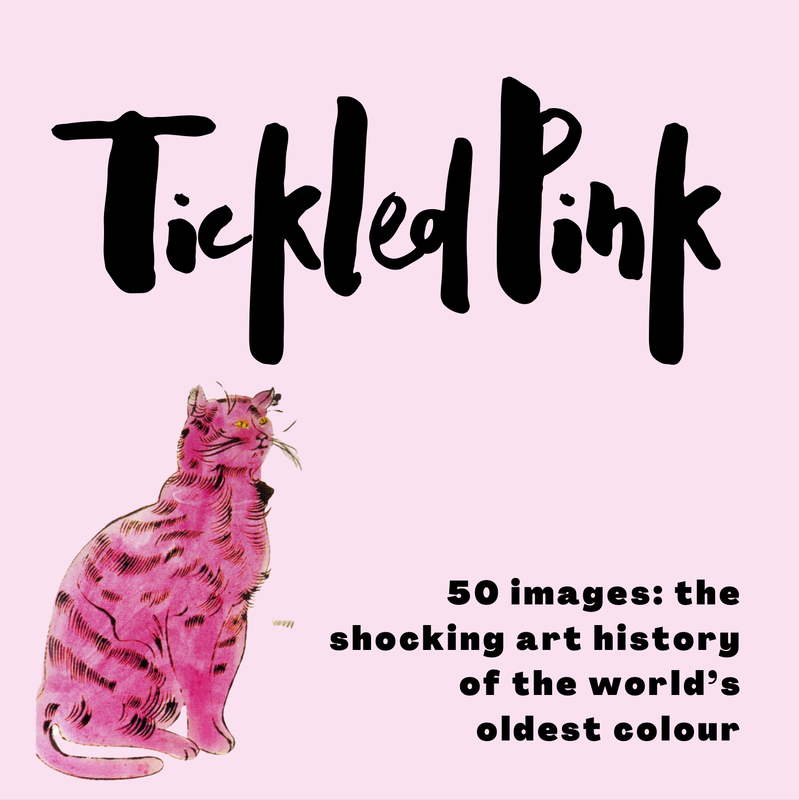
April 2024
|