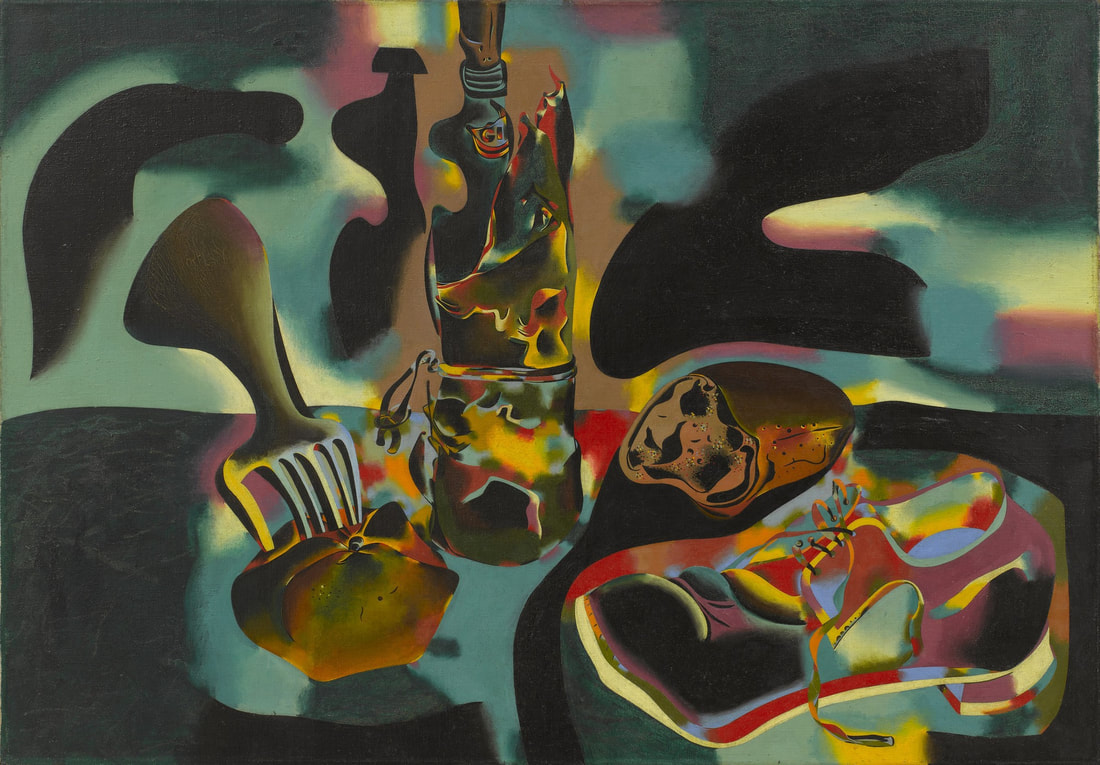
 Still Life with an Old Shoe, by Joan Miro (Spain) 1937 Apocalypse Now the fever-coloured sky remembers the thrill of birds apocalyptic shapes impaled on flames slip over the hill crawl towards me well-oiled tongues lap at stones spit songs that bounce bitter and barefoot crooked tines of bottled nightmares like rib bones cage fruit’s flesh isolated rotting bitter earth with a dearth of joy a refrain like liquid fire laps at me repeating a chant yellow and black that cracks the land homeless headless sightless i eat the skull like bread hollowing out the eyes and weep for stillness beyond the stars this is no time for despair a door we all pass through and so i do and so i do Elizabeth Kirkpatrick-Vrenios Elizabeth Kirkpatrick-Vrenios is professor emerita from American University, having chaired the vocal and music departments. Vrenios’ solo recitals throughout the US, South America, Scandinavia, Japan and Europe have been acclaimed. Recently featured in Tupelo Press's 30/30 challenge, she has been published in such journals as Clementine, Cumberland River Review, The Feminine Collective, The Kentucky Review, Unsplendid, Edison Literary review, Passager, NILVX, Unsplendid and featured in such anthologies as The Poeming Pigeon, Love Notes from Humanity, Stories of Music, the American Journal of Poetry, and was recently nominated for a Pushcart Prize. Her chapbook Special Delivery, prize winner with Yellow Chair Press, was published in 2016, and her chapbook Empty the Ocean with a Thimble will be forthcoming in April of 2021 with World Tech Communications LLC. As the artistic director of the Redwoods Opera in Mendocino, California she has influenced and trained vocal students across the country.
0 Comments
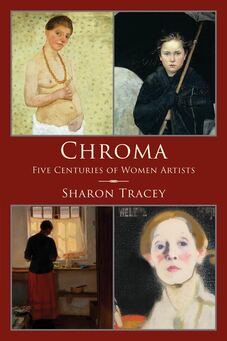 A Conversation with Sharon Tracey Author of Chroma: Five Centuries of Women Artists Shanti Arts, 2020 Paperback, $12.95 ISBN: 9781951651497 90 pages Libby Maxey: Your new book, Chroma, is entirely ekphrastic, covering (as the subtitle says) five centuries of women artists. Did you embark on this project intending to build a full-length poetry collection, or did the vision of the book take shape more gradually? Sharon Tracey: At first, the poems were just an extension of my life-long love of looking at paintings and experiencing the thrilling ways a work of art can make you feel. I probably had a dozen poems written—all inspired by the work of women artists, so often overlooked in the history of art—before I began to consider the possibility of a larger collection and possible book. At that point, I began to see myself as both poet and curator, with an opportunity to write ekphrastic poems that could also collectively highlight women artists and reference the times in which they lived and worked. Such were my initial thoughts. I can tell you, the hardest thing was setting boundaries for the project as I continued on, as the choices seemed infinite. I have many half-poems and ideas I would love to return to someday, along with a long list of women artists and paintings to inspire future poems. LM: Where does that life-long love of paintings come from? What kind of experiences with visual art—as a student or creator or museum-goer—gave you the confidence to take on the life and work of these women artists? ST: I have enjoyed making art and viewing it as long as I can remember, but here is one particularly vivid memory, when I viscerally felt that art mattered in important ways: I was living in Florence, Italy at the time and was visiting Munich when I saw an exhibition of Wassily Kandinsky’s work. I remember it was a Sunday and that the paintings glowed like stained glass, how they seemed to vibrate. This was before I was aware of his book, Concerning the Spiritual in Art, in which he discusses the psychology and language of colours, how colours embody music, emotion, spirit. It made important sense to me. Seeking out paintings became a kind of meditation, solace, and renewal. To replenish, to see what we can see, what we bring and take away, what we can save. What keeps us coming back. Museums and cathedrals are not so very far apart in some ways and are my two favorite places to visit in any city. Back then, I loved the work of artists such as Kandinsky, Matisse, and Cézanne and I didn’t stop to ask where all the women were—which now has become a sort of obsession, discovering both new and older work by women artists. LM: You’ve certainly educated me; I might never have heard of most of these women were it not for your work. I’m struck by how many of the poems in the collection are based on self-portraits; your depiction of an artist has an extra layer or two when you’re responding to how she depicts herself, which could be either helpful or intimidating. Several poems even take the form of a letter from the artist herself. What were you hoping to bring to the project with that approach? ST: I love the multiple reflections in self-portraits—the artist depicting another self and the viewer/writer responding to that depiction in various ways. So many possibilities. I had a feeling I could illuminate something, try to stand with the artist for a moment in the studio. And the farther back in time and history I traveled, the freer I felt in responding to self-portraits, leaning into the history, time, and place of a particular artist. In what I call the epistolary/persona poems—a letter in the voice of the artist to create a different kind of self-portrait—I use the subject of the painting as a jumping-off point for the poem, while imagining the inner life of the artist and referencing a biographical fact or two along the way. For example, with Rosa Bonheur’s Ploughing in the Nivernais, I wanted to convey her deep and abiding love for animals, the subject of her best-known work. Observing the oxen in her painting, I thought of Saint Luke, patron saint of artists (who is reported to have been a painter himself) and how the winged ox is his symbol, and the idea for the poem sprang from the painting in that way. I love how letters can create a sense of intimacy with the reader; combining the epistolary and persona forms was another way to create intimacy with the art and artist. LM: Were there some poems that you found especially difficult to write, yet you couldn’t let the art—or the artist—alone? ST: I had the most confidence when I had something tangible and personal to hang on to. For example, several years ago I visited Helsinki where Helene Schjerfbeck was born and painted many of her self-portraits. And as I stood at the edge of Helsinki Harbour, tasted cloudberries from the market, and smelled the spruce, it was as if I had permission to write in her voice and the poem (“Self-Portrait With Black Background”) came fairly quickly. In contrast, the more well-known an artist and painting, the more challenging it was, such as with Frida Kahlo’s Self-Portrait with Thorn Necklace and Hummingbird. So much has already been said and written (and I did find a way to incorporate the word cliché into the poem). But I couldn’t let go of a thought I had as I viewed the painting—that we women are often putting “pretty pins in our hair,” ones that hurt. And I wanted to try to work with that. LM: As you’ve indicated, many of these poems do foreground place and time, as much as they’re poems about people and their art. You’ve grouped them into “galleries,” which, like physical galleries in a museum, contain the art of an era, a defined period of years. This choice is particularly noteworthy because you start with contemporary artists and go back in time from there. Why did you choose to order the collection that way? ST: I knew from the beginning that I wanted to present the poems in a series of galleries as if the reader were physically walking through a museum. And I wanted to create what I hope to see more of in the world: exhibitions dedicated to the collective work of women artists, rather than a work here and there, often displayed in isolation amidst the work of male artists. Initially, I organized the poems/paintings chronologically, moving from the past to the present, which is often how art history is presented. But the more I thought about it, the more it seemed interesting to take the opposite approach and present the contemporary work first and then move back in time and history. I also thought that starting with more recent paintings would reinforce the idea of building upon the foundation of those who have come before. There’s another clue I hope readers/viewers will ponder: the titles of the poems/paintings (one and the same) hint at the range of subject matter afforded to women artists at different points in history. I should also note, that once a reader steps into a gallery with its specified time period, the poems are arranged “on the walls” in a way that made sense to me as curator, in terms of how they might best relate to one another. LM: A full-length poetry book is always, to some extent, a labour of love, but some poems call for more labour than others. Is there a poem in the book that nearly wrote itself, one that became what you wanted it to be without much revision? ST: From the beginning of the project, I had Amy Sherald’s Miss Everything (Unsuppressed Deliverance) in mind to include, not only because I love the painting and her work in general, but also because I love her layered and thought-provoking titles. For this particular painting I wrote an epistolary poem, or you might call it a fan letter (in fact I signed the letter that way). The poem came quickly, and I hope it conveys both the excitement and unease I felt viewing the painting, that moving spark of connection. Another example would be the concrete/found poem I shaped and collaged inspired by Box of Coloured Objects by Lucy Mackenzie, an artist who makes exquisite miniature paintings of everyday objects, giving them intense attention and time, and using such detailed brushstrokes it’s as if you could reach into the two-dimensional space and hold them. They are small still lifes but also seem larger than life in strange and wonderful ways. Upon viewing the painting, I immediately envisioned creating an imaginary box of my own that could hold a small world of her paintings (the box created visually by the placement of text). So I gathered sixteen paintings, represented by their titles, and set them down to make a found poem fairly quickly, including among them “two shuttlecocks,” “pear and fork,” and “Vermeer eyes with pearls.” It was like putting together a puzzle, in a satisfying way. LM: Many of these poems speak to the microcosmic world of a piece of art: one quotes Blake’s line, “the world in a grain of sand” (“Green and White”); in the next, the artist “gathers all of summer / in the air / and drops the days / into her humble squares” (“Summer”). That poem ends with the lines, “see what lasts, / what goes—“; what lasts for you after having put this project between book covers? ST: Yes, many speak to a microcosmic world, but the opposite is also true. The tension—between the forest and trees, so to speak—often adds something extra to a work of art. In terms of what lasts, for me, it is the idea of a permeable line between painting and poetry that you can sometimes see, hear, feel, and even cross when you bring close attention to a work of art. The way words can paint a picture in the mind, a painting can draw out language in response. A catalyst or connection that rings true in different ways, based on our own tastes, experiences, and memories. The idea that an artist’s voice, hand, and history are embedded in the work. That an artist can "drop the days" into a painting. Also what lasts is the collective power of bringing women artists together, across boundaries of time and geography, to view how they, in a sense, painted their own history at a particular point in time. What lasts for me is the desire for more—more work by women artists, more poetry, more stories, more remembering and recognition in the history of art. More windows for understanding the world and ourselves. I open Chroma with two epigraphs that, together, speak to all of this. The first is from Simonides of Ceos, the second from Sappho, to whom I’ll give the last word: “Painting is silent poetry, / and poetry is painting that speaks”; and "You may forget but / Let me tell you / this: someone in / some future time / will think of us." Libby Maxey, with Sharon Tracey Click here to view or purchase Chroma. Libby Maxey is a senior editor at Literary Mama. Her poems have appeared in Emrys, Pirene's Fountain, Stoneboat and elsewhere, and her first poetry collection, Kairos, won Finishing Line Press’s 2018 New Women’s Voices Chapbook Competition. Her nonliterary activities include singing classical repertoire, mothering two sons, and administering the Department of Classics at Amherst College. 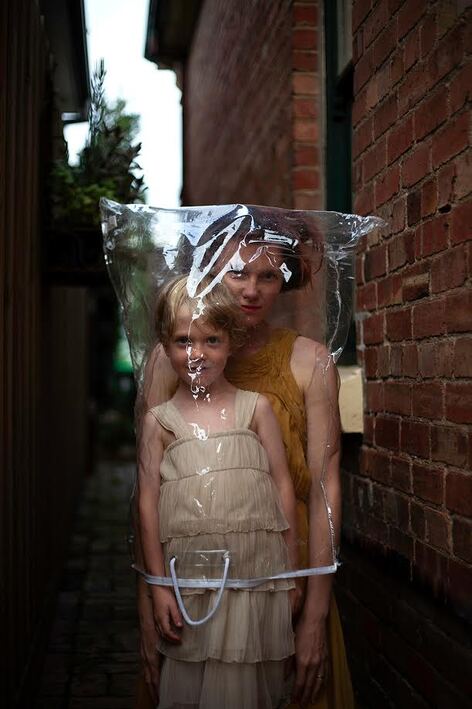 Protection, by Daisy Noyes (Australia) 2020 Curve curled into her curves edge bed clinging not much memory of his body other side of her sleeping mountain but a feeling, faint, that he somehow disapproved, and the one time I marched in from a nightmare and he was angled above, was she in danger, her eyes turned gentle and patient to my alarm, a reassurance, strange as it looked there was a logic to the shape they made, triangle was the word that stuck with me, she and the bedhead the right angle, he the hypotenuse and no place for this small body to fit 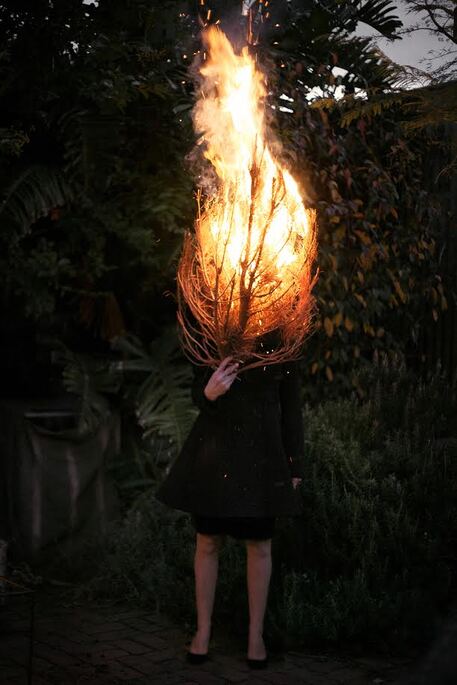 Self Portrait in Isolation #10, by Daisy Noyes (Australia) 2020 Flame morning light peeled brutal an anger in me I didn’t know existed, her sun wide smile always cheerful in the way a child of divorce learns to be, and every day I had the choice to eat my own face or devour hers, I learned slow, almost too late, which of those was the right thing to do, gradually lowered the burning rod and stood still, flames licking, so she could show me how to step with care into a new mouth 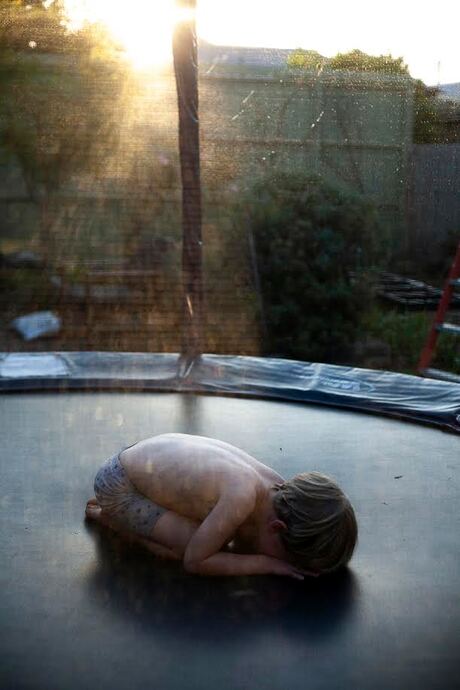 Mars Hiding, by Daisy Noyes (Australia) 2020 Skin my sister always knew she wanted to be a mother while I prevaricated past the bearing point, morning of her daughter’s birth I got the still dark phone call to go and be aunty for my 18 month old nephew, there she was, bare-legged, gathering items into a bag, it had all come on much quicker, maternity leave just begun, was meant to be three weeks away, the calmness of her urgency, slow moving, deep breath all that her body was holding, I slept restless and woke to a startled boy who blinked slow at this strangeness, arms up, I was okay to lift him into the day your life is about to change I informed him over Weet-Bix, those few hours he will never remember, where I held an ending and a beginning for this alien familiar who maybe smelled something of his mother in my skin Emilie Collyer Emilie Collyer lives in Australia on Wurundjeri country, where she writes poetry, plays and prose. Her writing has appeared most recently in Rabbit, Australian Poetry Journal, Witness Performance and Cordite. Award-winning plays include Contest, Dream Home and The Good Girl which was produced in New York, Hollywood and Florida. Emilie is currently undertaking a PhD in creative writing at RMIT. 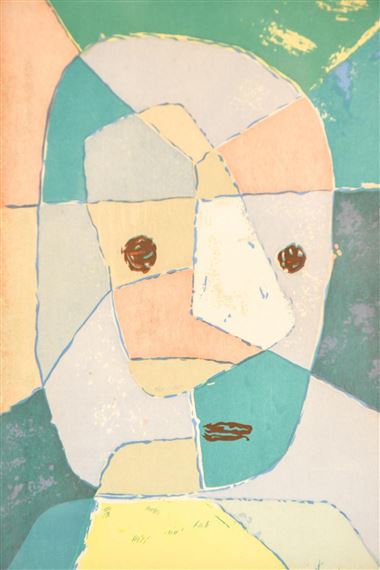 Blaubetonter Kopf (Head with Blue Tones, or The Blue Head), by Paul Klee (Germany, b. Switzerland) 1933 After Paul Klee 1. The Blue Head How fortunate you are, to call the sky your mother, though you must inhale more than its blue comfort. There’s no denying tornado green and blizzard white. Your button eyes smuggle in midnight while your tiny lips press together, deprived of words for the fickle weather, the hours dealt like playing cards. 2. Outbreak of Fear III We have done the work of the enemy by imagining ourselves dismembered: The severed head crying for the severed leg, the arms sawed up for the fireplace. Our actual fate may not be as horrendous, but we have already fled our flesh in anticipation. The blood is drained out, rendering skin the colour of ash. 3. Revolution of the Viaduct The arches were ordered to line up and stand still for inspection. But look, they have broken ranks, and the secret blood of stones has risen to the surface-- yellow, orange, pink. The arches are walking our way, one stiff leg in front of the other. If we are liberators, they will carry us on their shoulders. If we are slave masters, watch out for their feet. 4. Colourful Lightning An artist is drawing tonight with golden chalk. It’s nothing that makes sense, nothing that would answer prayer, just jagged brilliant lines. He loves these lines, but loves even more the act of the wandering, downward stroke. No sooner is he finished than he wipes the blackboard clean so his free hand can crack the darkness again. Robert Lowes Robert Lowes is a journalist and poet in St. Louis whose first collection of poetry, titled An Honest Hunger, was published earlier this year by Wipf and Stock Publishers under its Resource Publications imprint. His poems have appeared in journals such as The New Republic, December, the Chariton Review, Sentence: A Journal of Prose Poetics, Tampa Review, and the Christian Century. For the past seven years, he has coordinated the high school poetry contest of the St. Louis Poetry Center, recruiting judges like Naomi Shihab Nye and Jericho Brown, screening entries, and shaking the hands of winners at award ceremonies. For more information, visit robertlowes.com. 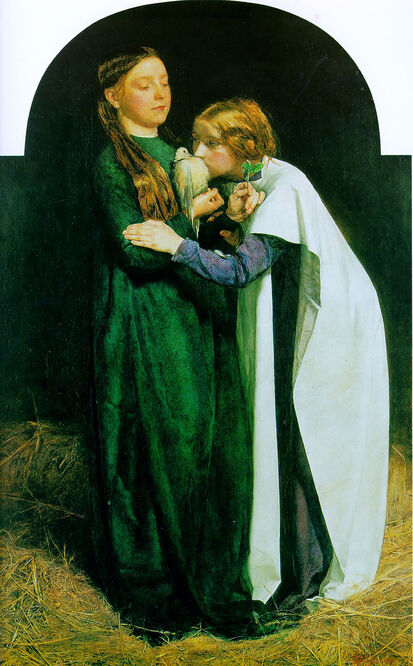 Return of the Dove to the Ark, by John Everett Millais (Britain) 1851 An Approaching Sound “And the dove came in to him in the evening; and, lo, in her mouth was an olive pluckt off: so Noah knew that the waters were abated from off the earth.” Genesis 8.11 We pretend having our life, even world’s life, always under control, from past generations to present days. Sometimes we feel close to that certainty, and it is good that this should happen, giving us some encouragement on the route. We work with the mind and the heart, science and desire, on outlining the future, which we anticipate promising and happy. Skirting around life’s corners, every so often, we are faced with frightening facts, perhaps echoes of ancient Greek tragedies, poor of hope in the human renaissance. Wars, revolutions, tyrannies and persecutions, born on the drumming of soulless men, have delayed landing in the promised land, where milk and honey spur and light reigns, preventing all evil once sown. A land we have not yet arrived to, but we heard an approaching sound of the beating of the wings of the dove we released in our present generation. The one that is bringing in its beak the green branch of the tree of peace and entire fraternal human feelings. Edilson Afonso Ferreira Mr. Ferreira, 76 years, is a Brazilian poet who writes in English rather than in Portuguese. Widely published in selected international journals in print and online, he began writing at age 67, after retiring as a bank employee. Nominated for The Pushcart Prize 2017, his first poetry collection, Lonely Sailor, One Hundred Poems, was launched in London, in November of 2018. He is always updating his works at www.edilsonmeloferreira.com. . 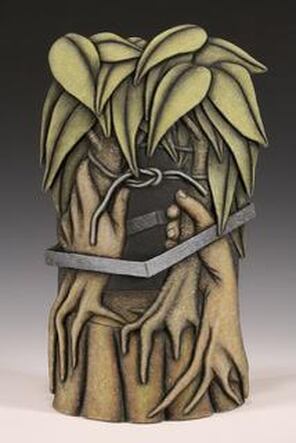 Square Root of Tree, by Louis Marak (USA) 2007 Tree Runs the Numbers Tree is logical. She likes to figure. She has time. If she gets stumped, she tells herself, "Tree, do the math. Run the numbers. Balance the damn equation." Still, sometimes she feels a panic—a growing knot. Is one place for eternity really the way? Is she, Tree wonders, bound? She concludes that her possibilities are linear: Trunk, branches, leaves. The systems are set. "And yet," Tree thinks, "I am a far-reaching, intricate pattern—the real action hidden down deep. I feel what's at work: Black, mud-slick roots, crisscrossing darkness, fingering the water table, forever pushing deeper, farther, unseen. Unsolvable." Jason M. Marak is a writer and artist living behind the redwood curtain in Northern California. His writing has appeared in a number of print and online journals including The Paris Review, Raritan, and 100-word story. To see more of his writing and visual art visit him on Instagram (@jasonmmarak) or at smokeandotherindications.blogspot.com. 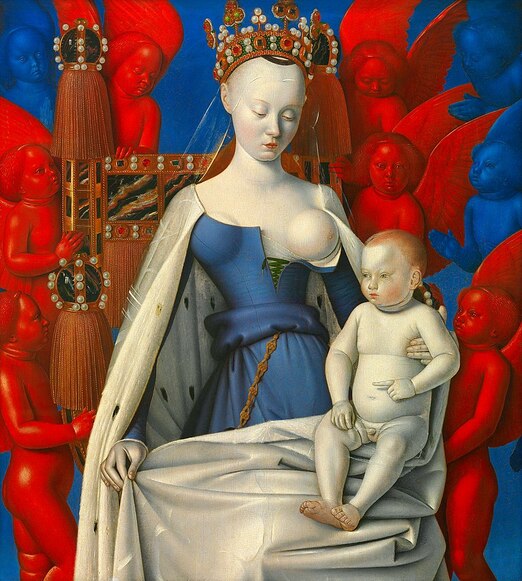 Virgin and Child Surrounded by Angels, by Jean Fouquet (France) 1452-1458 Virgin and Child Surrounded by Angels Royal Museum of Fine Arts, Antwerp, In the Zuid. South. Imposing. Intimidating. Inviting. Walkable from my pension. Used to visit whenever I could. I have this love affair with museums. Lose myself in their silence, the gentle shuffles from painting to painting. Some wormed their way under my skin. In Antwerp it’s the Fouquet Virgin. Not sure what fascinates me more: Its brilliance or its 15th Century involuntary surrealism. The virgin’s fashionably shaved hair and eyebrows, the colours of the ‘tricolore’: blue background, blue dress, red angels, ghostly white flesh, and a wink at 15th century voyeurs: one hard breast (which today could only be considered artificially enhanced) exposed, ostensibly to feed the little old man-child. Long before the French Revolution, court and church still paid handsomely for art that allowed looking without guilt. Rose Mary Boehm Rose Mary Boehm is a German-born British national living and writing in Lima, Peru. Her poetry has been published widely in mostly US poetry reviews (online and print). Her fourth poetry collection, The Rain Girl, was published by Chaffinch Press at the end August 2020. ** virgin and child surrounded by angels rather, blest are they who hear the word of God and keep it luke 11:28 she a milkwhite mystery who would be royal nourishment worthy of a holy, royal child this Queen of Heaven bares her breast as red and blue angels convene around her throne yet this otherworldly image was scandalous for its time viewer, do you recall another time another woman would also shock with her milkwhite cry how blessed are the breasts that nursed you and then came His scandalously tart reply Sister Lou Ella Hickman Sister Lou Ella Hickman’s poems and articles have appeared in numerous magazines and journals as well as four anthologies. She was nominated for the Pushcart Prize in 2017 and in 2020. Her first book of poetry entitled she: robed and wordless was published in 2015. (Press 53) ** Vision The angels anoint the miracle of your sainted birth. No more do I see -Through a Glass Darkly. With the blessings of your coming I now see face to face. We are sewn into the moon and the stars. You are the child that blesses the world.. I am made holy by our covenant.. A new beginning-a new life. Come all and surrender unto him your fear and resignation leaving only trust and love. For he is your God-your fate. The world anoints itself. Scribes will mark this day. the wind blows your name. the rain disrupts the sky. The birds and angels announce your holy birth. Sandy Rochelle Sandy Rochelle is a widely published poet, actress and filmmaker. Publications include: Impspired, Wild Word, Every Day Writer, Amethyst Review, Spillwords Press, and others. http://sandyrochelle.com ** As If, About As if a teenage peasant girl would wear a crown, and herself having borne a boy-child in a byre with cattle for her witnesses and an inn-keeper’s door slammed shut. As if a teenage peasant girl would clothe herself in yards of satin, taffeta, and cinch her pencil waist with strands of interwoven silk-- all below gems of costly price. As if a teenage peasant girl two thousand years ago in Roman-occupied Palestine would rest upon a burnished throne and flaunt her breast—for all the world like some Egyptian queen. But angels gathered; that is true. And outcast shepherds heard them singing high in hills of Judah under blazing white-hot comets-- so left their flocks and ran to tell the world: about a teenage peasant girl, about her hard-graft husband on his knees beside a manger…about the boy-child who would change the world. Lizzie Ballagher Lizzie Ballagher has just finished her first full collection of poetry. Her work has been featured in a variety of magazines and webzines, including Words for the Wild, The Alchemy Spoon, Poetry on the Lake, and The Ekphrastic Review. She blogs at https://lizzieballagherpoetry.wordpress.com/ ** Creating the Perfect Breasts Some say that implants create the ideal—you know, to undergo cosmetic surgery, place foreign material inside your body, add saline solution or other fillers to lift what sags, adjust what’s uneven, or to augment what’s deemed too small. In Fouquet’s painting, a drafting compass was used to create the virgin’s breasts. Here, immaculate circles, geometric shapes, round out the canvas. Her upper torso appears smooth and unblemished as does the child on her lap and the chorus of angels behind her. So, who’s to say we must follow a certain recipe to obtain perfection? Like wrinkles and the change of skin over time, I’m reminded of a river, its current, how it flows into crepelike existence. As physical appearance transforms, gravity reveals a new kind of adornment, renders its own unique artwork, sculpts a different type of aesthetic to behold. Jeannie E. Roberts Jeannie E. Roberts lives in an inspiring setting near Chippewa Falls, WI, where she writes, draws and paints, and often photographs her natural surroundings. She enjoys spending time outdoors, listening to the birds, and taking long walks. She’s authored four poetry collections and two children's books. As if Labyrinth - Pandemic Inspired Poems is forthcoming in May 2021 from Kelsay Books. She’s also poetry reader and editor of the online literary magazine Halfway Down the Stairs. ** Holy Mother I sleep in a high bed with the king, servant to his desire, though I cannot look upon the Virgin’s eyes, for they are lit with webs and cracks, those limits of holiness. Wounded like the the rest of us, her breath scarred and shallow, tears sacred to no one. It was either wife or whore. This, from force or circumstance, is buried with a child in dirt and pine. Each night he unbuckles a belt soaked in wine and breathlessness. To please the saints we dance at the Lord’s feet in fiery light. My troubled mind stings with nettles and humming stars. Above the ground hearts don’t forget, and though I smile at court, the gown exposes my breasts with gasps of scandal. Delicious! For the love of God I shall have my way, and fly without wings. In truth nothing good is free. He said I would pose for the painter as Virgin, a holy mother, that most revered of women, which certainly, I am not. Still, it pleases me to sit upon a golden throne, crowned with pearls, held by angels. In alabaster skin Seraphim raise me to flames and holy love, no longer queen without a crown, a true lady. No mercury mask on my face, I am held close at last to Cherubim. The world itself is light, for here I am no longer whore, only Virgin. Here, I won’t die for men’s pleasure. I shall be immortal, gazed upon, all eyes melting in pious love. Yet, it’s strange how light darkens. Holy Mother, pray for me. Maryann Gremillion Maryann Gremillion is an educator and writer working with elementary schools, teachers, and nonprofits to build transformative communities. She taught elementary school for fifteen years in Houston where she discovered a passion for teaching creative writing. Maryann also worked for twelve years as a writer-in-residence and then program director for Writers in the Schools. Her work has been published in Glass Mountain, Teachers and Writers magazine, and several local anthologies. She is excited to complete a book chapter about her work with teachers and writers in collaboration with Texas A&M University, due to be published January 2021. ** Holy Mother, Wholly Other I too popped out my breasts but they didn’t look like that-- perfect spheres to be plucked from my body like apples from a tree Already I can hear the choir: Mary, where are your cracked nipples? the leaky faucet and burst pipe? the milky stones sinking to the floor? the dark areolae lighting your baby home? Mary didn’t need a man but the man needs Mary to undress to pose to be immaculately conceived in the coolness of his gaze striped blue, red and marble white a fitting trio for a state flag Holy mother of God, I don’t see a mother. Charlene Kwiatkowski Charlene Kwiatkowski often writes about art and place from her home in Vancouver, Canada. Her debut poetry chapbook is forthcoming in 2021 with The Alfred Gustav Press. She has been published in Pulp Literature, June 2020: A Pandemic Anthology (845 Press),Train, PRISM international, Barren Magazine, Long Exposure, and elsewhere. Charlene has a Master’s degree in English Literature and works at a contemporary art gallery. You can find her occasionally blogging (when new motherhood allows) at textingthecity.wordpress.com ** Moonlight and Red Angels I cuddle under my fluffy blue down flannel blanket, facing my husband’s sleeping back, cupping my baby’s sweetly scented head against my breast, both of us bathed in white light from a full moon shining through the giant square skylight above us. Exhausted, I drift in and out of sleep as my baby suckles, his peach fuzz hair glowing like silver iridescence. The bright red lights of the digital alarm clocks I keep compulsively set around the room to be sure I awaken in time for work three days a week let me know we are approaching two in the morning. No work tomorrow and infinite magical darkness for nursing. No rushing through time right now. A family of four baby raccoons and one mother gather around the rim of the skylight watching over us like angels. Clouds start blocking the moonlight and snowflakes begin to fall. In my half-sleep, the phantasmagorical raccoons glow red, reflecting the seemingly multiplying clocks as the animal babies slide slowly down the increasingly slippery window. My vision blurs and my eyelids feel heavy. I adjust my baby on a cozy flannel pillow to switch breasts. I feel ecstatic compared to daytime on workdays, when I forlornly pump breast milk manually at my desk over lunch, skimming medical charts between the psychotherapy patients I nurture in meticulously calibrated and documented time slots. Now I can just enjoy my baby’s sucking lips on my nipples in the seemingly endless night. Nothing feels sadder than when I rush home from work in traffic on cold winter nights and arrive too late to nurse because my husband has just fed the baby from my breast milk supply in the freezer. Sometimes I just cannot pry my last needy patients out the door of my office filled with wall and desk clocks everywhere, reminders of my strict time limits on acts of giving reimbursed by health insurance to my hospital clinic. I am obsessed with staying on schedule. I hate when I am forced to leave too late and feel my breasts fill with milk, aching and leaking the whole way home. I cry every time I stop at a red light. On such nights, I collapse on the couch, bereft, miserably pumping my milk into plastic bottles, drained emotionally from doling out psychotherapy all day in precise forty-five minute “reimbursable hours.” My painful breasts are pathetically suctioned by a manual device while I hold my contented sleepy baby on my lap. The middle of the nights of missed evening feedings are the most precious feedings of all, as I slip in and out of consciousness under the sentry of magical red raccoon angels who peer down upon us and glow. Gloria Garfunkel Gloria Garfunkel is a retired psychotherapist with a Ph.D. in Psychology and Social Relations from Harvard University. She was an Art History major at Barnard College. She has published over a hundred stories of flash fiction and is completing a memoir in flashes of her childhood as a daughter of Holocaust survivors. ** Milk The baby wouldn’t latch. Time after time Mary raised him to her breast. Every time, he turned away, screaming. The nurse sent in the lactation consultant, who took one look at Mary’s breasts, and said, “Your nipples are too small.” She pinched hard, then offered a nipple made of silicon. Far better than Mary’s criminally small ones. “Try this nipple shield,” said the LC. When the baby refused that too, the LC commanded, “Pump.” By the third day of pumping, every two hours on the hour, Mary’s breasts were so full, they stood at attention. “I look like a sculpture of Boudicea,” she joked. “Or I can cut one off and be an Amazon.” Her breasts were heavy and hard, and hurt so much from the inside that cutting them off didn’t seem like such a bad idea. When she woke the next morning, they had turned into stone. She wasn’t even surprised. Her baby gladly took the bottle she had pumped during the night. This time when she pressed her breast, they didn’t hurt. All around her, she could hear laughter, like she was being watched by countless red babies who turned their mouths away, repudiating her. She called the LC. "You mean they're rock hard?" the LC asked. “No. They're made out of rock. Literally.” “Hmm,” said the LC. “Come over to the clinic. Let me have a look.” “Oh,” said the LC. “You weren’t joking. They are made of rock.” Mary’s blue dress gaped open. It looked like someone had taken two large river rocks and stuck them at random angles onto her skinny chest. “I've never seen anything like this,” the LC said. “So now what?” Mary asked. The LC laid her hand on the cold smooth surface again. As though she couldn't quite believe her touch. Mary saw the touch, but didn't feel it, except as a kind of phantom memory. It was easier this way. “There could be advantages,” the LC said. She handed Mary the big, baby-weight doll with the creepy unhinging mouth that the clinic used to teach holding positions. It was twice the size of Mary’s baby, and held itself upright rather than squirming like a recalcitrant worm in her arms. “Look how erect the nipple is standing. Should be super easy to get a latch,” the LC said. “ Even pumping should be easier. You just hook the flange on top, and it will stay in place.” “Except that it's stone,” Mary said. The LC looked at her blankly. “I don't think stones excrete milk.” “Oh,” the LC’s excitement dimmed. But then she brightened. “There are legends of stones pouring forth water. Doesn’t that hymn go something like 'Who turned the rock into a pool of water, the flint into a fountain of waters?' Why not milk?” Mary didn’t think this was much of an argument, but she had no energy to argue with the mad-eyed zeal. Besides, she didn’t want to be a bad mother. “How do we check?” she asked. The LC squeezed Mary’s breast, Her fingers didn't make a dent in the cold surface. Mary felt a spurt of satisfaction at the thought that the LC was probably hurting herself with all that pressure, while she couldn’t feel a thing. “Well, I guess we can try what Moses did.” “Which was?” But the LC had left the room. She came back with a hammer. “It should be a staff, but I think this might do.” She raised the hammer over her head. “What are you doing?!” Mary tried to jerk away. It was too late. Smash, right down on her breast. The rock rang, and then a hairline crack spread up to the nipple. Milk seeped out, glinting like water over the pale stone. “See?” said the LC. “It worked! If at first you don't succeed, just try a little harder”. Batnadiv HaKarmi Batnadiv HaKarmi is an American born writer and painter living in Jerusalem. A graduate of the Shaindy Rudoff Graduate Program in Creative Writing at Bar Ilan University, her work has been published in Poet Lore, Ilanot Review, Poetry International, MomEgg Review and Partial Answers. She is the recipient of the Andrea Moria Prize for Poetry, and was shortlisted for the Bridport Prize for Flash Fiction. Her work can be seen at www.batnadiv.com ** Maternité Alabaster virgin queen, her regal cape and jeweled crown, her fulsome breast escaped the tight-laced bodice of her silken gown. The infant pale, doll-like upon her knee gazes at some point unseen by mortal eyes, ignores her murmurs and maternal milk. What child so still? No cries, no smiles to light his mother’s heart. Her countenance a mask, mouth pursed, eyes closed. The love that courses for this child, a god, his thoughts already fixed, as seraphim and cherubim ring round the virgin’s throne, a chorus of the living and the damned. Jennifer Hernandez Jennifer Hernandez, Minnesota teacher/writer, has performed her work at a non-profit garage and a taxidermy-filled bike shop. Her flash fiction, poetry, and creative non-fiction touch on themes of identity, social justice, and the different lenses through which we view the world. She delights in the interplay of image and text and has published work in Visual Verse and Poetry in the Park in the Dark, a project sponsored by Saint Paul Almanac in which poets and artists collaborated to create broadside posters for display in solar-powered “rocks” that lit up at night for passersby. ** Stephen, Martyr Should I treat it as a postcard, artist unknown, to me, half diptych stands as striking, herald tones, heraldic shades, a veil between the vivid and washed holy marble plane, so fine the portrait, early date, I want to see its twin. But then I’m left to grapple, pre-reformation church, if even centre-justified, supposed, this manger birth. Madonna’s not appealing, the Queen of Heaven song, incongruent portrayal, a juxta to my faith. Perhaps I should be distant, or taken off the case, restrict myself to painting, ignore the personal. But then what of engagement, a subject. spirit stirred - you may be academic, but this affair’s of heart; I try to social distance, but that would mean a mask. And then I delve still further, a guidebook from the rack, and wracks the word, the struggle, king’s lover feeds my lord. I learn that she has neighbour, through patronage, reward, and Stephen, the first martyr, is stoned cold, pointed, bold. I know the zeitgeist different - though wonder, watching news - I know said fallen women, the Nazarene’s response. It’s not the breast portrayal - the baby’s fat on milk - though Agnès known for low-gowns, a provocation stance. I guess who pays the piper, can chose the model worked, but state that names the mistress, a title to the crown? You’ll think that I am foolish, too close to feel the art; it’s set me all a lather, these corrupt gospel soaps. But that’s because the artist, holistic slice of life; dictators use the poets, while novels burnt in piles. We all admire the brushstrokes, the colour palette range; I have to face the subject, then subjugate my rage. I think of temple tables, all overturned on stage, inclusion sold for pigeons, then justify the trade. Stephen Kingsnorth Stephen Kingsnorth (Cambridge M.A., English & Religious Studies), retired to Wales from ministry in the Methodist Church, has had over 200 pieces published by on-line poetry sites, including The Ekphrastic Review, printed journals and anthologies. https://poetrykingsnorth.wordpress.com/ ** Truth Profane Why use your talent to blaspheme the Gospel -- painting patron's dream where favored saint would honor plea that mistress of the King could be, resplendently bejeweled seen, in mockery, as modern queen, of lowly Mary, saint by task, who honored but what God would ask and, far more modest, would expose no more than faith by which she chose to serve her Child at willing breast the nurture craved at his behest? You prove no more than truth profane of right by war and blood to reign. Portly Bard Old man. Ekphrastic fan. Prefers to craft with sole intent of verse becoming complement... ...and by such homage being lent... ideally also compliment. ** The Christmas Angel There was a snowstorm on Christmas Eve, and an argument in our house. By the time we finished dinner and Mom settled the younger kids with Grandma, everyone was upset. When she drove me into the crowded church parking lot, we were late. It was almost time for the pageant and my special role as the Little Christmas Angel. The Sunday School teacher had shown beautiful pictures of the Nativity by famous artists, so everyone understood exactly how the scene and characters should look. Mary would wear a blue dress and a white mantle and a peaceful expression. She’d wrap the naked Baby Jesus in a white cloth. A bright spotlight would shine on them. We’d rehearsed for weeks after Sunday School. My grandmother had made me a beautiful angel costume with a long silver gown, gauzy wings and a gold tinsel halo. I’d visualized standing on the raised platform in centre stage behind the Holy Family and singing Angels We Have Heard On High. I’d practiced spreading my wings and gently flapping them to cool the baby’s face. I thought God would probably watch from a mysterious place above the overhead spotlights and smile. God would see that I was serious about my responsibilities. In my six years on Earth, this would be the most thrilling thing that ever happened. When I arrived in the church basement where everyone assembled to go onstage, chaos reigned. My gown was gone! Frantically, I tugged on the Choir Director’s robe and fearfully asked where it was. She told me a sad truth. Because I was late, they’d re-assigned my costume and role. There was no place left for me. I could sit in the audience with my mother and watch—or go home. It took a moment to comprehend this. My jaw dropped, knees buckled and I dropped to the floor. Ruined! Christmas Eve was ruined . . . I was supposed to be an angel! Tears spilled down my face as I sat cross-legged on the cold tiles. A kindly teacher offered me an old red bathrobe and a mop handle. She said I could be a shepherd and stand in the background. I reluctantly accepted and tied a rope around my waist to hitch up the oversized gown. It smelled like cigarettes. The angels fluttered their wings and adjusted their halos for the stage while I watched, stomach twisting with envy. As the pageant began, everyone forgot about me. From behind the red velvet curtains, I watched the entire cast assemble before the packed audience. Ooh! Ahh! A polite round of applause broke out as they took their places. It was time to make a grand entrance. I had no lines or directions to follow and wandered onto the stage in an improvised solo performance. Strolling about, I pretended to search for something—sheep, perhaps? “Baaaaah baaaaah . . . here, sheep, sheep, sheep.” Feigning concern, I checked my Mickey-Mouse watch. Did the old time shepherds wear watches? When I heard a few giggles from the front row, it occurred to me I’d made a mistake. The back of the stage was crowded, and it was impossible to find a place to stand. The Wise Men, in their fancy crowns and long capes, elbowed me out of the way. Two boys disguised as a brown cow tried to kick me. I tripped over my drooping robe and had to roll up my floppy sleeves. The angel who had replaced me sneered and said, “Get lost, kid.” There was a clearing in the middle of the stage. Heart pounding, I walked up to the Holy family and knelt down on a bundle of straw beside the manger. Our Mary was a young mother who’d risked the bad weather to bring the beautiful newborn child to church. Lying on a soft white blanket in the little wooden bed, the baby whimpered, pink mouth twisting for her breast. She removed the wrappings and lifted him to her lap. Oblivious to his solemn responsibilities, the baby gurgled and waved a chubby hand. I reached out and touched a wee warm finger. The babe smiled. Attracted to a glowing light in the middle of the auditorium, I peered into the darkness. It was my mother’s face, shining like a star, attentive to my every move on stage. Afterwards, the teacher chastised me for "stealing the show." Whatever that meant. She didn’t return my angel costume. On the slow, snowy car ride home, Mother tried to console me. “Those angels seemed awfully hot and cranky up there. I could see them scratching and they sang out of tune. It’s a good thing you weren’t one of them.” After a moment, I said, “It turned out better.” As the wind blew drifts of snow across our path, the world outside the car disappeared. Face tight with worry, Mother hunched forward over the steering wheel, straining to see the dimly lit road ahead. Beneath their burden of snow, the twinkling red and green lights strung on our trees welcomed us when we pulled into our driveway. We were home and I reached for her hand. Sharon Frayne Sharon Frayne is a former high school visual art and English teacher, now writing and painting full time. She lives in Niagara-on-the-Lake, where she belongs to the Pumphouse Art Gallery and the NOTL Writers Circle. ** The Muse Once, in a Wendy’s in the heart of Nebraska, I nursed my baby, took off my teal coat, unslung my girl, and created a makeshift tent to be modest as I gorged on the delicious food-- Frosty and fries had never tasted so good. Still, the kid one booth over snickered, like he’d never seen a breast before. As if. The woman in the painting—the Virgin Mary—has no such problems. She exposes her perfect white breast—marble-like, the shape of an orange or full moon-- to her red-haired Jesus, while the angels watch, strange purveyors of the scene, looking downcast or boldly at the viewer (maybe they want some fries?) (they seem uncomfortable there). The Virgin herself looks down at her babe, cheeks flushed against white pallor, her mouth inscrutable—a tint of red that she traced in the mirror just for this. A mouth you could kiss before you scrambled to leave. A woman who is beyond caring, turned to stone out of glossy ecstasy. Why is she so bored? Jesus points, a slim finger, as if he’s saying “Hey, Mama. Hey.” (He’s not crying or squirming for milk like my babies. No, he’s a dignified little man.) But Mama will have none of it. The passion that made him is mired in mythological weeds. A jeweled crown. She wants to rip it from her head, to release her long hair. It will be soon—uncoiled, like it was when they pretended to make rapturous love. This is silly, this show, this bulwark of misogyny. She sighs. Covers her breasts and scurries away, leaving the artist’s studio and the borrowed child, 15 years old; friend of a friend. Sally Cobau Sally Cobau is a writer/mother/teacher from Dillon, Montana. Having received her MFA in poetry from the University of Montana, she's had work published in Poems Across the Big Sky, rattle, The Sun, and Room. She likes to bake, cook, and hike in her spare time. She loves dogs, and always hunts for wild animals--especially foxes and owls--on her hikes. ** Perception Jean Fouquet, star of the art world stands back, views his Virgin Mother, smiles. He has definitely captured her: her bold, powerful gaze; her milk-white skin; those full, hard, breasts with one breast freed from an unlaced bodice; her robe brushed into being out of the rarest lapis blue; her pale ermine cloak balanced smoothly on delicate shoulders; her gold crown studded with exquisite pearls and flawless gems. She is perfection. Étienne Chevalier thinks so too. He studies the finished painting for the first time, remembering her. He suppresses a strong desire to weep. In his head, he rebukes himself. The Secretary of State cannot be seen to be vulnerable, even in front of an artist, especially not one who is costing him a fortune with his insistence on using the best hand-ground pigments. Not that he resents the money. She deserves it. She always gave a good report of him to the King and now his intervention will secure her place in Heaven. How magnificent she will look in church! Though his response needs to be measured, cautious. He cannot as yet be certain how everyone will view this representation. Furthermore, he has lost one of his closest allies. He must proceed with care. He senses Fouquet’s eyes following him around the space. Chevalier moves back and forth, shifts his stance, examining the painting from different angles so it will look as if he needs more time to assess. It is a ploy he practices often. A random question would look appropriate. He turns to Fouquet: “Why is the Infant Christ pointing?” The artist laughs, declaring that it is obvious. He reminds his patron that the Virgin Mother and the Infant Christ will be placed next to his painting of Chevalier kneeling in front of St Stephen. The Infant Christ is therefore pointing at the painting’s owner. It is a gesture in his honour. Surely everyone must acknowledge the Secretary of State’s generous patronage, his vision, his respect for the King’s late…? Before Fouquet can say any more, Chevalier nods, hurries away, biting his lower lip. Fouquet sighs. His knows his patron loves this work. Why doesn’t he say so? She is the most exquisite Virgin Mother there has ever been! Any fool can see this! Surely, after this creation he must be appointed Court Painter before the year is out? He deserves it now! He glances up at his masterpiece, considers the vibrancy of the blue, the brilliance of the reds, the solemn adoration of the cherubs, the charisma of this most divine woman. The grieving King will be overjoyed that beautiful Agnès Sorel has been brought back to life so majestically. Though who knows what Queen Marie might say when she learns that the Virgin Mother is the spitting image of her husband’s dead mistress? Dorothy Burrows Dorothy Burrows enjoys writing flash fiction, poetry and short plays. Both her poetry and flash fiction have been published online by various e-zines including The Ekphrastic Review. Four of her short audio scripts are to be found in a permanent installation in a museum in Oxfordshire. She tweets @rambling_dot . ** Simplistic Opulence I wish someone would tell me why why the painting is so ornate ornate when the story is so simple simple as can be. Wearing a cloak of royal blue Mary sits on her bejeweled throne and is surrounded surrounded by little red devils (like the ones that perch on your shoulder and whisper in your ear) disguised as angels. How can we relate? How can we relate when the tale we hear is so different different from what we see? Seeing is believing after all The serenity and simplicity is now overtaken by ostentatious opulence. Nivedita Karthik Nivedita Karthik a graduate in Immunology from the University of Oxford. She is an accomplished Bharatanatyam dancer and published poet from India. Her poetry has appeared in Glomag, The Society of Classical Poets, The Epoch Times, Visual Verse, The Bamboo Hut, and Eskimopie and is forthcoming in The Sequoyah Cherokee River Journal. ** In the Image of My Mother I remember relishing a few moments of watching my mother halt her day after she was done carving meaning into our lives, as she etched our days with a safe morning, of lunch boxes with storytelling under whirling fans with flickering warmth of a casserole with newly learned dessert platters with nights in laps of slowed scents with lessons crafted into a filigree with mystery found in garnet drops with clicking talk of knitting needles with bookshelves made of minutiae I remember relishing a few moments of crying into her diaphragm, listening after she was done stepping her feet one before the other, always breathing her smile a clasp around our lives, hair in a bun, shaped like a receding cloud she came alive, pretending scenes from silent movies-- I half remember relishing a few idle moments, floating in her fading image palpable from an unnamed distance. Kashiana Singh Kashiana Singh lives in Chicago and embodies her TEDx talk theme of Work as Worship into her everyday. Her first collection is Shelling Peanuts and Stringing Words. Her chapbook Crushed Anthills is a journey through 10 cities. Her poems have been published on various platforms including Rattle, Poets Reading the News, Visual Verse, Oddball Magazine, Café Dissensus, and others. Kashiana proudly serves as an Associate Poetry Editor for Poets Reading the News. ** 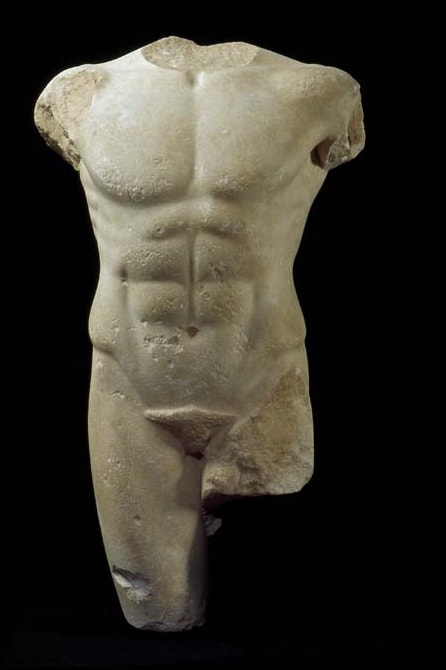 Male Torso (Anatolia) c. 500 B.C. False Start in Art School With George Segal’s white plaster figures Serving as my model, I sopped a friend In the clothes he was trapped in for hours As I tried to pry them off, scissoring a seam Through which I might husk him, The plaster fastened to the hair on his legs. “Do what you must” the mock-comic Response after I’d stuck him, drawing blood, And asked if he’d rather that I stopped. Introduction to Sculpture’s major project, Which I’d pretty much now botched. If I had it to do over again, I’d torso him In short sleeves and gym shorts and hand in My update on the amputated relics We’d studied in Art History class-- An archaic Apollo of free-standing cloth To set before racks of dusty amphorae. Either way, I’ll still have stopped painting, A few years out of Art school, To make my slow way instead among words. Robert Gibb Robert Gibb's books include After, which won the 2016 Marsh Hawk Press Poetry Prize, and Among Ruins, which won Notre Dame’s Sandeen Prize in Poetry for 2017. Other awards include a 1997 National Poetry Series title (The Origins of Evening), two NEA Fellowships, a Best American Poetry and a Pushcart Prize. A new book, Sightlines, winner of the 2019 Prize Americana for Poetry, will be published in January 2021.  Here it is, at last! Our first anthology! Download your free copy below! Our goal is to make The Ekphrastic Review and this ebook anthology of talent go viral. Will you help? Please share this free book with your holiday list, on your Facebook pages, on Twitter, Youtube, in your writing groups, with your students, on your website, everywhere! This anthology celebrates five years of The Ekphrastic Review. Thank you to all of our writers and readers for making this amazing journal and community possible! 
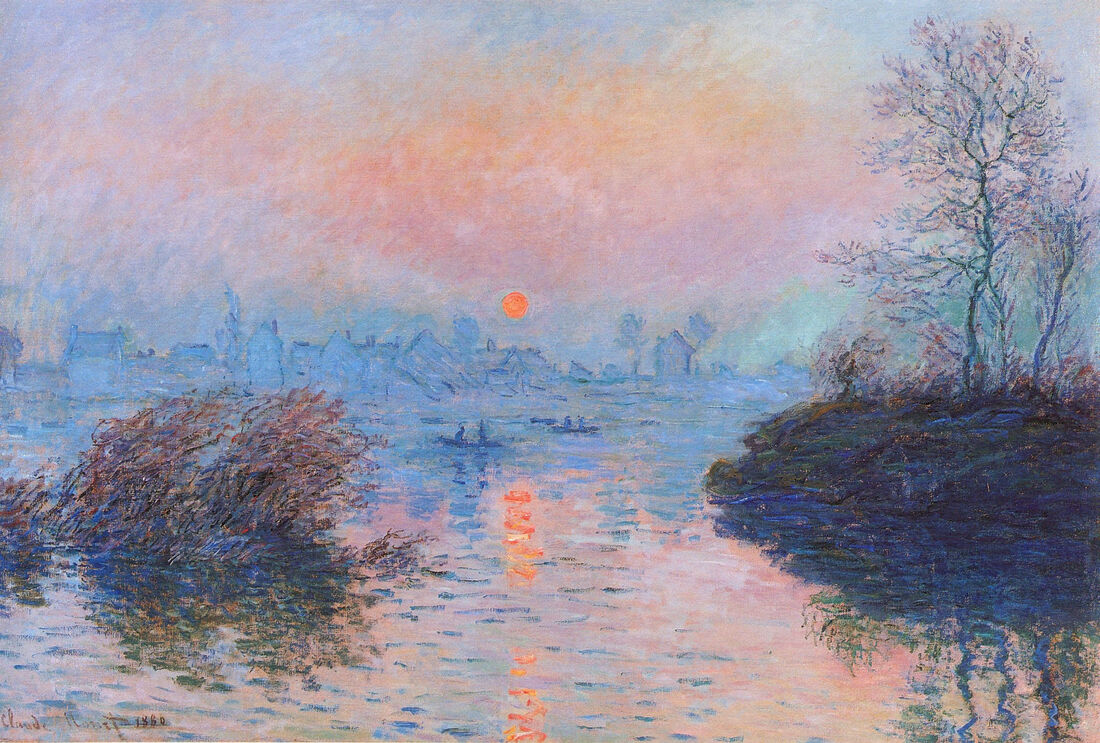 Sunset on the Seine at Lavacourt, Winter Effect, by Claude Monet (France) 1880 سیاہ اور نیلا ساحل سمندر ایک ناممکن گلابی اور چاندی رنگ کا آئینہ بن گیا، وہ چند مزید گھڑیوں کے لئے ان اندھیروں کو روک رھا تھا جو دن کو نگل رہے تھے۔ ایک خنکی پانی پر چھا گئی، اور دھیرے سے میرے گلے اور انگلیوں کے سروں پر سرگوشی کرنے کے لئے رکی۔ میں نے اپنے تھیلے کو ٹٹول کر چادر نکالی، اور اپنے کندھوں پر پھیلا لی۔ میں چلتی رھی۔ یہ ہی پانی، سورج تلے، سیاہ یا چمکتے ہوئے تیکھے نیلے رنگ میں بدل سکتا ہے۔ سرد موسم میں یہ بلور کی طرح جم کر میلوں لمبا تودہ بن جائے گا۔ اس کے شمالی ساحل دوا کی پرانی بوتلوں کی طرح گہرے سبز، یا اکتوبر کی طرح سرخ اور نارنجی کے بھی ہو سکتے ہیں۔ لیکن آج کی رات یہ چھوٹے بیلے رقص کے جوتوں کی طرح ہلکی نیلی اور گلابی ہے۔ رات شائستگی سے چھاتی ہے، روشنی گونجتے ہوئے جب تک کہ غائب نہ ہو جائے، چاند آسمان میں نقش ہو جائے۔ Transliteration:
Siyah aur Nila Sahil-e-samundar ek na-mumkin gulabi aur chaandi rang ka aaeena ban gaya, woh chund mazeed gharyoon ke liye unn andheroon ko roak raha tha jo din ko nigal rahe the. Ek khunki pani par chaa gayi aur dhere se mere gale aur ungleoon ke siroon par sargoshi kerne ke liye rukein. Main ne apne thele ko tatool kar chaadar nikali, aur apne khandoon par phela li. Main chalti rahi. Yehi pani, suraaj tale, siyah ya chamakte huwe tikhe nile rang mein badal sakta hai. Sard mosaam mein yeh bilwar ki tarah jam kar miloon lamba todah ban jaaye ga. Iss ke shumali sahil dwaa ki poraani botaloon ki tarah gehre sabaz, ya October ki tarah surkh aur naaranji rang ke bhi ho sakte hain. Lekin aaj ki raat yeh choote ballet raqs ke jooton ki tarah halki nili aur gulabi hai. Raat shaistagi se chaati hai, roshni goonjte huwe jab tak ke gayab na ho jaaye, chaand aasman mein naksh ho jaaye. Black and Blue The beach turned an impossible pink and silver mirror, resisting for just a few more minutes the shadows swallowing the day. A coolness spread across the water, stopping lazily to whisper at my throat and fingertips. I fumbled in my bag for a shawl, drew it across my shoulders. I kept on walking. This same water can turn black, or blaze bright blue in the sun. In winter it will freeze crystal white and turn into a glacier for miles. it can be the murky green of old apothecary bottles, or red and orange to match October on its north-most shores. But tonight it is baby blue and pink as a ballet slipper. The night descends softly, light echoing until it’s gone, moon painted into sky. Lorette C. Luzajic, translated into Urdu by Maraam Pasha and Saad Ali. The English version of this poem was first published in Pretty Time Machine, by Lorette C. Luzajic (Mixed Up Media Books, 2020.) Maraam Pasha (b. 1999 C.E. in Lahore, Pakistan) has been raised in Rawalpindi & Islamabad, Pakistan. She earned her Bachelor’s degree in Accounting & Finance from the National University of Pakistan, Pakistan. By profession, she is a Marketing & Communication Executive, and now works at Mob Inspire, USA. She has been published in The Ekphrastic Review. She finds literature a way to connect with both herself and others. Her other interests include: photography, painting, music, travelling, baking, and sculpting. She shares her artistic creations on her page: www.instagram.com/maraam_pasha. Saad Ali (b. 1980 C.E. in Okara, Pakistan) has been brought up in the UK and Pakistan. He holds a BSc and an MSc in Management from the University of Leicester, UK. He is an existential philosopher-poet. Ali has authored four books of poetry i.e. Ephemeral Echoes (AuthorHouse, 2018), Metamorphoses: Poetic Discourses (AuthorHouse, 2019), Ekphrases: Book One (AuthorHouse, 2020), and Prose Poems: Βιβλίο Άλφα (AuthorHouse, 2020). He is a regular contributor to The Ekphrastic Review. By profession, he is a Lecturer, Consultant and Trainer/Mentor. Some of his influences include: Vyasa, Homer, Ovid, Attar, Rumi, Nietzsche, and Tagore. He is fond of the Persian, Chinese and Greek cuisines. He likes learning different languages, travelling by train, and exploring cities on foot. To learn more about his work, please visit www.saadalipoetry.com. Lorette C. Luzajic is an award-winning, internationally collected visual artist. She is also a widely published author who usually writes about art. She is the founder and editor of The Ekphrastic Review. Visit her at www.mixedupmedia.ca. |
The Ekphrastic Review

COOKIES/PRIVACY
This site uses cookies to deliver your best navigation experience this time and next. Continuing here means you consent to cookies. Thank you. Join us on Facebook:
Tickled Pink Contest
April 2024
|
||