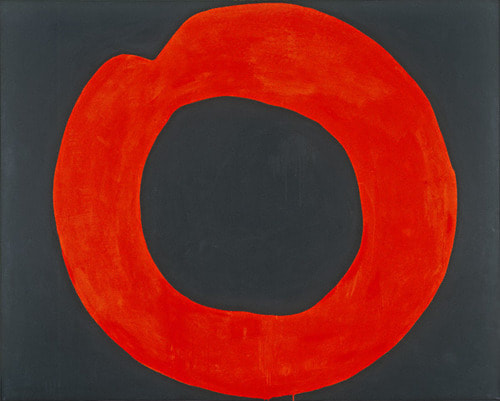
 Red Circle on Black, by Jiro Yoshihara (Japan) 1965 Red Enso The wind blew clouds across the sky in rapid scrawl as streaks, puffs, and stacks—semaphores written across the landscape of Himalayan peaks, shrouded then revealed—I longed for one last glimpse of Mount Kailash before I climbed into the car, the flaps of my cap beat against my ears but held my hair inside, no strands whipped my face, but I could not walk to the open car door yet, I turned to my Ama-la, prayed this wouldn’t be the last time I’d see her, when the sun suddenly appeared. Everything fell still into the blue sky. Mount Kailash appeared. Ama-la clutched her apron, afraid to wave, I ran to her and held her tight. She embraced me. I shut my eyes tight, dots of light appeared against the red skin of my eyelids. I tucked my head into her shoulder and saw single red circle. I had not seen this circle with eyes open, now only one image appeared, not two, not one for each shut eye, but a single image, I wondered why with both eyes closed I didn’t see two images, but instead this single red ring as though painted purposefully by one hand, then I heard my mother’s voice: “Jampa my love, it is this circle of love that keeps us together whether perfect or imperfect, and I know you have seen it as I do with my eyes closed. We will never be apart in mind, only by distance, and you will always be my child, my beloved boy, though I must let you go, your journey from here may seem to go into a line of an unknown future, or an arc from young to vigorous adult, then to old, or as a series of circles, morning to night to next morning to night, that elapses in days, or months, year after year, but at the end of your life, this circle will tie you onwards to the next time you return, even when you take your last breath, you might recognize me as someone you knew before, I might be your child next time, so do not miss me. In parting, we'll meet again.” Annie Bien Annie Bien has published two poetry collections, flash fiction, and a pamphlet, Messages from Under a Pillow, that includes her own illustrations. She is an English translator of Tibetan Buddhist scriptures. Forthcoming is a historical novel on the Sixth Dalai Lama, co-written with Robert Thurman. https://www.anniebien.com/ ** To Jiro Yoshihara Regarding Red Circle on Black art renewing life reflecting -- imperfectly -- life renewing art Portly Bard Old man. Ekphrastic fan. Prefers to craft with sole intent... of verse becoming complement... ...and by such homage being lent... ideally also compliment. Ekphrastic joy comes not from praise for words but from returning gaze far more aware of fortune art becomes to eyes that fathom heart. ** Obsidian Bold boiling lava hits icy ocean cold as mistrust misunderstanding and all other mis- It all happened too fast No time for crystallization Sharper than diamond and surgeon’s steel blade A giant black tape 0n the mid-melt mouth of the ocean Jiang Pu Jiang Pu, Ph.D., is an author, editor and translator of many textbooks, literature and children's books; and is the founder of NextGen Education. Her recent poems have appeared in California Quarterly, Caesura, Topical Poetry, among others. She grows a bee & butterfly garden in the San Francisco Bay Area. Her first name means "a big river". www.jiangpu.org ** Choose You must decide-- inside or out. All black. That will ooze buckets about who you are—what spills and what is con- tained. Do not get seduced by the O ring—crimped. Choose your purgatory. Jay Brodbar Jay Brodbar: "My family here in Toronto and my writing practice are my two pillars, the latter getting a boost in coping with isolation in the time of plague. I have published in various journals including McGill Street, Parchment, Reform Jewish Quarterly. My poem, What We need Beyond the Pale, appears in the Poems in Response to Peril: An Anthology in Support of Ukraine, with proceeds going to PEN Ukraine." ** Only Night Knows For Sure A circle blazing orange-red against darkness. Snake aflame in the matte-black night. Fireworm corkscrewing through midnight-blue water. Night as it passes through the orange-red, crackling circle in Yoshihara’s painting like words an ear picks from the crackle of a flame. From the ravings of sooty beaks. A rave of ravens. Gathering secrets tucked beneath ebony pinions, clucked about in small talk and inuendo. What does night know of me as it pulls me through that circle? Pulling me by the eyes through an illusion of motion in the painting. Are they words as snake venom, which can stop a heart? As the neurotoxin in fireworm spines, setting the world into a tailspin when brushing past? My wife says I dwell too much on words and things passed long ago. Wheel in a rut. But can a circle go anywhere other than back as it moves forward? Follow the tread—a line of burning blood—and look at how it falls back onto itself over and over again. Recollections on an axle. Rumors turning. A conspiracy of ravens, gossiping within earshot. A scorching circle. The circle in the painting, going nowhere and round and round. My mother says, from among the dead, that I dwell too much on the pain of the living. It’s like the poet who says he’s studied and become intimate with the speed of darkness.[2] So fast it’s always here, coming from nowhere.[3] Circling in an ocean current. Burning at the slightest touch. Gravity pulling continually from the hole of a circle. On a current of air, caught in a feather. As if the cells which compose the hole crackled, ready to take the cells which fashion the circle with them. On a current of breath. A treachery of ravens, gathered and cackling. Glistening black marbles in feathered heads, taking in the entire world. Black news caught in crystal balls. My father says there’s something inside the hole, but best not to look too long or too deeply into it. A circle burning through the black background of a painting. A reverse brand, seen from under the skin, searing. Marking its own. The fireworm lands and the tingling from its spines begins. My brother looked long and red into the blackness of that hole, peeling apart its layers, before he finally fell through it. He’s still falling. I hear him in an owl’s screech. In the grinding rust between axle and white-enameled steel wheel on a red child’s wagon. The wheel turns, revolving around dead things, as ravens are wont to do. Searching with the whole eye. With the hole in the eye. The hole beneath a fiery brow. Night knows about this. About him. Is he why I fear waking in less than utter dark? In the turning of a worm—a word? —something burns through and is carried, floating. Playing the circle where it lies, in the truth toward which a golf game would return? My wife, who used to play golf, says to hit the ball and move on—the circle will take care of itself. Circle at the game/s end. Reversing, circling back as if gazing deeper at a painting. Raven in the hole at the circle’s core, cawing for the others in its unkindness. Trickster, roosting in the hole of my circle, pulling with its beak. The caw in the morning, an orange-red tear though myself. Is it actually the night wanting me back? Is it my brother wanting me back? Better to play the ball, move on. Jonathan Yungkans Jonathan Yungkans finds time to write while working as an in-home health-care provider, aided by copious amounts of coffee in the early-morning blackness. His work has appeared in MacQueen's Quinterly, Synkroniciti, Unbroken and other publications. ** Red Circle on Black Here against the black background of grief Love inscribes itself in a red circle which grief can never swallow. As long as I remain in that red circle eternally, darkness will not cover me. Elissa Greenwald Elissa Greenwald, a retired English teacher, now prefers writing to reading. ** The red ring is perfectly imperfect: a universe expanding, contracting, breathing a heartbeat an umbilical cord a circumcision a tick’s bite bulls eye unleashing a crippling palsy the burnished brass plucked on a carousel ride with cackling cousins a secured seal - what no human may tear asunder Grandma Flo’s jiggly, canned fruit filled bundt Jello mold cupping marks - a practice that failed to clear the fluid in time an unknowable centre adrift in the black of everything else Jeffrey G. Moss Jeffrey G. Moss was born and bred in Brooklyn, USA. After 32 years guiding 13/14 year olds in crafting their worlds he has finally started following some of his own writer’s advice. His creative non-fiction has appeared in Bending Genres, Cagibi, Hunger Mountain Review, Under the Gum Tree, and Hippocampus. Find him on IG @jeffgm. ** Temptation of the Circles Everyone at home was eagerly waiting for Diwali—Indian festival of lights which adds extra sentences to autobiographies and school essays every year. The walls of home had become fierce like Allen Ginsberg’s “Howl.” The old paint had already started falling off the walls like the cascade of descending swaras. Festival brings offers, bonus and loans. Father had applied for a festival loan from his office to purchase paint. The good news was that his officer’s pen tagged Rescued screamed on the paper—-‘sanctioned.’ Money was drawn, paint accessories purchased and furniture was weaponed with tattered and unusable bed sheets, newspapers so as to protect it from falling wet paint. The room was already ready yesterday and whitewashing had started. Now what next? The next threat was Vani. Vani was their two-and-a-half year old naughty baby girl. They already knew about her unexpected quirks. Just six months back she graduated from crawling, zigzag to perfect walking. And see now—-she’s gliding! Her round, eyes on her round face reflect infinite energy! She would live like a butterfly hovering around every flower of the garden. At one moment she’s on the window pane at another she’s at the diwan. She would fall down, rehearse again, cry and laugh again, and then again run—-laughing, falling, jumping—- bare foot. All holes tempted her. Many holes are circles after all! Compelled by her instincts she’d go happy around inserting her fingers in running-electric-sockets or any other empty spaces she would come across, sometimes even hers or father’s nostrils. The pet Jimmy had mixed feelings of love, subordination and scare for her as once she startled him by putting her finger in his bum when he while asleep and was already being sniffed by one of his street opponents, in dream. While exploring her senses, yesterday, she poked her fingers on the newly painted wall. Two times she spoilt the paint. What can she do? Colours fascinated her. “Pappa..pappa…gimme colours papa,” Vani babbled, her eyes already hypnotised with ‘her’ expected answer, present in future, “Yes. Yes. Why not Vanu. These all buckets are for you Darlo.” The father turned towards mother and instructed with a flat high tone (mainly the first one) you only find in Mandarin, “You’ve to take care of this monkey before she spoils everything. I told you to send her to the play school but you denied. You never do what I say.” Listening the word ‘school’ Vani clenched mother’s legs and looked at the father through the green ripples of her sari. Mother caressed Vani with love. "She’s not even three. Don’t you remember how uncontrollably she cried when we sent her once?” Mother instructed Vani to bring her notebook on which she could write with a pencil. Vani ignored the pencil-book-idea and made herself invisible behind the door from where in half crying tone she kept insisting on dripping her fingers into the bucket of paint. Suddenly accompanying the drizzling sky, the Sun came to a position where it could enter the room through the window and reflect the mixed colours kept in the bucket forming young handsome rainbow on the white wall. “Alright Mom, pencil. Gimme one,” Vani babbled in a language which only her mother could translate. But there was no reply. Father had gone out to bring thinner for the paint and mother had gone to the veranda to collect wet clothes from outside. Vani knew that it’s ‘the’ opportunity. She ran towards her coveted aim like the best female sprinters of the would-be The Paris Olympic— 26 Jul, 2024. Like a philosopher holding his jaw on his hairy paws, Jimmy gazed suspiciously at her activities, hiding his ipseity with his fluffy tail. Vani inserted her fingers into the paint tub and scribbled circles on the wall depicting something which only she or her God knew. Droplets of colour poured on her arms, nostrils, lips and everywhere around the floor. She painted many many circles. Every circle was different. Enchanted by the magic of circles she made, she would poke her finger in the middle of it. She went on and on, destabilising centres, unexhausted. That wall was now an admixture of beauty and beast. After a while mother came inside. She saw Vani and the wall, the whirlpool of colours around her. Her mouth opened agape, the wet cloths she held on her shoulder fell down with a thud of Newton’s apple. She went running towards her and yelled, "Vani! Vani!!" Sandeep Sharma Sandeep Sharma is an Asst Prof of Comparative Literature at Government College, Diggal (HP), India. He is Associate Editor of the journals In Translation (Université Badji Moktar de Annaba) and Traduction et Langues (University of Oran 2). He received the Award of Academic Excellence (2022) by the Arab Translators’ Association for his contribution to research and linguistics. He has published his works with Impspired (UK); SIL International (US);The Yellow Medicine Review (Southwest Minnesota State University); PoetryXHunger (Maryland State Arts Council, US); Southwest Word Fiesta (Silver City, New Mexico); Lothlorien Poetry Journal (US); The Anguillian (Anguilla); In Translation (Algeria), HP University (India) and so on. His book on Translation Studies is made available as a reference book in the universities of Africa, Ukraine and India. His page, with 277k viewers, remains at the top 1% position on academia.edu. Here is the link to the page https://hp-in.academia.edu/SsandeepSharma ** caught in the crossfire he is a volcano threatening to erupt a gasp of thin-red-lipped fear a bloodshot eye on high alert a cigarette burn on flaky skin a target ripe for a sniper’s gun a hole in the heart erasing love a petalless poppy weeping blood a scarlet wreath laid at his feet Kate Young Kate Young lives in England and enjoys writing poetry, painting and playing the guitar and ukulele. Her poems have appeared in various webzines, magazines, and chapbooks. Her work has also featured in the anthologies Places of Poetry and Write Out Loud. Her pamphlet A Spark in the Darkness has been published by Hedgehog Press and her next pamphlet Beyond the School Gate is due to be published in the next month. Find her on Twitter @Kateyoung12poet. ** Onxy Mood O stony sorrow O sorry loss O loop too hollow O no tomorrow O woozy cocoon O poppy knot O ghostly blotch O cold clock stop O cross fox howl O owl scorn dollop O phlox blossom spool O sky myrrh-blown O bloodshot body O scorch of pox O colon clot O lot of horror O shock of drool O snort of rot O joy forgot My bowl of soot Helen Freeman Helen has poems published on various sites and magazines and regularly submits to The Ekphrastic Review. She currently lives in Durham, England. Instagram @chemchemi.hf ** The Nip Stare at red circle on black for mere minutes, then look away to a white wall. The image reverses, rehearses. Red turns green, black urns white. Boundless roundness. Rods and cones, my brain moans and gives up, spluttering, gasping for air. In the blink of an eye, the wink of trying to change things. Infinite jest, circle with a nip taken out by a hungry universe. It’s not perfectly round, more human, with foibles. The caged circle too contained by the dark. Chipped like her toenail polish, tonal dripping with blood. Wild and pacing, bracing for an escape. Never turn your back on the circle. Red eyes flashing in the dark. Lynne Kemen Lynne Kemen lives in Upstate New York. Her chapbook, More Than a Handful was published in 2020. Her work is anthologized in Seeing Things (2020) and several others. She is published in Silver Birch Press, The Ravens Perch, Fresh Words Magazine, Spillwords, Topical Poetry, Lothlorien Poetry Journal, and Blue Mountain Review. Lynne stands on the Board of Bright Hill Press. She is an editor for the Blue Mountain Review and a lifetime member of The Southern Collective Experience. Her book of poetry, Shoes for Lucy will be published in 2023 by SCE Press. ** Poet’s Wudu Unroll the prayer rug. Surrender to surrender. Kneel in the pew, needing to be kneaded. Settle on the cushion cross legs close eyes. Bow begin the kata yin leading yang arrive where time neither ticks nor tocks feel the hand of Author True holding the pen of your life. Mike Wilson Mike Wilson’s work has appeared in magazines including Amsterdam Quarterly, Mud Season Review, The Pettigru Review, Still: The Journal, The Coachella Review, and in Mike’s book, Arranging Deck Chairs on the Titanic, (Rabbit House Press, 2020), political poetry for a post-truth world. He resides in Lexington, Kentucky, and can be found at mikewilsonwriter.com ** Blind Spot Early Christmas Day, she catches a glimpse of an unwanted gift: a grey dot, lingering like some weird charcoal patch, stuck over her right eye. It blocks her stars’ jazzy blues. It steals a host of angel shapes. It snatches the tree-lights’ dazzle. All she can see is a bright red halo, filched from Santa’s hat, beaming back at her like a Bloody Mary, half-drunk. Dorothy Burrows Based in the UK, Dorothy Burrows enjoys writing poems, flash fiction and short plays. Her work has been published both online and in print journals. She often doodles in circles. ** 無限 (Infinite) by squaring the circle, this unaccustomed stroke of artistic notion unknown by many a man you wonder if they’ll understand your dab of red on black as conjured in your mind avant-garde, you hope they exclaim as impasto flows by many a field and fallow but time will tell, you know as for all innovative lexes you ARE a pioneer of vicissitude in the realm of the inured *** oh, unblemished stillness unfolds in my mind as I try to fathom how it feels to be liberated from the shackled chains of the unyielding traditions in this Self of cyclic effort we call the perpetuation of Life Andrea Damic Andrea Damic born in Sarajevo, Bosnia and Herzegovina, lives and works in Sydney, Australia. She’s an amateur photographer and author of prose and poetry. She writes at night when everyone is asleep; when she lacks words to express herself, she uses photography to speak for her. She spends many an hour fiddling around with her website https://damicandrea.wordpress.com/ ** What my heart yearns for now. L. She's only 6 years old but she swings the fire poi like a pro carving a perfect red right angle into the November blackness. Wrists and elbows flick sharp, fluid. She's Zorro. My heart is so full it could burst the Thames Barrier with an ocean of bluebells, king- fishers, Finding-Nemo-fishes, with an ocean of electricity all around the w w w w w w world. O. She's only 6 years old but she has the poise of a pro swooshing a perfect red circle through the November chill. Her arm spinning from her shoulder. My heart is so full of pride Scottish pipe bands march up my arteries, with kilts and drums. Red sparks light up face-painted faces eating toffee apples. Red sparks light up sheets of copper for the copper-bowl-beating. She lassos us all together with a perfect red circle of molten candy strawberry, raspberry, cherry. V. She's only 6 years old but she can write with molten glass in the air. She can spin and swing and change direction abruptly. Making a succession of red ticks, flick-booking on my retinas. My nostrils breathe smoke from the bonfire breathe cider, lentil curry, roasted pumpkin. In the distance snatches of sound from the singing workshop - chanting, clapping, laughing. My heart is a Venetian kiln full of Murano an Armada, a coastline of blazing beacons. Her fire trails whip us all together into a Big Top, into trapeze and clowns and elephants and funfair, into a circus. e. She's only 6 years old but she can spiral fire like candy floss like Celtic writing, like scarlet ribbons. Buzzards are mewing overhead. Clover and vetch grow under her toes. Red deer watch from the larches at the ruined monastery. She loops her red threads around us tying us all together, over and over. We hold our breath, scrunched up like empty packets of crisps in tight fists. Our hearts leap across the night, leap through my daughter's hoop of flame. saskia ashby saskia ashby is a UK visual/performance artist and poet. ** stillness [inhale] 1 2 3 4 [exhale] 5 4 3 2 1 [breathe]. ### Tonka Dobreva Tonka Dobreva is a writer and Christian life coach. Her work has previously appeared in Ekstasis Magazine and is forthcoming in The Amethyst Review. ** Ebb and Flow I chase my cousins into the laundry room. They shriek in laughter, tossing a wad of clothing back and forth, stashing it into the dryer, but I manage to peel away their fingers from the metal door—and it’s in that moment as my twin cousins have collapsed onto the floor with laughter, and I hold, triumphantly, a soiled piece of clothing--that I find out what menstruation is. I don’t remember when I first got my period. The doctors always ask me that, and so I estimate: middle school, 12 years old. For my mother, it happened in gym class. White shorts. Somersaults. Eternal embarrassment. She still winces when she tells the story. I’m diagnosed with PCOS–Polycystic Ovarian Syndrome–in college. Irregular periods, extreme pain, blood-clots-larger-than-a-quarter. But my breaking point is my first year of teaching. My roommate and I joke about how that first year begins to mirror the 10 Plagues of Egypt: lice, mice, and a three month long flood of blood. And it is a gush. I use triple layers of protection: super tampons, bedtime extra-long pads, specially designed period panties (black) that should never go in the dryer. I give up on wearing jeans and stick to black slacks. I stash tampons and pads everywhere—in my car, the bottom drawer of my desk at work, my purse, the pocket of my backpack. I drive with a towel over the seat of my car. I set alarms for 3:00 in the morning to remind me to take a pain killer or else I’ll never uncurl from the covers at 6:00. When my gynecologist appointment finally comes, my doctor warns me that if/when I try to have kids, it may be difficult. To solve the issue of my never ending period, she prescribes medicine to make my body shed all of the lining of my uterus. I cannot understand how there is still tissue and blood left to be sloughed off. But yet, somehow there is. The shedding continues a month into taking birth control before, finally, the madness ends. In the third year of trying for a baby, I buy the expensive digital ovulation and pregnancy tests because I can’t take the color game anymore. I need the shock of the answer in harsh, black lettering to believe it. No: you are not pregnant. No: you are not ovulating. Late at night, I google for hope: when will I ovulate if my cycle is 35 days long? 40 days long? 42? How heavy is implantation bleeding? How many days does implantation bleeding last? My period—both the lack of one and its reappearance—betrays me. In August 2022, the doctors inform us that my husband is missing something in his DNA; he can’t and will never be able to produce sperm. We both stop taking fertility medicine. We stop counting days and measuring colors and debating names. Instead, we research sperm donation, adoption, fostering. We cry. We question. We make depressing art. We vent about all the well-meaning nonsense we’re told. We promise to adopt a dog when Summer comes. We kayak in tandem and bicker about taking turns paddling. We dream about going on a cruise around Japan. We navigate the Chattahoochee River’s rapids and rocks in inner tubes, flip out into the two feet of cold water—and cackle as other pink and green tubes bump helplessly into us. And eventually, we loosen our grip on the grudges against our bodies. Annalee Simonds Annalee Simonds writes creative nonfiction, fiction, and poetry. She dares her high school students to use semicolons and em-dashes in their own writing. When she's not teaching, she dabbles in watercolour. She grew up in Georgia, but now lives in Utah. ** Red Circle on Black Target with no center. Big apple without core. Aimless fruit in sleepless city. Bruised, but given to the poor. Laura Gunnells Miller Laura Gunnells Miller is a writer in southeast Tennessee who enjoys exploring rural backroads and creating travel photography books. Her poetry has been curated by Artemis Journal, Pine Mountain Sand & Gravel, American Diversity Report and other publications. ** Into the Darkness Graves under a November sky, dark memories of wilting poppies, red blood, black mud, flooded trenches. Mouths without faces, bodies without limbs, fingers,arms, feet; here a skull lingers. Scarlet tissue in a lunar landscape, the dark side of the Moon. Rings of fire, of sacrifice, of heroism, wreaths of poppies, pride, pomp, patriotism. Beyond - vacancy, darkness, the wronged wait in the blackness, the nothingness of oblivion, for the glorious mirage. Stateless, without passports, nameless, awaiting that other, promised country on which the sun never rises. Sarah Das Gupta Sarah Das Gupta is a retired teacher living near Cambridge who also taught in India and Tanzania. She started writing last October after a stay in hospital, following an accident. Her work has appeared in many magazines and anthologies from ten countries, including US, UK, Canada, Australia, India, and Nigeria. Writing has been instrumental in learning to walk again. ** Can 0 Be More than Zero? Sometimes she pushes against the notch in the red ring, thinking it’s a hinge that will open to possibilities, but it doesn’t budge. + Sometimes she stands on a red cliff looking into the black face of a volcano, tired of trying to be chill. + Sometimes she walks in circles at the bus stop, creating the red strokes of a Japanese brush painting, but the bus never comes. Sandi Stromberg Sandi Stromberg’s full-length collection, Frogs Don't Sing Red, was published by Kelsay Books in April 2023 and includes several works nominated for a Pushcart Prize and Best of the Net. Most recently, her poetry has appeared in The Orchards Poetry Journal, Panoply, San Pedro River Review, MockingHeart Review, Sappho’s Torque, The Ekphrastic Review, Waco WordFest Anthology: MOON, and Unknotting the Line: The Poetry in Prose. She is an editor at The Ekphrastic Review. Her poetry, translated into Dutch, can be found at Brabant Cultureel and at https://wwwtransito-ah.blogspot.com/2023/07/sandi-stromberg-vak-27-graf-no-66.html. ** Unborn Eye After Jiro Yoshihara After Tomas Transtromer First thing What do see? What do see, before re-entering? Somewhere back in the iris dark, Still joining the stars. What do see before yesterday returns, Wearing reverential all white, The lining of a black suit worn inside Out, as day is to night. What do see see uncorrupted with your Unborn eyes? Quick, someone is coming, remembering. Christopher Martin Christopher Martin is a poet and Buddhist living by the mouth of the Tyne on the north east coast of England. His work has featured in various publications and events. His debut collection is due out 2024 @theblackcatpoetrypress. ** Blast Crater The surrounding perimeter formed a closed curve, rim still aglow with heat from the mountain of smoking rubble that had collapsed into its epicenter. Hot ash covered everything and hung in the air like a plague of sand flies, biting, blinding. We could see there were no survivors. Then a mild breeze created an updraft, which became a whirlwind whose writhing column soared far into the heavens. We prayed it was loaded with souls at peace. R. A. Allen R. A. Allen's poetry has appeared in the New York Quarterly, B O D Y, The Penn Review, RHINO, The Los Angeles Review, Maier Museum of Art Journal of Ekphrastic Poetry, Alba and elsewhere. His work has been nominated for a Best of the Net and two Pushcarts. He lives in Memphis, a city of light and sound. bodyliterature.com/2020/02/17/r-a-allen/ ** monoku 1. not a perfect red circle, like existence itself gembun 2. the black seems more like storm clouds when red is circled within a black background... how brilliant the sunset haynaku 3. enso sacred circle black creates red Daniel Brown Daniel Brown has just published at age 72 his first collection FAMILY PORTRAITS IN VERSE and Other Illustrated Poems published by Epigraph Books. He has most recently been published in Jerry Jazz Musician and Chronogram Magazine and has been included in Arts Mid-Hudson gallery presentation Poets Respond To Art in Poughkeepsie, NY. ** Aubade with Circle Game after Joni Mitchell Someday I’ll love the bottomless swamp. They will tell him take your time… which means to begin by contemplating a dot, and then to reflect on a line wiggling as a sparkling redfish that spirals close to a dark-blue boat drawn off the coast, beaches with plenty of compact sand, throwing perfect, an auburn frisbee feeling like vinyl, an LP ready to needle the future, then gulf fallen, but recovered by your lover’s hand when the sky was full with high cloudlets. Despite the sloppy throws and blisters, you keep throwing. And catching, captive on the carousel of time… I’ll eventually love August, days dripping by. And the seasons they go round and round. And the frontier of a small radio, jostling the antenna to work—clothes as costume—before wonder, before we caught a dragonfly inside a jar. Cartwheels thru the town. Round with decent looks, and later, we escape the escape room masquerading as an art gallery full of painted ponies we press fingertips on. Lights dot up lines under a starry night to reveal clues which help secure the Declaration of Independence and unscramble wooden blocks to spell: teamwork. A hidden door unlocks. We can’t return we can only look. Yes, I love kissing farewell to old, traditional paint, monsters left inside at palace altars. Dear, let us throw our gentle bodies into the swamp. Peat forms coal, fuel for the simple gesture of joining together, sheets of someday. No, dreams don’t lose their grandeur of coming true… Oh, for the elusive, pristine circle. John Milkereit John Milkereit resides in Houston, Texas working as a mechanical engineer and has completed a M.F.A. in Creative Writing at the Rainier Writing Workshop. His work has appeared in various literary journals including Naugatuck River Review, San Pedro River Review, and previous issues of the The Ekphrastic Review. He has published two chapbooks (Pudding House Press) and three full-length collections of poems, including most recently from December, A Place Comfortable with Fire (Lamar University Literary Press).
0 Comments
 What a wild time it was- unbridled creation. Thank you to everyone who participated in our second annual ekphrastic marathon! Every one who tried this fun and gruelling writing event is a courageous soul. Reading the entries birthed during the marathon, and choosing some for this showcase, proved a difficult task, as always. What a wondrous variety of works were inspired. It was not easy to select a few from so many shining jewels. Congratulations to everyone whose work is here. They are in alphabetic order of author, except for the first two, which are the winning poem and the winning story. I am grateful to our editor Sandi Stromberg for her help choosing the winners. Congratulations to Roy J. Beckemeyer for his winning story, "Performance Memoir in Yellow" (which was inspired by two of the prompts!) Congratulations to Karen FitzGerald for her winning poem, "Manuela's First Baby." Let's do this again sometime! Lorette
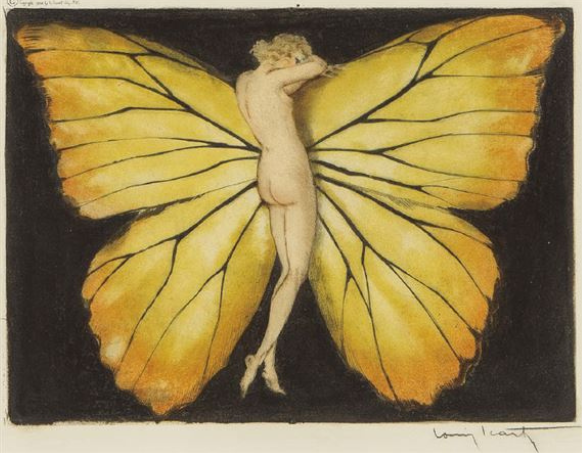
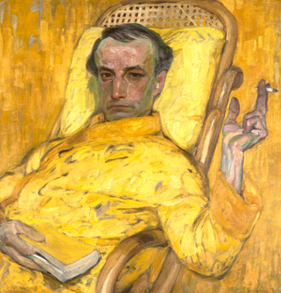
Flash Fiction Winner: Performance Memoir in Yellow He chose to misread her title, announce it as “Woman in the Wings,” so sat, stage left, alone in the spotlight, aglow, smoke curling from his Gitanes, and addressed the audience using his tobacco-thickened accent, described each step in a stage whisper as she danced it: how she unfurled her wings, there just off stage right, crooning “Oh, déployer ses ailes,” how she carefully revealed her slender nudity. Her blonde hair was the color of lemons, she wore the fragrance of Limoncello. He kept track of his place in his autobiography with his index finger, used it to feel the ink on the paper, to trace the words with which he had first described her, first revealed that she was his initial, his inimitable love, first told how his fingers would trace each wing vein from wingtip back to her body, how the wings might have been birthed by Caesarian Section rather than sewn as gossamer puppets, their intricate motions and movement controlled by her tapered fingers. He said nothing about how she eyed him from the cover of her folded arm, how she turned only enough for him to imagine seeing the slight swelling that would reveal her breast if she chose to turn a bit more, how she showed in the way her eyebrow arched to disappear into her cascading hair that she had had enough for one night. He glanced up, raised his own eyebrows, signaled for the lights to be darkened, left the audience only the afterimage of his radiance burned into the rods and cones of their vision, left them feeling (or imagining they felt) a slight swirling of air stirring the hairs on the backs of their necks as she whisked out from beneath the rapidly descending curtain, invisibly danced in midair the choreography he had described only moments before, their hearts aching with longing to see her, yet even then somehow satisfied to simply follow each move by sensing the evolving wake of her wings, feeling the delicate eroticism of his descriptions in the slight movements of air. They sat quietly in the fading golden afterglow of his memories, her ghostly absence, nurturing each recollection as if it now was one of their own. Roy J. Beckemeyer Roy J. Beckemeyer’s fifth and latest book of poetry is The Currency of His Light, (Turning Plow Press, 2023). Beckemeyer’s work has been nominated for Pushcart and Best of the Net awards and has appeared in Best Small Fictions 2019. He has designed and built airplanes, discovered and named fossils of Palaeozoic insect species, and has traveled the world. Beckemeyer lives with and for his wife of 61 years, Pat, in Wichita, Kansas. His author’s page is at royjbeckemeyer.com. 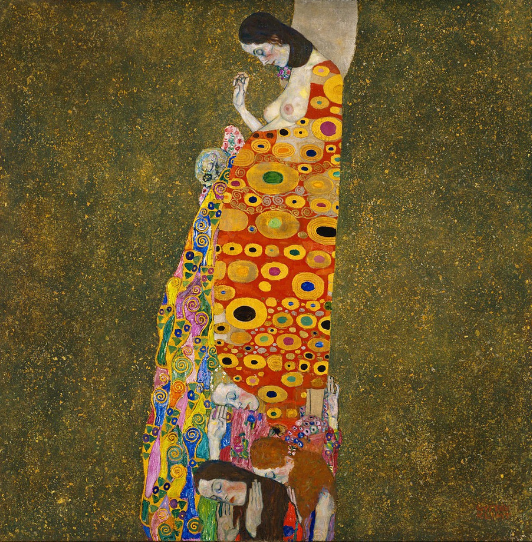 Hope 2, by Gustav Klimt (Austria) 1907 Poetry Winner: Manuela's First Baby While body grows to carry you, my sweet baby, I press down worry and banish fears so that you, mi amada, may flourish in your readiness for my arms. I will cherish each pain that causes you to pass from my body into this world where you will be loved, nourished and named Esperanza. Doubt tumbles from heart like snow from an evergreen. Fertile family tree. Karen FitzGerald Karen "Fitz" FitzGerald is a genre fluid writer. She has an MA in English Lit from Sonoma State University where she was recognized for her work in language centered theories of human behavior (1994) . She currently enjoys the beneficence of The Sitting Room (https://sittingroomlibrary.org) who grants her the privacy of their writing room, under the Redwoods in Penngrove, California. 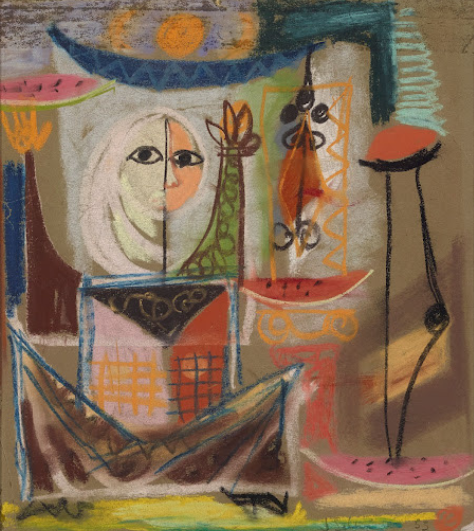 The Watermelon Seller, by Jawad Saleem (Iraq) 1953 Dusk&Dawn in/on the Streets&Roads of Lavapuri For my mother, Mona 1. The street hawker (from up North) continues to sell watermelons on the wooden cart parked right next to a manhole (without a cover)—which is, most certainly, at least a decade older than the fruit seller—shouting: FRESH & CHEAP! 50 Rs per kg! But such catchy sales mantras do not fool a seasoned bargainer such as my mother. 2. A stray dog and a bitch are interlocked; local town boys are throwing stones—even their worn-out Bata flip flops—at the pair to somehow dislodge them. (This scene: a perfect analogy to understand as to why/how the intimate relationships and marriages break and fail in such a social setting.) 3. The reflection of the sunrays off the surface of freshly laid asphalt is as bright as the light being emitted from a white hole; even the most expensive of the Ray Bans can’t seem to offer any respite for the ordeals of the retinas. Never mind missing the red and the amber and the green of the occasionally functional traffic lights—barely installed at the required legal height and distance. 4. The people continue to stick on to their favourite political demagogues like houseflies to sugar. Now they’re carrying our rallies against the “Foreign Intervention”; now they’re conducting protests to condemn the “Inflation”; now they’re organising sit-ins against the “Character Assassination”, and what have you. For a proper escape and/or catharsis, I’d dare suggest, the proper venue is: discos/clubs, pubs/bars, gigs/concerts, cinema, art, literature, poetry, sports, and tourism. 5. Left, right & centre, the check posts have sprung up like the Spring Gardens in the Netherlands! (Cynicism, distrust, and pessimism are the signature traits, here. The society and people are not to be entirely blamed, I suppose—after all, they’ve been played at the hands of the economic hitmen & terror/ism mongers for many, many decades.) 6. Oh, YES!—the clerics are definitely fond of all the (post)modern paraphernalia that The West has to offer e.g. big TV screens, huge-ass SUVs, sexy smart phones/tablets, fast double decker airplanes, can’t-breathe-without SM (Youtube, Metaverse, TikTok, WhatsApp, etc.), scary tanks and fighter jets and kalashnikovs, interest based banking system, and what have you. But at the slightest hint of a critique of their religious dogmatism / fundamentalism, they’re out & about on the roads & in the streets like the deadly swarms of locusts vandalising retail shops, bus stops, and setting buildings on fire—even setting people on fire (under the banner of blasphemy), if need be! Oh, YES!—hypocrisy happens to be a trademark trait of the clerics, after all! 7. The businessmen (far too many), the lawyers (many, many), the generals (many), the academics (merely a handful), the poet (merely a handful), and the philosophers (hardly any) are barely moved by the respective scenes; for, the majority of ‘em have been but only conditioned under such a commonplace. (After all, the in-your-face Social Class System works as the fuel to their raison d'être-fire! The verb named ‘Change’ is as if کفر/Kufr in their sacred books.) Saad Ali Saad Ali (b. 1980 C.E. in Okara, Pakistan) has been brought up and educated in the United Kingdom and Pakistan. He is a poet-philosopher and literary translator. His new collection of poems is titled Owl Of Pines: Sunyata (AuthorHouse, 2021). His work has been nominated for the Best of the Net Anthology. He likes learning different languages, travelling by train, and exploring cities on foot. To learn further about his work, please visit www.saadalipoetry.com. 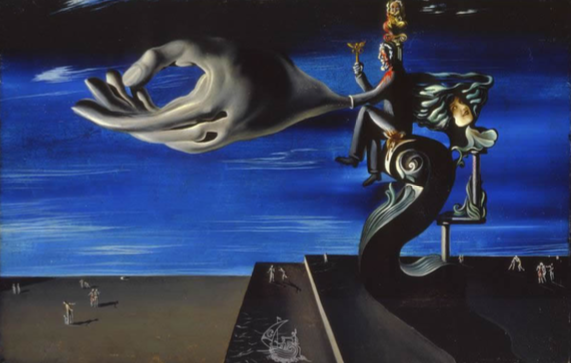 The Hand- The Remorse of Conscience, by Salvador Dali (Spain) 1930 X You offer your dreams like an open palm, cloud-like and beckoning. High above the earthen plane, laden with the people we were, you keep watch in the evening sky, hoping to catch a glimpse of our past selves in the future. But your eyes begin to bleed from the staring. The beauty that feeds your mind in the night causes pain in the light of the rising sun. I know you want to believe in Fate, or, that there’s something cosmic that binds us. I want to believe it, too, and some might say that’s enough. But whatever tie exists between us, it is not meant to bind. Keep my likeness on its pedestal, if you must. I won’t begrudge you that. Just promise me you’ll come down from your mountainous perch, find shelter from the storms in another lover’s arms. Brown with waiting, the torchbearer falls-- God is watching Caitlin M.S. Buxbaum Caitlin M.S. Buxbaum is a writer and teacher from Wasilla, Alaska. She currently serves as CEO of Red Sweater Press, President of Alaska Writers Guild, and is working on her MFA in Creative Writing with Antioch University LA. She is also on the marketing team for Lunch Ticket, Antioch's online literary magazine. Learn more about her and read more of her work at caitbuxbaum.com.  Composition with Red, Blue, and Yellow, by Piet Mondrian (Netherlands) 1930 Love Crate Annie saw red when Jon told her “I just want to be fair and square with you: we’re at different stages in life.” She would bend his jagged thoughts into her straight-line itinerary diamondring-marriage-house-children-dog. She cooked all his favorite food for his meals: shrimp scampi with penne, goat cheese raviolis, pesto fusilli, stuffed him with rosemary pork chops and petits choux with pastry cream until the buttons of his shirt burst and she had to sew him up like a fat trussed goose. She roped him tighter, stowed him in her crate. One by one, she raised the rods to cage him in: no more guys’ night out, no more video games, tracker on his phone leaving only the tiniest square of yellow sun for his freedom. He grew blue, stopped eating until he became thin as a thread, slipped through his prison bars, and disappeared into the sky. Christine H. Chen Christine H. Chen was born in Hong Kong and grew up in Madagascar before settling in Boston where she worked as a research chemist. Her fiction has appeared in Bending Genres, Atticus Review, Visual Verse: An Anthology of Art and Words, and other journals and anthologies. Her work was selected for Wigleaf Top 50 2023, and she is the co-translator from French of My Lemon Tree (Spuyten Duyvil, forthcoming late 2023). Read more at www.christinehchen.com 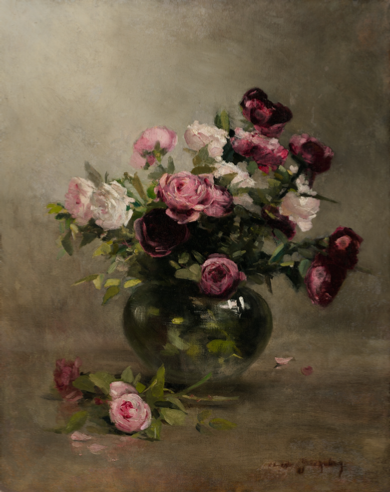 Vase of Roses, by Eva Gonzalez (France) 1870s Fair Eva She is a writer’s daughter, and pictures him tearing pages from his pad, as vapour trails down soaking walls. He demands her to arrange the flowers, and her sister won’t do either: they paint. Early morning, her rosing thoughts direct domestic tea, her bird- eye’s view wins over a master. The salon starts showing her pastels, and she draws on a graveyard of time, fills a vase of passion. Have worlds always been turned down, settings ever so impressive? Colours grow, as petals weather on. She sneaks through careful flowers, and might mark: a men-society opens slowly to a woman. Silk and satin seem not real painting gear, but what climbs over patios, is right what she wants to possess, on purpose. The hope and dream are that she may be captured by collectors, alive, alive. Kate Copeland *Fair Eva is the name of a pink rose. Kate Copeland started absorbing books ever since a little lass. Her love for words led her to teaching & translating; her love for art & water to poetry…please find her pieces @The Ekphrastic Review, Poets’ Choice, First Lit.Review-East, Wildfire Words, The Metaworker, The Weekly/Five South, New Feathers, AltPoetryPrompts a.o. Her recent Insta reads: https://www.instagram.com/kate.copeland.poems/ Over the years, she worked at literary festivals and Breathe-Read-Write-sessions, recent linguistic-poetry workshops were via the IWWG (more workshops in the making). Kate was born @ harbour city and adores housesitting @ the world. 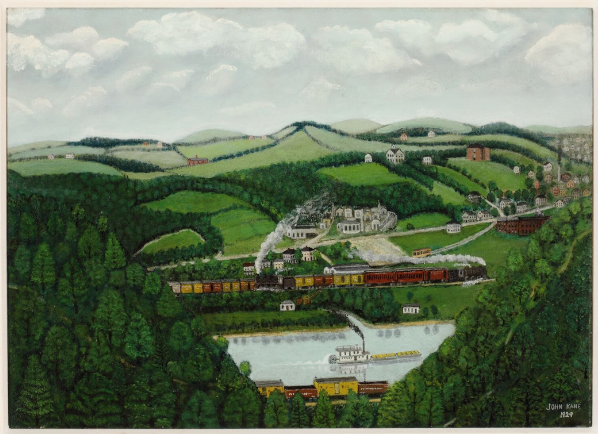 Hills and Rivers, Steamboat at Sleepy Hollow, by John Kane (USA) 1929 Evening Itinerary of Two Septuagenarians We choose our TV dramas from the category “Scenic.” Why not disguise the demise of our own dazzle in someone else’s daydream? Hills drowning in soft mystery of moss, we board a fleeting train and settle into a dance staged long before we began. When the season ends, we’ve already chosen our next couched adventure - descent into Bordeaux’s distilled elegance, camera swooping over wineries castled in stone surrounded by labyrinth fields seducing us with sun stoked greenery, stirring the pleasure pot of memories of a rented car that swept us too between those winding vines of southern France. The plots are incidental, tired trails of handsome men and gorgeous women, the underside of their riches exposed in some tawdry murder. But dozing in the sustenance of our just finished dinner, we are unphased by their decay or the wit of the detective who uncovers all the clues we miss. We imbibe mountains, sunsets, turquoise ocean, sip ever half full glasses of rose. Joanne Durham Joanne Durham is the author of To Drink from a Wider Bowl, winner of the Sinclair Poetry Prize (Evening Street Press 2022) and On Shifting Shoals (Kelsay Books 2023). She finds Ekphrastic writing fascinating and won two awards for Ekphrastic poems in 2023: Third Wednesday's annual poetry contest and the Mary Ruffin Poole Prize. A Pushcart nominee, her ekphrastic poems have appeared in numerous journals, including The Inflectionist Review, Dodging the Rain, and Litmosphere (finalist for Lit/South Award). She lives on the North Carolina coast, with the ever artful ocean as her backyard and muse. https://www.joannedurham.com/ 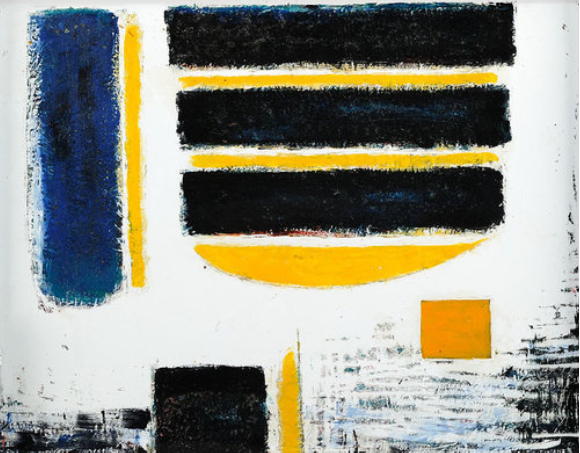 Sailing, by Sargent Claude Johnson (USA) 1950 Peace Offering But what if the sign was a thick slice of layered cake, filled with sweet-tartness of lemon curd? What if you could taste my apology in each bite? Gabby Gilliam Gabby Gilliam's poetry has appeared in One Art, Anti-Heroin Chic, Plant-Human Quarterly, The Ekphrastic Review, Vermillion, Deep Overstock, Spank the Carp, and others. It has also appeared in anthologies from Pure Slush, White Stag Publishing, Black Hare Press, Raven’s Quoth Press, Devil’s Party Press, and more. You can find her online at gabbygilliam.com or on Facebook at www.facebook.com/GabbyGilliamAuthor. 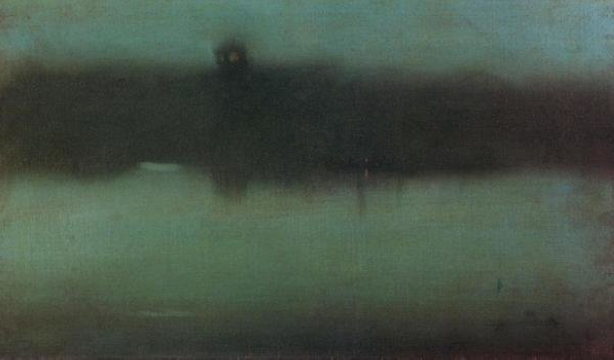 Nocturne in Grey and Silver, by James McNeill Whistler (USA) 1873 All that Disappears the light is almost gone swallowed by clouds sky no longer blue a soup of green and brown day and darkness both the same cars rust in the fields erode in air with birds and trees nothing grows it’s silent here on Earth: glaciers melted oceans filled with smoke and glass empty rivers no voices it’s over Maryann Gremillion Maryann Gremillion: "For years and years I tried to fit in conventional work places that crushed my soul but provided a living. I don't have to do that anymore! Hurray! I am grateful to have found myself. Writing and art matter." 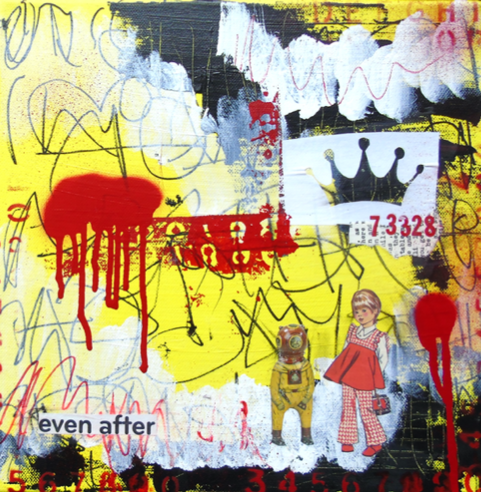 Even After, by Lorette C. Luzajic (Canada) 2021 Even After After the blood pooled and dried and dripped and flowed—because your kitchen floor was built on a slant you always meant to fix—after the police arrived—after they searched for a note—after they drove you away—body covered in a white sheet-- after the three weeks it took to locate a relative-- after the flames consumed your bones—after the death certificate arrived and I flew out of the chair, out of my body—after I screamed into the abyss of the Grand Canyon—after I lit candles and incense—after digesting the two words on the certificate located in the “Manner of Death” section-- Even after that, I still see you, all 6’2” of you, thin against an angry back drop of purple-black clouds, covered in camouflage, legs steady in the rushing current of the Housatonic River, your line casting with ease, the way a raven trusts its wings: without having to think about where to go. You’re home. Belonging only to yourself and the rush of water you couldn’t control, but learned to endure. Joyce Hayden Joyce Hayden is a former university writing professor. An advocate for underserved populations, Joyce has led generative writing groups for battered women, teens at risk and survivors of abuse. She continues to facilitate online writing classes and has taught a weekly Ekphrastic writing class for over three years. Her work appears in Al Jazeera English, The Yellow Arrow Journal, Manifest Station, and many other publications. 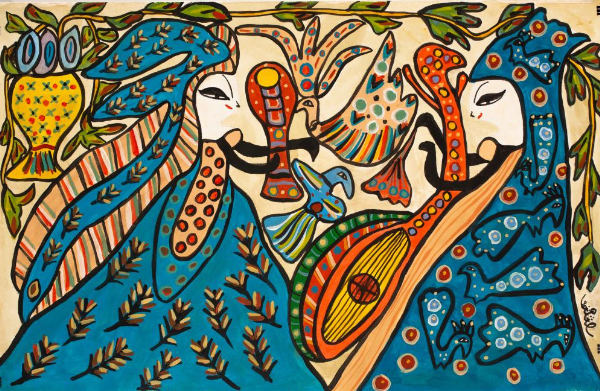 Untitled, by Baya Mahieddine (Algeria) 1990 Sing Sing to me with lute and lyre Sing to me on wind and fire Sing to me with lips and eyes Sing to me in truth and lies Sing to me of wings and birds Sing to me in loving words Sing to me in green and blue Sing to me in every hue Sing to me of magic beast Sing to me, then let us feast Sing today on river’s bend Sing tomorrow, never end Cathy Hollister Cathy Hollister is an older writer whose work celebrates treasures embedded in age, isolation, and continual readjustments. When not writing you might find her on the dance floor enjoying the company of friends or deep in the woods basking in the peace of solitude. Her work has been in Smokey Blue Literary and Arts Magazine, Open Door Magazine, Humans of the World Blog, Beyond Words Magazine, The Ekphrastic Review, Poet’s Choice anthologies, and others. Her new book Seasoned Women is available at Poet’s Choice. She lives in middle Tennessee; find her online at www.cathyhollister.com 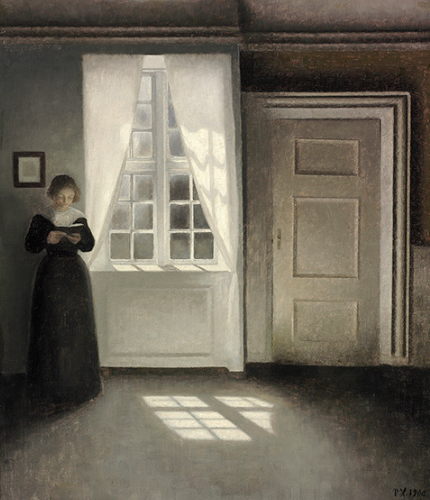 Interior from Strandgade 30, by Vilhelm Hammershoi (Denmakr) 1900 No Longer Yesterday Hector sent me this small book—a handful of time—by messenger. A black book, white pages, dark lacey ink creeping all over the margins. A primer for how · All things grow rigid and bright · Stepping beyond the muddy smudge of shadow · Straight lines, sharp corners · Incandescence · Exposed bloom · Fire-found agonist · Wild sublimity · Sweep of land · Brokenness · Glistening Ending on the last page with · hatches and hatchlings · horizons of swoon · a dip Each line was a whole story, sediments of restless fish and tentacles//landed//lashing. At “dip,” I slipped off the planet—beyond the showcase of mullioned light into a puddle of possibility, just beyond the toes of my shiny, patent-leather shoes under my heavy, lamp-black skirt. I’m disappeared between the rough covers in the rough hands. What covers? someone asks. Some covers. Who asks? A covering. No one asks whose hands. · Swell · Swollen · Swoop · Slowly · Stallion · Smoke Who has gone back into the pages (me? Could it be me?) and added a layer of s’s? All this I was blind to. I stand by the window in the sunlight—no longer the woman who answered the door. Annaliese Jakimides Annaliese Jakimides is a writer and mixed media artist who grew up in inner-city Boston and raised a family on 40+ acres on a dirt road in northern Maine, growing almost all their food and pumping water by hand. She currently lives in a small city next to a library. She’s worked with environmental justice organizations, international arts groups, and people in prisons. Cited in national competitions, and nominated for a Pushcart and Best of the Net, her works have been included in many journals, magazines, and anthologies, and broadcast on NPR. annaliesejakimides.com 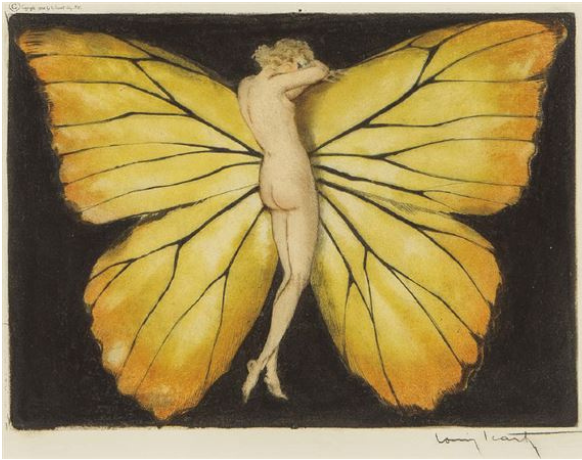 Woman in Wings, by Louis Icart (France) 1936 Butterfly Woman I wanted to know these fragile wings understand why some choose flight: time and tenderness and tomorrows strength and sorrows and salvation When I emerged fully whole in 1958 my wings were immediately clipped I was taught the words home & now I was reminded to be nice, not kind Nice doesn’t get one very far along it swells the tongue & doesn't last Kindness is damp soil & sunshine some gentle rain and deadheading Paper wings are fragile and light our backsides are strong & naked in the places, our wings once grew shoulder blades: winged scapulas & once, we had teeth named wisdom Patty Joslyn Patty Joslyn lives in Vermont. She’s fascinated with death and birth as passages into new realms. She has been published in El Calendario de Todos Santos, poetsonline.org, VOYA, (Voices of Youth Advocates), Tupelo Press-30/30 Project-March 2015, Still Point Arts Quarterly, and several anthologies. Patty’s book ru mi nate was born in 2017. Patty has never fully recovered from empty nest syndrome or the fact she can no longer do a cartwheel. 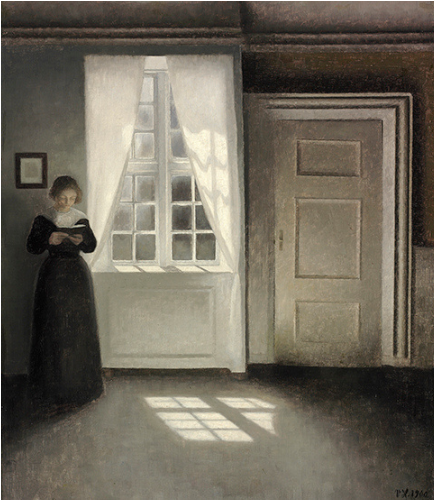 Interior from Strandgade 30, by Vilhelm Hammershoi (Denmark) 1900 Interior from Strandgade It is 1900 where you are hiding, being careful not to be seen by the exterior world where your head in a book would be looked on as frivolous or a waste of time when you could have been learning to sew, to cook, to make babies or to turn down suitors that are not in your heart wishing you could find a lover who would accept your books, your music, your curiosity about what lay outside that window, beyond the tree branches that you have starred at so many times. The squares on the window pain, the rectangles on the door, the refraction on the floor give you hope. And dear, you stand, tired of being told to sit still like a little lady, a proper lady. If you could close your eyes and transport yourself over a century would you be surprised to learn that your country, your Denmark, encourages women to work and provides care for your children? Imagine. Jennifer B. Kahnweiler Jennifer B. Kahnweiler is a non-fiction author of five books and a poet who is based in Atlanta, GA. A favourite aunt gifted her with a book of Edna St. Vincent Millay’s poems and she was hooked. She started writing poems during the pandemic, and received the Natasha Trethewey poetry prize from the Atlanta Writers Club. She has recently been published in the Avalon Literary Review and MacQueen's Quinterly. 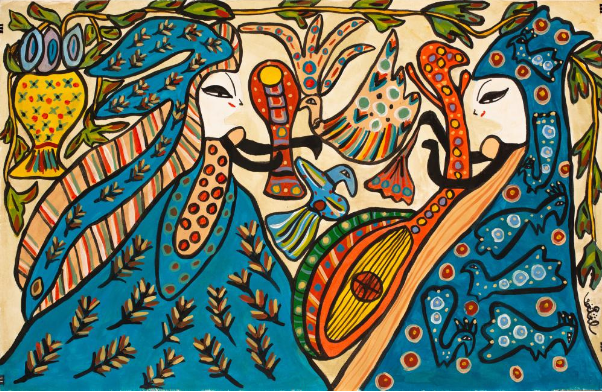 Untitled, by Baya Mahieddine (Algeria) 1990 Music & Art Clasp Hands Meeting in the garden, flowers and vines encircling us. Birds in branches, peacocks displaying. Preening. We’re enfixed in fabric. Restriction of our movement in marked contrast to theirs. Yet the fabric flutters, print alive and moving. Music and art clasp hands. Ode to oud. Rattles rattle seeds. In the garden, we’re not resigned to the attics or nooses of society. We reign on Tuesday mornings. No grey–bright colours and forms. It’s a feast of senses. The whole garden is in dialogue, avian and Algerian Arabic. Who Who asks the owl as we twitter like birds. Lynne Kemen Lynne Kemen lives in the Great Western Catskills of New York and appears s in various literary journals. She published her chapbook, More Than a Handful, in 2020. Additionally, she contributes as an Interviewer and Essay Editor for The Blue Mountain Review, a culture-focused journal, and is a member of The Southern Collective Experience. Lynne's upcoming book, Shoes for Lucy, is set to be released in the fall of 2023 by SCE Press. 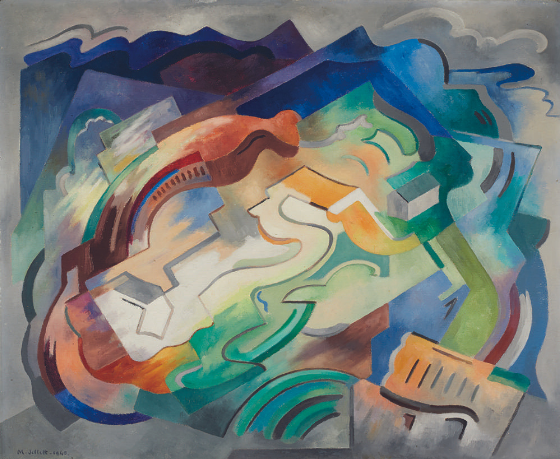 The Land Eire, by Mainie (Mary Harriet) Jellett (Ireland) 1940 Irish Swirl Ireland. Green hills. Fields of green where sheep graze. Long country roads past rolling, green hills. Small homes with thatched roofs touched by fresh moss. Friends pass on the country road and wave to the man by his small home. In the city. Dublin. Walking past Trinity College. Taking the way by St. Stephen's Green. "Look, there's Guinness Storehouse." Now the taverns. Fire glows on the pub side from the market stall. Drinks all around. Happy faces going red. In Belfast. One church. Another. We pass on opposite streets. We go, catching glares from shadows. The heat builds in our heads. Streets quiet. Then it comes. The bombs. Screams. Red haired children lie in sudden blood. Around the island, the ocean and the sea. The sea rises and falls in waves. Blue rolls one wave into another. Blue waves touch green Irish shores. Breezes blow fresh off waves and onto the land. The air becomes cool, clean, free. From hills by the shore, we discover open expanses. Norbert Kovacs Norbert Kovacs lives and writes in Hartford, Connecticut. He loves visiting art museums, especially the Met in New York. He has published stories recently in Blink-Ink, Ekphrastic, and MacQueen's Quinterly. His website: www.norbertkovacs.net. 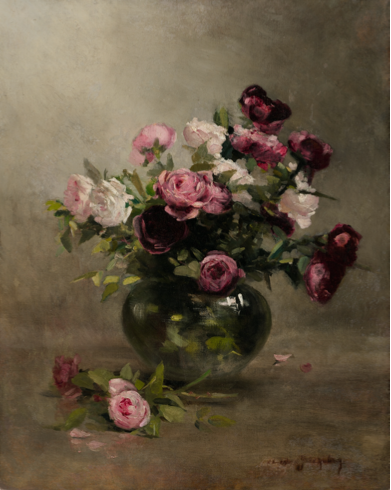 Vase of Roses, by Eva Gonzalez (France) 1870s Four Aspects of Roses White, pink, deep pink, red. These colours cover all the aspects of love: Agape, storge, philae, eros-- Love of God, Love of parents for children, Love for friends and, then that deep love of one other that causes the wheel of creation to turn, arouses us to the beauty of the other three. I see these four colours joined, sitting in this vase and I wonder if my mother, a practical parent, not so demonstrative as other moms, a woman who eschewed poetry, read only blockbuster novels but who often filled a vase with roses such as these, in all four colours, all the colours of love, roses from her own garden. Did she understand more of love and its philosophy than I knew? Joan Leotta Joan Leotta plays with words on page and stage. She performs tales of food, family, and strong women. Internationally published as an essayist, poet, short story writer, and novelist, she’s a 2021 and 2022 Pushcart nominee, Best of the Net 2022 nominee, and 2022 runner-up in Robert Frost Competition. Her essays, poems, CNF, and fiction appear in Impspired, The Ekphrastic Review, Verse Visual, Verse Virtual, Gargoyle, Silver Birch, Yellow Mama, Mystery Tribune, Ovunquesiamo, MacQueen’s Quinterly and others. Her poetry chapbooks are Languid Lusciousness with Lemon and Feathers on Stone. 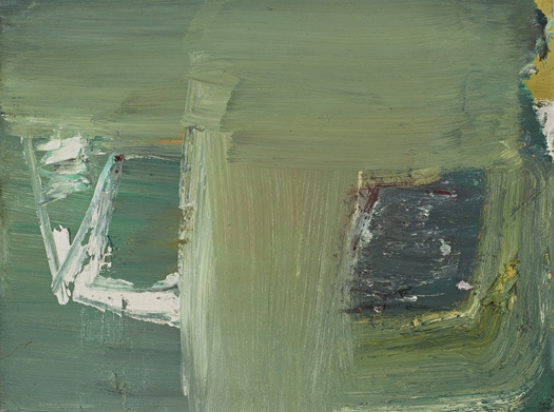 Untitled, by Franz Kline (USA) 1960 heresy of paraphrase paraphrase is to say the same thing in less words / yet we attempt to suss meaning from / a poem, a painting, / a sculpture. / it is impossible / the exact nuance / the artist is trying to convey we each experience creative works from our own perspective / in this experience the meaning of art lies, / the essence of the thing is the thing, / it is a sacred other worldly thing, / goes beyond intent / intertwines with it / rumples the sheets and stays the night. Dane Lyn Dane Lyn (they/them) is a neurospicy, genderqueer, disabled, educator, poet, and glitter enthusiast in a love-hate relationship with Los Angeles, where they reside. Dane has an MFA from Lindenwood University, a ridiculous collection of succulents, and four scavenger hunt runner up ribbons. Dane’s work can be seen in Quillkeepers, Gnashing Teeth, Gutslut, and Imposter. They are currently finding out that editing an online poetry journal (Ink and Marrow) is both rewarding and a slog. Their debut chapbook by bottlecap press, bubblegum black, was released in early 2023 with rave reviews from their mom. They are on social media @punkhippypoet, and most of their published work can be seen at www.danelyn.net 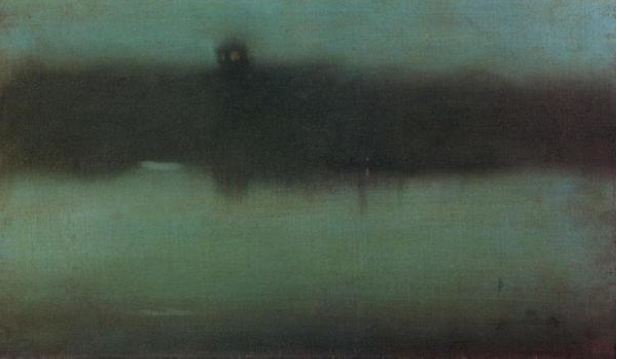 Nocturne in Grey and Silver, by James McNeill Whistler (USA) 1873 That Nagging Sense of Dread Can take me outside for a walk. I look up at the foggy sky, make out the image of the sea, Salt Island, a quick hike at low tide, is so murky it is as if it were a cloud that will float away. I have suffered such loss and heartbreak, but I know it can be easily forgotten and cast out by one gleaming moment of joy. The way one feels when a cloud finally parts and the heat of the sun warms the face, the whoo, hoo of Turtle Doves, or the sound of his flute echoing through our home, late at night when the rest of the world sleeps. I remember my mother, climbing with her to the top of the giant carnival slide, the lights of the fair pink, blue and gold, lighting our faces. A heart can ache from grief at unexpected moments and as I cross a path beneath the huge chestnut trees, I remember fall days when I gathered pails full of bronze prizes to show her. The vivid blue sky I see through the lush leaves reminds me of the wide world still waiting to be found, that would excite her so, and that sharp needle that’s been piercing my heart begins to melt. As I continue my walk, I come upon the soft green prickly pod with my toe. I lower my foot onto it to reveal its shiny bronze prize, the first of the season. Andrea Marcusa Andrea Marcusa's writings have appeared in The Gettysburg Review, River Teeth, New Flash Fiction Review, Citron Review, and others. She’s received recognition in a range of competitions, including Smokelong, Cleaver, Raleigh Review, Best Micro Fiction and others. She lives in New York City and is a member of the faculty at The Writer's Studio and is also a watercolourist. 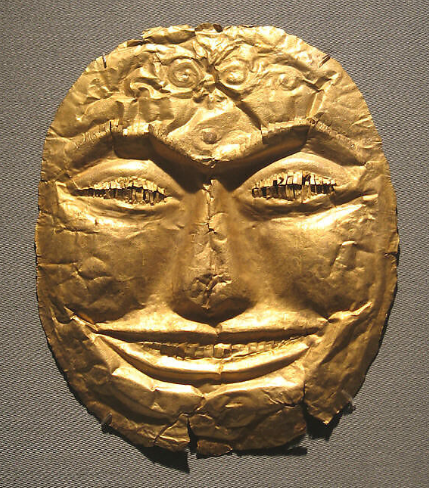 Gold Funerary Mask (Indonesia) 14th century A Happy Death? This is what is left of you after seven centuries – a smiling face of beaten gold. Did you commission this piece before you died, knowing Death was near, or just because you knew you were Mortal even as you were worshipped, revered, holy, sacrosanct, divine? Were you granted the Happy Death? Did you know if you’d lived a good life? Were you at peace as the transformation from Life to Other approached? All we know is that we see you now as Happy. I hope you were. I hope there is Truth behind the mask. Laura McGinnis 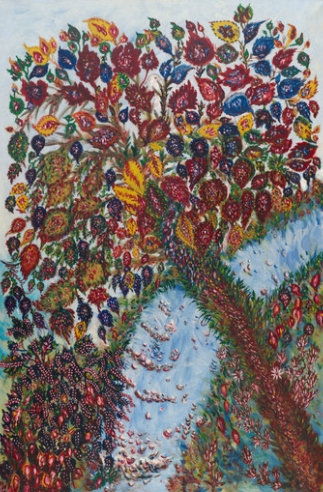 Tree of Paradise, by Serraphine Louis (France) 1928 A Haiku Series Flowers like jewels Kaleidoscopic colours an orchard of dreams. Pomegranates ripe this tree is really a heart pulsing with strange fruit. Synchronised wonder: scarlet, crimson, royal blue seeds of tomorrow. Siobhan Mc Laughlin Siobhán is a poet from Co. Donegal in Ireland and has been published several times in The Ekphrastic Review. Her poems have been published in The Honest Ulsterman, Drawn to the Light Press, The Poetry Village, The Trouvaille Review, Bealtaine Magazine and Quince as well as others. She enjoys reading and writing ekphrastic poetry, both of which she finds is a meditative and transportive exercise. She blogs at www.a-blog-of-ones-own.blogspot.com Twitter: @siobhan347 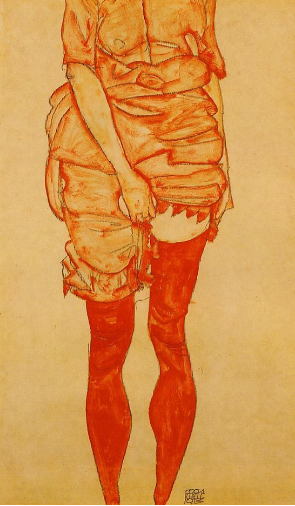 Standing Woman in Red, by Egon Schiele (Austria) 1913 Absent the Face Is that a finger or a nipple so erect it looks like a knife buried to the hilt where a nipple should be? The “standing” woman is headless, only her body shown. Against ochre ground, her dress would be ochre too except for the red wash on all the edges, even the tears on the left hip and the hole her left hand conceals where the genitalia are. The matching red legs wear stockings or blood. The red representations of shark teeth over her right thigh, parallel to her hidden mons and the valley beyond, say she is being eaten, washed in blood from vagina outward. The absence of head suggests she is personless, just wound, all body, for the face is the place of identity, of eye, mouth, nostril, the fragile loveable territory of the self which the Standing Woman may sell or surrender to whatever’s teeth are showing next to what might have been, in kinder times, love’s bower. Mary B. Moore Mary B. Moore’s poetry books include Dear If, (Orison Books); Flicker (Dogfish Head Prize, 2016); The Book Of Snow (Cleveland State UP, 1997). Chapbooks, both prize winners, are Amanda and the Man Soul (Emrys 2017) and Eating the Light (Sable Books 2016). Recent poems also appear in Poetry, Prairie Schooner, Birmingham Poetry Review, Gettysburg Review, ekphrastic.net, Nelle, Terrain, Georgia Review, 32 Poems, The Nasty Woman Poet anthology, and more. A retired professor, she lives in Huntington WV. 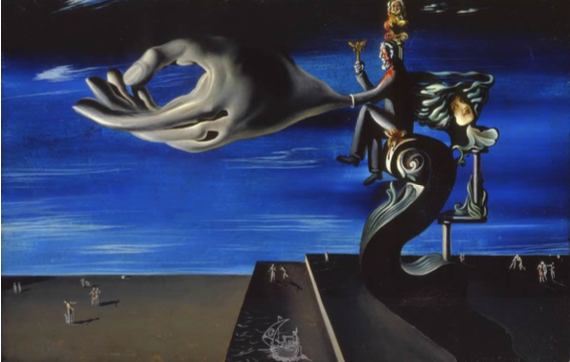 The Hand- The Remorse of Conscience, by Salvador Dali (Spain) 1930 The Hand, The Remorse of Conscience Maureen accepts the box at the door, remembering how she felt when her son moved out six short years ago. It had felt like someone had cleaved her heart in two, thrown half of it into the river. She’d watched her husband and son chat excitedly, pretending to tidy the emptying room so she could shed the occasional tear without their comments. She’d doted on Mark for 18 years and then worried that he didn’t have the skills to live on his own, kind of like his father, Stephen, who couldn’t make dinner or do a load of laundry. Or wouldn’t, but aren’t they almost the same? He might have learned by now, two years on his own after what happened. The stereotype is that divorcing parents tell the children, “We still love you, but we don’t love each other.” But Stephen had stopped loving Mark, and Maureen too, by proxy, because he said she enabled Mark by paying for his rehab over and over. “Insanity is doing the same thing but expecting different outcomes,” Stephen lectured as he packed his own boxes. Maureen had no tears to hide. She thought of cooking dinner every night, sorting laundry for individual loads each week, sitting with Stephen for a heart-to-heart he never heard. She should have left him first. She should have followed Mark to California, held him in the palm of her hand so he always felt her love and never had to seek it from other sources. Allison Renner 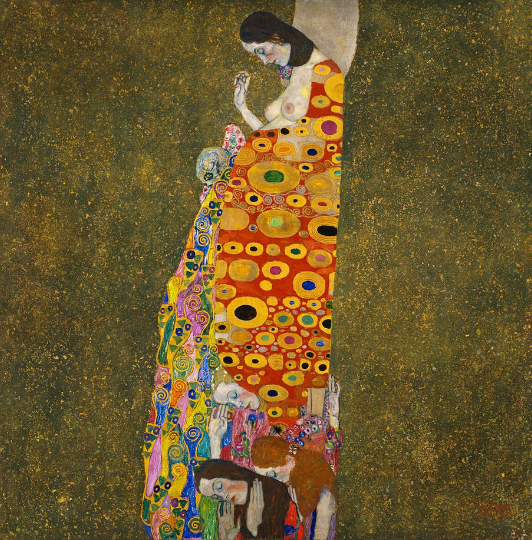 Hope 2, by Gustav Klimt (Austria) 1907 Hope The night sky was smeared with stars. She recognized Venus through the smoke choking the port city. Eventually the bombing would end, the fires would die. Would her house remain? Would she? Her sisters, their heads bent, prayed at her feet. One got up to cover her in a blanket of colours scented with lavender and put a cloth dipped in water and vinegar to her lips. There would be no midwife, no doctor, no husband. In the morning, one of her sisters opened the shutters and looked out the window. The fires had become embers, and a layer of ash like fresh snow covered the rooftops. When the sun shone bright orange across the bay, she held a baby boy in her arms. It was the happiest day of her life. Marjorie Robertson Marjorie Robertson is an essayist, novelist, short story writer and multilinguist. Her first novel, Bitters in the Honey, was a semifinalist in the 2014 William Faulkner-William Wisdom Writing Competition. Her other interests include creating art + text, studying how visual and sound affect the written word, and teaching writing to English language learners and the 1.5 generation. 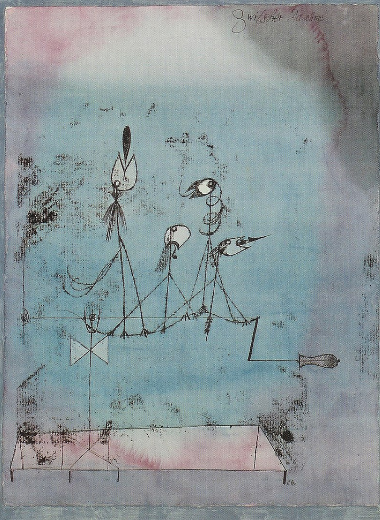 The Twittering Machine, by Paul Klee (Switzerland) 1922 Ode Magic In a meagre dwelling in the yard of the Hen and Chickens public house, lived a curious hook-nosed old woman, known as ‘Ode Magic’. She lived alone, and eked out her living by dispensing spells and charms, for five shillings a turn. Some folk said Ode Magic had three crimson teats. Some said she could turn into a hare. Some said she had suckled a peppery grimalkin. To cure toothache, that pain straight from the Devil, Ode Magic would take a live mole from a trap, cut off its paws before it was dead, exhort folk to wear them on a chain, around their necks. A mouse fried in butter, cured a child of whooping cough. Warts vanished when Ode Magic rubbed them with a hanged man’s hand. Mumps, shingles, rheumatism – Ode Magic cured common ailments with a handful of nettles, a starving pigeon held to the throat, blood drawn from the tip of a black malkin’s tail. To ease labour pain, she hired out a charmed stone, stolen from an eagle’s nest, Before long, Ode Magic’s fame spread. Known as ‘a wise woman’, she could now afford to move to a cottage in Hell Lane. The cottage had its own pigsty and well. It stood alone at the end of the lane, not a quarter of a mile from the Black Wagon colliery. Unsurprisingly, the colliery gaffer had heard of Ode Magic’s sorcery and decided to consult her, with a problem: the mystery of the disappearing candles. “Missus,” the gaffer said. “We’ve searched all of the blokes, ‘oo works the pit, but ower candles keep vanishin’. Can yow ‘elp?” Ode Magic said that the Devil was stealing the candles, but for the sum of ten gold guineas, she would dispense a charm. Once the gaffer had crossed her palm, Ode Magic first made various secret signs, and then told him what to do. As instructed, at midnight the gaffer and a gang of colliers went down to the deepest cavern in the pit, and settled themselves. After a long and weary vigil, they heard a strange scratching noise. The gaffer struck a match, raised the Bible in his right hand and the colliers started chanting the Lord’s Prayer, backwards. Several swore they could smell brimstone and sulphur but no demon appeared. More matches were lit, and as the black cavern illuminated, from the shadows scurried a swarm of greedy rats. In the corner lay a pile of gnawed wax. The rats had stolen the candles, not the Devil. At dawn the next morning, the crimson-faced gaffer hammered on the door of Ode Magic’s cottage, demanding back his guineas. But the canny old woman had vanished. The cottage was bare, except for a rickety rocking chair, a basket of apples, and curled up in front of the dying embers, a brindled cat. Jane Salmons Jane Salmons is from Stourbridge in the UK. She has a poetry pamphlet Enter GHOST (dancing girl press, 2022) and full poetry collection The Quiet Spy (Pindrop Press, 2022). Jane has stories published with MacQueen’s Quinterly, The Ekphrastic Review, Ink Sweat & Tears, and in Ad Hoc Fiction anthologies Dandelion Years and Flash Fiction Festival Five; and forthcoming in The Dribble Drabble Review. Her microfiction has been shortlisted for the Bath Flash Fiction Award and nominated for Best Microfiction 2023 and Best of the Net 2024. She won the Pokrass Prize at the Bath Flash Fiction Festival in 2022. www.janesalmonspoetry.co.uk 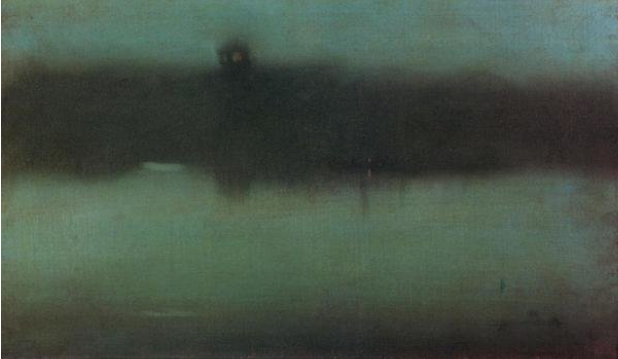 Nocturne in Grey and Silver, by James McNeill Whistler (USA) 1873 Aubade The river is a ghost before the sun, haunting the land with a thick mist, holding back the slime of monsters who stir, cut fins against the surface Water gurgles over shallow-drowned stones, bleeds across the sharp shale, is strained by the skeletons of trees, feet still stuck in the shallows mud My boat slices through in glide, oars dipping into the black surface, pulling us upstream for landing, a river town still sleeping this morn, it’s life still hidden by the fog By sunlight, we will be provisioned, and fast on our way, if this ghost gives up her spirit, if the day burns it clear, But I am possessed by the half-light, alive to the beauty of shadows, dark on dark growing lighter with the hope of a new morning. Michael E. (Maik) Strosahl 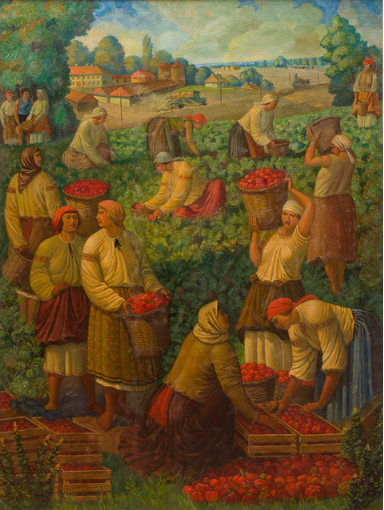 Picking Tomatoes, by Ivan Padalka (Ukraine) 1932 A Migrant Couple Picks Tomatoes Here my love, red as our blood, picked at height of its blossoming dense as flesh, juiced with water smelling as the sweet dirt in your hair as it tumbles, as it tumbles through my hands. Our pantry will fill with its paste and berry, sauce and pickles. Taken from baskets that see know no ending, only the weight of our work and scarlet season our ripe hands prove. How full we are when our eyes rest on these crates of plump tomatoes. The weathered hands that touched skin so tenderly to get this far and the occasional crush and bleed. Rebecca Surmount Rebecca Surmont lives in Minneapolis, MN and has worked as a movement artist, physical actor, dancer, and collaborative teaching artist throughout the Midwest. Her poems have been appeared in journals such as Tiny Seed Literary Journal, Trouvaille Review, The Ekphrastic Review, and Topical Poetry, Minneapolis’ Southwest Journal, and The Anthology Seasons by Trolley Car Press. She works as a leadership consultant and coach. 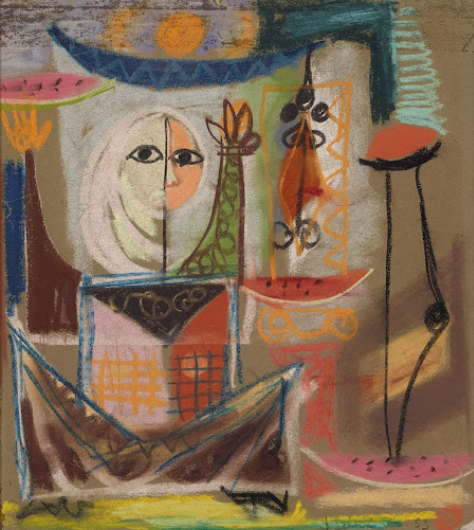 The Watermelon Seller, by Jawad Saleem (Iraq) 1953 The Watermelon Seller In mid-summer, he loaded the gear-grinding International with his striped melons and me and headed down the country roads near the patch to sell to those residing along the path. We rounded bends and curves in silence, he absorbed in the fields of corn drying from the summer heat and the several weeks’ want of rain, finally coming to a row of houses in the middle of nowhere where he stopped and exited the truck like one in leg irons. At the tailgate, he cut the mint-green, dark-striped melon with his pocketknife to demonstrate to potential buyers the fruit’s freshness as it burped into perfect hemispheres, revealing the lush, crisp meat of red or yellow melon from which he cut the heart and offered on the tip of the knife to the kids. The twenty-five cents dug from overhauls and aprons, plus the children’s smiles, was enough, enough to make my sober-hearted farmer-father happy. Jo Taylor Jo Taylor is a retired, 35-year English teacher from Georgia. Her favourite genre to teach high school students was poetry, and today she dedicates more time to writing it. In 2021, she self-published her first collection of poems, Strange Fire, and her second collection, Come Before Winter will be out early next year (Kelsay Books). She enjoys morning walks, playing with her two grandsons, and collecting and reading cookbooks. 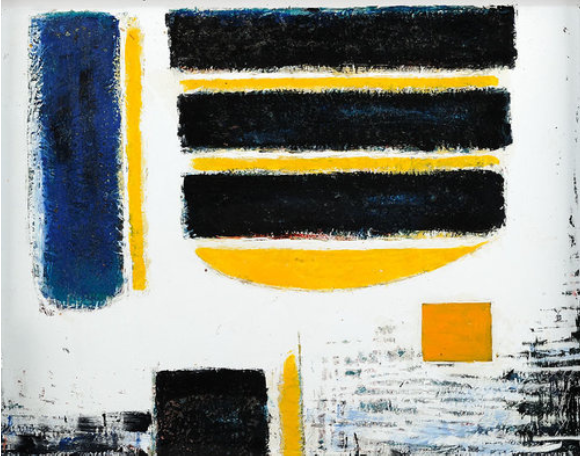 Sailing, by Sargent Claude Johnson (USA) 1950 Sailing Away on Memory As long as memory lasts, I’ll continue to deconstruct that day – the onomatopoeic flap, flap, flap of the sail, crotchety buzz of the motor, laughter of the gulls as we headed out. I feel the wind tossing my hair, spindrift moisturizing my face. Not exactly a romantic day with his dad as skipper, but sailing on a calm sea with no sweater or sweaty weather came close to paradise. Silly teen that I was, I expected the magic to last. My first love threw me over. Alarie Tennille Alarie Tennille was a pioneer coed at the University of Virginia, where she earned her degree in English, Phi Beta Kappa key, and black belt in Feminism. Alarie received the first editor’s choice Fantastic Ekphrastic Award from The Ekphrastic Review, and in 2022, her latest book, Three A.M. at the Museum, was named Director’s Pick for the Nelson-Atkins Museum of Art gift shop. Vase of Roses, by Eva Gonzalez (France) 1870s Climbers 1. Tousled haired Lillian padded after Fletcher to see what he did next. “What are you doing now?” she asked. So curious for three. Fletcher gave her an indulgent smile, pruning shears in hand. “Cutting out dead wood, little girl,” he said. “I’m not little. Call me Lillian.” “I can do that,” he said with a laugh. “Or I could just call you Lil.” “Does it hurt them when you cut?” said Lillian. “I don’t suppose so, no. Cutting what’s not growing makes the roses grow better,” said Fletcher. “Oh,” said Lillian. “And stronger.” “Exactly,” said the gardener. “You’re a clever one.” “I know,” said Lillian and put her nose in a pink rose. “That’s not a fragrant one. Come take a look at this climber. Put your nose in that. But always check for bees. They may be working,” said Fletcher, “and not know you’re coming.” “Oh,” said Lillian and followed Fletcher’s lead. Stopped when he did, leaned, hovered and sniffed. She laughed as Fletcher’s scissors went ‘snip, snip. snip,’ avoiding thorns altogether. “I like the climbers best,” she said. By mid-June the rose garden was coming into its own. It had been planned and planted so as to succeed one another throughout summer into early fall. Splashes of color and fragrance abounded. Especially the old fashioned climbers white, pink, cream and apricot. Lillian’s mother arranged the roses herself in lovely cut glass vases. They decorated the house, even Lillian’s nursery. A perfect nook held a weighted vase with wands of roses and baby’s breath. II. Lillian’s bridal bouquet was a simple spray of her fragrant favorites. After their honeymoon in the Bahamas, she and husband Robert moved into her childhood home, aptly named, Garden Hill. “Aren’t we the lucky ones, Sweetheart?” said Robert. “Indeed we are,” Lillian said. “Garden Hill can hold us all!” A handsome three story brick house with black shutters, two acres of cultivated gardens with fruit trees, a swimming pond that substituted for ice skating in winter. Beyond that Fletcher’s cottage, a stone wall and wildflower meadow. III. Gray haired Fletcher was bent through the shoulders but in fit health otherwise. He never married. “Me, marry?” said Fletcher when Lillian was a teen-ager and working by his side. She’d become his unofficial gardening assistant. “I’m wed to Garden Hill. And you’ve become an excellent pruner.” “High praise, indeed,” she said. “I think that new yellow cultivar is going to be a stunner.” Fletcher, at 87, died peacefully in his sleep. It was full summer and the roses were at their peak. He left Lillian handwritten gardening journals full of snippets and drawings, all dated. They covered some forty years. How did he find the time? she wondered. Dear Fletcher. The journals were as valuable to her as the double stranded pearls Robert gave her on their 25th wedding anniversary. The sections on fragrant climbing roses were her favorite and most frequently read. Dog-eared actually. Revered and loved. Deborah Trowbridge Deborah writes flash, short stories and creative non-fiction in northwestern Montana. Most recently her work has been published in Fifty-Word Stories, "Bees," in March, and "My Papa, the Poet," in July. Her flash, "M. Binet," is forthcoming in print this fall in San Fedele Press' American Writers Review 2023. 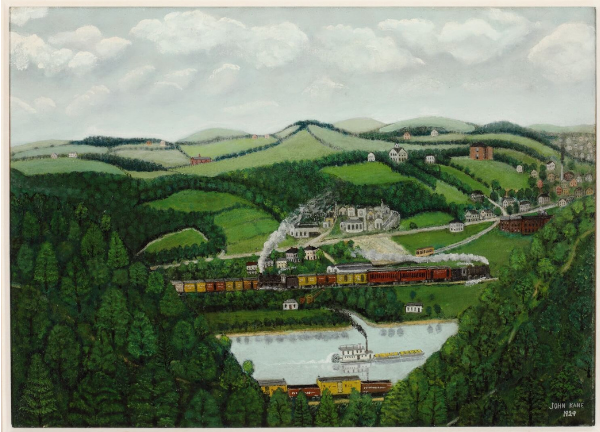 Hills and Rivers, Steamboat at Sleepy Hollow, by John Kane (USA) 1929 sleepy hollow not the stuff of headless horsemen commanding the evening pathways; dark ambiguity but the day’s offering the commerce of industry melded with pastoral hues; land rising and falling to showcase sweeping beauty Cristy Watson Cristy Watson is an award-winning novelist who loves to enter writing contests. She has poetry published in CV2 Magazine, Worth More Standing (Caitlin Press, 2022) and The Poetry Marathon Anthology (2019-2023). Having resided in Surrey, BC for years, she currently lives with her sister in Calgary, Alberta and continues to volunteer with the Surrey International Writer’s Conference. She will be presenting a poetry workshop at the Write on Bowen Festival of Readers and Writers in September.  Bowie Wall, Brixton London by James Cochran, aka Jimmy C (England) 2013. Click image to visit artist site. Used with artist permission. Join us for biweekly ekphrastic writing challenges. See why so many writers are hooked on ekphrasis! We feature some of the most accomplished, influential writers working today, and we also welcome emerging or first time writers and those who simply want to experience art in a deeper way or try something creative. The prompt this time is Bowie Wall, by Jimmy C. Deadline is September 1, 2023. We are delighted to have Kate Copeland as our guest editor again! You can submit poetry, creative nonfiction, flash fiction, microfiction, or any other form creative writing you like. 1000 words max please. The Rules 1. Use this visual art prompt as a springboard for your writing. It can be a poem or short prose (fiction or nonfiction.) You can research the artwork or artist and use your discoveries to fuel your writing, or you can let the image alone provoke your imagination. 2. Write as many poems and stories as you like. Send only your best works or final draft, not everything you wrote down. (Please note, experimental formats are difficult to publish online. We will consider them but they present technical difficulties with web software that may not be easily resolved.) Please copy and paste your submission into the body of the email, even if you include an attachment such as Word or PDF. 3. There is no mandatory submission fee, but we ask you to consider a voluntary donation to show your support to the time, management, maintenance, and promotion of The Ekphrastic Review. It takes an incredible amount of time to curate the journal, read regular and contest submissions, etc. Paying all expenses out of pocket is also prohibitive. Thank you. A voluntary gift does not affect the selection process in any way. 4. USE THIS EMAIL ONLY.
Send your work to [email protected]. Challenge submissions sent to the other inboxes will most likely be lost as those are read in chronological order of receipt, weeks or longer behind, and are not seen at all by guest editors. They will be discarded. Sorry. 5.Include JIMMY C. CHALLENGE in the subject line. 6. Include your name and a brief bio. If you do not include your bio, it will not be included with your work, if accepted. Even if you have already written for The Ekphrastic Review or submitted other works and your bio is "on file" you must include it in your challenge submission. 7. Late submissions will be discarded. Sorry. 8. Deadline is midnight EST, September 1, 2023. 9. Please do not send revisions, corrections, or changes to your poetry or your biography after the fact. If it's not ready yet, hang on to it until it is. 10. Selected submissions will be published together, with the prompt, one week after the deadline. 11. Due to the demands of the increasing volume of submissions, we do not send out sorry notices or yes letters for challenge submissions. You will see what poetry and stories have been selected when the responses are posted one week after the deadline. Understand that we value your participation as part of our ekphrastic community, but we can only choose a handful of the many entries we receive. 12. A word on the selection process: we strive for a balance between rewarding regular participants and sharing the voices of writers who are new to our family. We also look for a variety of perspectives and styles, and a range of interesting takes on the painting. It is difficult to reproduce experimental formatting, so unfortunately we won't choose many with unusual spacing or typography. 13. By submitting to The Ekphrastic Review, you are also automatically joining our subscribers' list. Your submission is your permission. We don't send spam and we don't send many emails- you will not receive forty-four emails a day! Our newsletter occasionally updates you on some of the challenges, news, contests, prize nominations, ekphrastic happenings, prompt ebooks, workshops, and more. 14. Rinse and repeat with upcoming ekphrastic writing challenges! 15. Please share this prompt with your writing groups, Facebook groups, social media circles, and anywhere else you can. The simple act of sharing brings readers to The Ekphrastic Review, and that is the best way to support the poets and writers on our pages! 16. Check this space every Friday for new challenges and selected responses, alternating weekly. 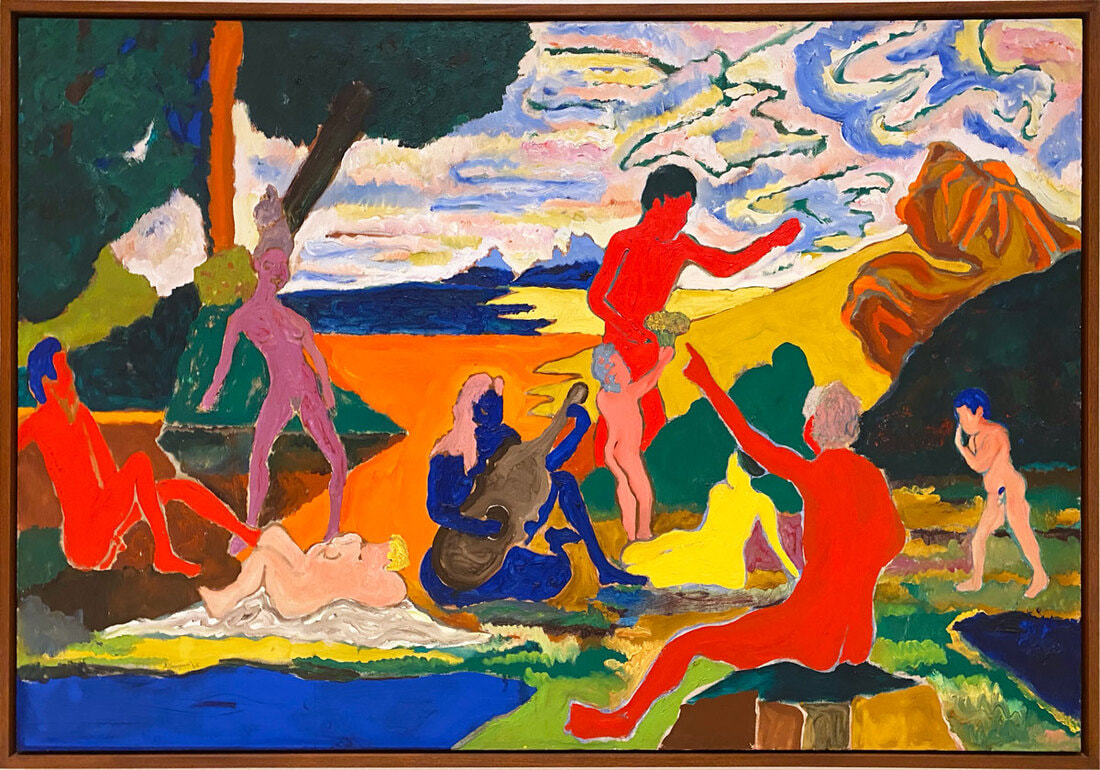 Homage to Nina Simone, by Bob Thompson (USA) 1965 Figure 8 Revolution With the right pen you find your voice and the notion of what’s love can be drawn in the sand with a stick. Your song moves me across the dunes at night and I draw a figure 8 in the sand before the fire. In time poetry takes place and watching the sunrise over coffee becomes a poem going up the side of the day. The 8 in the sand is still traceable for now. An ant crawls across the stick. Encounters another. They bow to each other in greeting. We smile in the golden light, good morning. Guy Biederman Guy Biederman is the author of Translated From The Original, one-inch punch fiction (Nomadic Press), Nova Nights poetry (Nomadic Press), Edible Grace, lyrical micro prose (KYSO Flash)) and three other collections of short work. A former peace corps volunteer (Guatemala ’81-’82), gardener, publisher, and creative writing instructor, Guy lives on a houseboat in Sausalito California, hosts floating word jams, and walks the planks daily. ** Disguised Self Creeps along a dark drooping tail unto its green beady eyes- breathing silence behind my silhouette. In wake for the veils to flutter, gently wave rhythm of colours onto the white georgette- pink, yellow, orange from far end of darkness. Little patches of red are shared by the dancing girls, golden tiaras and long necklaces. On a cold night open to sky, crouched memories spring to music, roses warm among the dead pretending to be life. Abha Das Sarma An engineer and management consultant by profession, Abha Das Sarma enjoys writing. Besides having a blog of over 200 poems (http://dassarmafamily.blogspot.com), her poems have appeared in Muddy River Poetry Review, Spillwords, Verse-Virtual, Visual Verse, Sparks of Calliope, Trouvaille Review, Silver Birch Press, Blue Heron Review, here and elsewhere. Having spent her growing up years in small towns of northern India, she currently lives in Bengaluru. ** The Garden of Beautiful Things The artists, saying: which unexplains-- that unknowingly so-- bound simply by where the mirror takes it. And this, they said, In a grumble office, fantasizing of tread cloth that might emulate sun breaking. For sigh, testimony, more truths-- though none would claim the religiosity needed. Yet needed, lands vivid and ripe, long alp and straddled flume, laid out to the people vibrant, naked only in in their disproof of angst and couldn’t-be. Robert Henry Robert is a college student hoping to take his pen along the way. ** Homage to Nina Simone Goddam, miss a hippy & your shot will go all the way to Baltimore where the sinnerman sits in his colourful stew, cradling the Bill of Rights, whose brother, the Bill of Wrongs, with his golden hair the true length of their love, has left for the north of Europe where they paint with their souls, staining canvasses in history’s hues, black blood mixed in the toothy bite of little girl blue standing in the pink, left lonely in the Rue Rabelais where the devil sits sniggering in his Citroen, strange fruit hanging from his twisted mouth, white lipped & lusting after the long armed angels back in Philadelphia, you gotta sing for your supper in Atlantic City to be canonised the patron saint of rebellion, the German Shepherds are howling in Carnegie Hall, Baching at the colour of your skin, the sergeant stashes the cash beneath the bleeding fountains in the yard, climb, climb the piano & hang from the lilac tree screaming for your people, your purpose, your peace of mind, birds flying high, past all disappointment singing their show tune for all the ladies in the country of lies, lie down, take your medication & turn off the television, all the babies are cared for before they are born & your mothers keep whispering their prayers in the back of the police car, the handcuffs no hindrance to their rosary wringing, learn how to hide those tears, they’re no good for watering this pale land, if you wanna live in the palace its yessir yessir yessir, the raindrops will fall & it’s nobody’s fault but yours Simon Parker is a London based writer, performer and teacher. His work been published in The Ekphrastic Review and has been performed at the Lyric Hammersmith Studio, Hackney Empire Studio, The Place, Somerset House, Half Moon Theatre, Southbank Centre, the Totally Thames Festival, and the Edinburgh Fringe Festival. Simon is an associate artist of Vocal Point Theatre, a theatre company dedicated to telling stories from those not often heard, and providing workshops for the marginalised. He runs creative writing and reading groups for the homeless, socially excluded and vulnerable. If you want to know more go to https://www.simonparkerwriter.com ** Indelible Moments These burning skies overhead draped in the scattering light of motley bubbles shadow a nimble jamboree of voices youthful and ripe rejoicing nearby the murmuring creek frolicking in the leafy shades their nakedness laid bare in a verdant meadow carefree about the world shading that which hides their flaws revealing the naiveté of their childish nature vulnerability in its purest form unmasked, for all to see awaiting the sun’s setting melody flushed in the colours of fall of crimson, amber and gold the mellow notes of guitar strings an undulating motion of their leisurely breaths evoking soothing contemplation about an indelible moment such as this impenitent in its distinctive nature reminding me of life’s transience as I hope to pencil in my legacy parietal art for posterity Like so many before me Andrea Damic Andrea Damic born in Sarajevo, Bosnia and Herzegovina, lives and works in Sydney, Australia. She’s an amateur photographer and author of prose and poetry. She writes at night when everyone is asleep; when she lacks words to express herself, she uses photography to speak for her. She spends many an hour fiddling around with her website https://damicandrea.wordpress.com/ ** If I Were Nina Simone, This is What I Might Say Call me Eunice, for Nina is a lie. My father’s name is Divine, my mother’s Mary. Even so, and to my mother’s great disappointment, I was not the second coming. Just young, gifted, and Black. But by God, I could play the piano. The singing was just something I needed to do to earn a living. Funny, most people think of me as a singer, if they think of me at all. I hid who I was from my mother and my father, playing the devil’s music and living the devil’s life. I mean, I dwelt in Greenwich village – what did they expect? I even married Satan, though he looked like somebody else. Someone in a uniform. I suppose I hoped for order, but it just made things worse. Others followed. Some I loved, some I cursed; none helped me any more than he did. When I sing, I become Bach and Blue, for that is the tone of sadness. I spit bullets, I seduce. My songs are like my life, all over the place. I sing in search of a country, a new country. But in the end, I have no home. Do I succumb to the blues? Sometimes. Sometimes. That’s a truth. I sing sweet, I sing raging, and then I refuse to sing at all. How can I not turn blue with sadness, blue with anger, with all the colours that surround me? Wayne Garry Fife Wayne Garry Fife is an anthropologist and writer who lives in St. John’s on the island of Newfoundland in Canada. He writes micro fiction, flash fiction, short stories, memoir, novels, and non-fiction. His latest book, published by Palgrave Macmillan, is entitled Imaginary Worlds (Invitation to an Argument). ** To Match the World on Fire Red bodies chained to match the world on fire, predating our scorching summer. The origin of life, the in between. There is no amount of blue that may quell our haze, no amount of green that may bring us back To an original lie, to life, I meant to lie by a rock, scalding our backs. To lie by the banks of the river of fire, to lie. The three ages of Man replace the clouds, my eyes stray, strain itchy from the smoke around me. Air Quality Index 7, Severe Risk, my lungs wished to be those trees. Alveoli refuse to expand, even the guitar burns. Almost. Luciana Erregue-Sacchi Luciana Erregue-Sacchi is an Argentinian-Canadian art historian, poet, translator, editor, and award winning publisher (Laberinto Press) from amiskwaciwâskahikan (Treaty Six). Her creative-non-fiction has been longlisted for the Susan Crean Award. Her work has been published in Polyglot Magazine, Humber Literary Review (Canada), The Selkie (UK), Agni Magazine (US), and others. Luciana is a Banff Centre Literary Arts Alumni, 2019 Edmonton Arts Council Artist in Residence, and the WGA’s Horizons Writers Circle coordinator. Her debut chapbook titled Of Mothers and Madonnas(April 2023 through The Polyglot. Luciana loves walking everywhere, especially the Edmonton River Valley with her family and friends. ** Summertime Goddam “Summertime and the livin' is easy” bob painted his figures in all the colours for those who only saw Black & White knew eyes needed to really see magic figures, simple, symbols popping from the page more real than life moving, flowing in 3-d a fantasy of equality bob played his melodies mixing oils on the palette figures lithe as blue notes scatting across his canvas nina always the centre chanteuse adding her Goddam songs calling for change soul and sass and bad-ass rage I put a spell on you To be Young, Gifted and Black (nina and bob both knew) Feeling Good I wish I knew how it would feel to be free Backlash Blues Today is a killer Don't let me be misunderstood Ain’t Got No Life Let it be me The Desperate Ones Mississippi Goddam (and she meant every word of it) Emily Tee Note: the second half is a found poem using selected titles (with annotations) from “Nina Simone’s 20 greatest songs – ranked!" Alexis Petridis in The Guardian, 20 July 2023 Emily Tee writes poetry and flash fiction. She's had pieces published in The Ekphrastic Review Challenges, Aurum Review and elsewhere online, and in print in some publications by Dreich and other places. She lives in the UK. ** Homage to Nina Simone We had danced with abandon all through the night as though a spell had been cast on us. We were feelin’ good as streaks of morning colored the sky and we collapsed, exhausted and settled on the grass to enjoy our dejeuner sur l’herbe, a picnic someone had brought. And while we ate, we listened to the woman with the guitar singing the blues. Gretchen Fletcher Gretchen won the Poetry Society of America's Bright Lights/Big Verse competition and was projected on the Jumbotron while reading her winning poem in Times Square. One of her poems was choreographed and performed by dance companies in Palm Beach and San Francisco, and others appear in datebooks published in Chicago by Woman Made Gallery. Her poetry has been published in journals including The Chattahoochee Review, Inkwell, Pudding Magazine, Upstreet, Canada’s lichen, and online at Poetry Southeast, SeaStories, and prairiehome.publicradio. Her poems are also included in anthologies including Sincerely Elvis, You Are Here: New York Streets in Poetry, Proposing on the Brooklyn Bridge: Poems About Marriage and Capital BookFest’s Family Pictures, Poems and Photographs Celebrating Our Loved Ones. Gretchen has led writing workshops for Florida Center for the Book, an affiliate of the Library of Congress. Her chapbooks, That Severed Cord and The Scent of Oranges, were published by Finishing Line Press. ** Suzanne In the Morning She didn’t even plan to sing the Devil’s music for the crowd that gathered round To hear her warbly sound Her perfect pace an instrument tuned To honey silk unapologetically pure sugar sweet dagger sharp Suzanne In the morning To love Somebody Like Nina Simone High Priestess of soul Carolina contralto of equal rights Colour unspoiled by restraint You can listen today and it’s just the same Jessi Waugh Jessi Waugh lives at the Carolina coast with her husband and two boys. Her background is in science and education; her interests run all over the place. Jessi teaches yoga and writes fiction, nonfiction, and poetry. She is having pieces published in Main Street Rag Literary Magazine, Sasee Magazine, moonShine review, and Last Stanza Poetry Jounral this year, among others. Find her online at www.reader-writer.com. ** Happening Electric colours rendered flat beneath the melding pastel sky; this young black, deconstructing art that’s old white for a hipper age, whose story, back, excluded hues. Thus dusky, husky sultry stage of bacchanal where lute is changed to strumming, groovy moody blues, of flesh, skin, simple idyl nudes, in Nina’s brew, sway. sinew swing. His riffing, shifting of techniques: they happened, all as Ginsberg primed, but barriers broken, abled vice, as burst, twist, stick, spill over, out to souls, mouths, eyes unscene before. ‘It’s just a feeling’ - homage thing, ‘you can describe’, but tell it, no. ‘But when it happens’, then ‘you know’ so ‘that’s what I by freedom, mean’; the Simone sermon, sane to see. He died as fast as he had lived, visceral pleasures, pains conjoined. To live in flesh so die there too; he’s disappointed, not surprised, no longer here; as he, so we. Stephen Kingsnorth Stephen Kingsnorth (Cambridge M.A., English & Religious Studies), retired to Wales, UK, from ministry in the Methodist Church due to Parkinson’s Disease, has had pieces published by on-line poetry sites, printed journals and anthologies, including The Ekphrastic Review. His blog is at https://poetrykingsnorth.wordpress.com ** a spell fell over the people did not know they were the same, unclothed music made them sway and dance under the sky a spell made them one – music, earth a life celebration feeling good – people, all colours dawn of a new day Julie A. Dickson Julie A. Dickson has written poetry for most of her life, from memories, nature and prompts, having discovered Ekphrastic Poems, she was hooked! Her poetry appears in over 65 journals including Lothlorien, Misfit, Girl God and The Ekphrastic Review. She has served on two poetry boards and as guest editor on several journals. Her degree in Behavioral Science allows an interesting look into the nature of people. ** Atomic Energy Black is the colour of my true love’s hair, he’s my brown eyed handsome man and I’m falling in love again (can’t help it). He’s funkier than a mosquito’s tweeter and it might as well be spring, blue in green, I’ve got a crush on you. Lush life in sentimental mood, oh blackbird, light my fire, let it be me, won’t you dream a little dream of me? Turn turn turn my cotton-eyed Joe, give me lilac wine, fine and mellow. Brown baby, you go to my head. My funny valentine, you’d be so nice to come home to, why not take my hand, precious lord? Be my husband. Wild is the wind, but here comes the sun, I’m your little girl blue and I’m feeling good, I’m falling in love again (can’t help it). Helen Freeman Helen loves trying her hand at the prompts on The Ekphrastic Review. She also enjoys Nina Simone’s songs. She has poems published on various sites and magazines and currently lives in Durham, England. Instagram @chemchemi.hf ** frozen tears northern firs bear strange fruit blood on the needles blood on the snow our indigenous women our indigenous girls missing murdered Donna-Lee Smith (with a nod to Abel Meeropol's haunting lyrics) Donna-Lee Smith had the privilege to teach writing courses in First Nations and Inuit communities during her 25-year tenure with McGill University. Her students' laughter and innate story-telling gifts made every session pure pleasure. She learned more about life from her students than they ever learned about writing from her (she often told them this and they laughingly agreed!) Tragically, heartrendingly, inconceivably, there are over 4,000 missing and murdered Indigenous women and girls (MMIWG) across Canada. ** To Bob Thompson Regarding Homage to Nina Simone Your vibrant colours sing the praise of melancholy and malaise as tapestry of sea and shore becoming vivid metaphor -- the shards of shattered dream embraced as window stained that courage graced with disadvantaged discontent unbowed, unwilling to relent, and persevering to profess defiance of undue duress, clinging to unrest as gleam that glistened as her self-esteem in music letting jazz infuse Bach and gospel, soul, and blues. Portly Bard Old man. Ekphrastic fan. Prefers to craft with sole intent... of verse becoming complement... ...and by such homage being lent... ideally also compliment. Ekphrastic joy comes not from praise for words but from returning gaze far more aware of fortune art becomes to eyes that fathom heart. ** Genitive Case At last! Re-dressed! Re-dreamed! Why it took them so long to leave Le Dejeuner Sur L’herbe and realize how ridiculously they were mocked behind those cravats, jackets and old verbal rag against her dazzling nude rebellious act? At last, they changed their minds, and redressed, I mean – undressed, in accordance to her vanguard stance, their long-imprisoned bodies raising red with anger for being so rudely misaligned with her exposed spellbinding vibe. No more. Here they come in matching demeanor happy to correct their interactive miss-manner, yet, instantly dashing all hopes, arriving at a splitting point: just as Manet couldn’t stop their chat, so Thompson couldn’t control their argument: - It must be to the left - one pointed. - No, to the right - another objected. - Aside! - Above! Red fingers firing a quest in a-la-Matisse dense color forest for the best setting of the new rebel muse, towering over her as over a threaten nest, missing to realize that resonance was not a matter of spatial precision, but of her whisky-soaked vibrato expansion. Pointers heat up until the brawl brims out of Thompson’s hand, and tumbles in Poussin’s Bacchanalia scene, where, as by the artist’s memoir, they mingle with other rebels and soak some tips for cool interactive skills. From Thompson’s modern brush via Manet’s avant guarde twists, to Poussin’s notorious classics, reflecting color revolutionary Matisse, and bouncing back in style, is, indeed, Salon de Refuses’ grand tour with solemn soul-and-blues allure. At this point her deep timbre intones the soul’s love of the single note, and her sun-soaked bold bearings start slowly departing from Manet’s polished porcelain daring. Then she sits – yes, she is plain grounded, but on the opposite side of the canvas to keep in check the other’s syncopations, setting an audience inducing entanglement, while the sunny mass of her voice rolls the rhythm of the embodied blues until it emancipates her body language from her counterpart’s strain phrasing reaching a guttural arch with a deep ecstatic urge. Her liberal musings come across the viewer’s wonderings igniting a flash behind the scene, where it seems she had seen the light of her dream, hence - the melting source of her swinging resolve, outshining the porcelain anticipation stronghold. Her spirited vibrato raises a stout jazz turnaround, replacing chords works a turn of phrase: her inflamed fulfillment pitch over the other’s chilled expectation launch. (The two ends of a genitive change.) By that time, behind the scene, the fiery fighters are on their knees before the altar of her voice in the soul of souls, breathing and praying each single note as a resolve to each of their piled trials and tribulations – in and out of: hard days, nights, streets, centuries, boundaries, back of busses and audiences – fiery soul and blues outbursts, live, piled in the timbre of her sun-soaked man-refused voice… Ekaterina Dukas Ekaterina Dukas, MA, has studied and taught linguistics and culture at Universities of Sofia, Delhi and London and authored a book on mediaeval art for the British Library. She writes poetry as a pilgrimage to the meaning and her poems have featured repeatedly in the The Ekphrastic Review and its challenges. Her collection of poems Ekphrasticon is published by Europa Edizioni, 2021. ** All on That Day (for Nina Simone) Oh, sinnerman, where you gonna run to? Sinnerman where you gonna run to? Where you gonna run to? All on that day --traditional, African American unlimited this landscape as it echoes oh and oh again-- the essences naked, footsteps spiral bleeding red earth footsteps voices naked with dancing fire levitating the sinnerman entangled with the river river overflowing fire through the body of the sinnerman filled with the who and the what and the nowhere to go nowhere to go at all but to the devil waiting within the sum of all the opposites patched together from the opposing forces of toolate prayers that add up to nothing but please please please begging for mercy crying please and begging from the threshold of confession riding the currents of reluctant regret keep digging deeper past regret beyond confession beyond words beyond silence beyond hope beyond the unforgiving past of actions speaking too loud running through the labyrinthine lies filled with excuses excuses you have integrated into the stories you left hanging in the fragments of the wild wind the fragmented words that drown inside the whirlwind that is the power, the Power of Creation the power that questions every foolish footstep every hunger fulfilled with endless useless desires hunger that ought to be filled instead with prayer echoing oh into being--a landscape all the colours of amen Kerfe Roig A resident of New York City, Kerfe Roig enjoys transforming words and images into something new. Follow her explorations on her blogs, https://methodtwomadness.wordpress.com/ (which she does with her friend Nina), and https://kblog.blog/. ** A VIEW OF HEAVEN, GODDAMN "EVERYBODY" sang Nina "knows about MISSISSIPPI, GODDAMN" everybody knew the suppression of black folks voting the murder of CIVIL RIGHTS WORKERS for registering people for a basic HUMAN RIGHT EVERYBODY, EVERYBODY knew; who knew about this world of people EVERYBODY with skin so hauntingly bright unashamed NAKEDNESS REDS and BLUE a YELLOW woman kids with BLUE hair and some WHITE folks too; a world void of shadows, skin color so EQUAL, the sky is evolved into opaque swirls never seen this side of HEAVEN where lolling in the ORANGE grass listening to guitar, without FEAR means KNOWING, EACH and EVERYONE what it is TO BE FREE, and NINA'S surrogate PURPLE body hair piled AFRICAN GODDESS high comes prancing in to observe this KINGLY DREAM, while FUTURITY it may well be, she's put a SPELL on EVERYTHING. Daniel Brown Daniel Brown has just published at age 72 his first collection FAMILY PORTRAITS IN VERSE and Other Illustrated Poems published by Epigraph Books. He has most recently been published in Jerry Jazz Musician and Chronogram Magazine and has been included in Arts Mid-Hudson gallery presentation Poets Respond To Art in Poughkeepsie, NY. 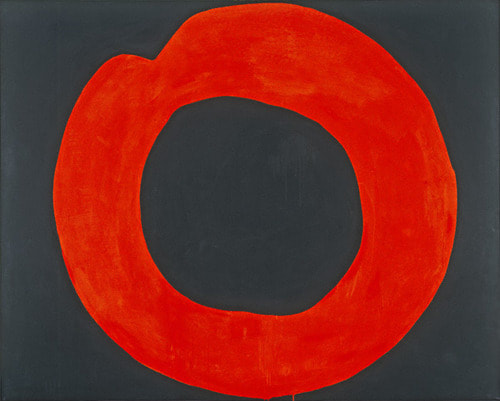 Red Circle on Black, by Jiro Yoshihara (Japan) 1965 Join us for biweekly ekphrastic writing challenges. See why so many writers are hooked on ekphrasis! We feature some of the most accomplished, influential writers working today, and we also welcome emerging or first time writers and those who simply want to experience art in a deeper way or try something creative. The prompt this time is Red Circle on Black, by Jiro Yoshihara. Deadline is August 18, 2023. You can submit poetry, creative nonfiction, flash fiction, microfiction, or any other form creative writing you like. 1000 words max please. The Rules 1. Use this visual art prompt as a springboard for your writing. It can be a poem or short prose (fiction or nonfiction.) You can research the artwork or artist and use your discoveries to fuel your writing, or you can let the image alone provoke your imagination. 2. Write as many poems and stories as you like. Send only your best works or final draft, not everything you wrote down. (Please note, experimental formats are difficult to publish online. We will consider them but they present technical difficulties with web software that may not be easily resolved.) Please copy and paste your submission into the body of the email, even if you include an attachment such as Word or PDF. 3. There is no mandatory submission fee, but we ask you to consider a voluntary donation to show your support to the time, management, maintenance, and promotion of The Ekphrastic Review. It takes an incredible amount of time to curate the journal, read regular and contest submissions, etc. Paying all expenses out of pocket is also prohibitive. Thank you. A voluntary gift does not affect the selection process in any way. 4. USE THIS EMAIL ONLY. Send your work to [email protected]. Challenge submissions sent to the other inboxes will most likely be lost as those are read in chronological order of receipt, weeks or longer behind, and are not seen at all by guest editors. They will be discarded. Sorry. 5.Include YOSHIHARA CHALLENGE in the subject line. 6. Include your name and a brief bio. If you do not include your bio, it will not be included with your work, if accepted. Even if you have already written for The Ekphrastic Review or submitted other works and your bio is "on file" you must include it in your challenge submission. 7. Late submissions will be discarded. Sorry. 8. Deadline is midnight EST, August 18, 2023. 9. Please do not send revisions, corrections, or changes to your poetry or your biography after the fact. If it's not ready yet, hang on to it until it is. 10. Selected submissions will be published together, with the prompt, one week after the deadline. 11. Due to the demands of the increasing volume of submissions, we do not send out sorry notices or yes letters for challenge submissions. You will see what poetry and stories have been selected when the responses are posted one week after the deadline. Understand that we value your participation as part of our ekphrastic community, but we can only choose a handful of the many entries we receive. 12. A word on the selection process: we strive for a balance between rewarding regular participants and sharing the voices of writers who are new to our family. We also look for a variety of perspectives and styles, and a range of interesting takes on the painting. It is difficult to reproduce experimental formatting, so unfortunately we won't choose many with unusual spacing or typography. 13. By submitting to The Ekphrastic Review, you are also automatically joining our subscribers' list. Your submission is your permission. We don't send spam and we don't send many emails- you will not receive forty-four emails a day! Our newsletter occasionally updates you on some of the challenges, news, contests, prize nominations, ekphrastic happenings, prompt ebooks, workshops, and more. 14. Rinse and repeat with upcoming ekphrastic writing challenges! 15. Please share this prompt with your writing groups, Facebook groups, social media circles, and anywhere else you can. The simple act of sharing brings readers to The Ekphrastic Review, and that is the best way to support the poets and writers on our pages! 16. Check this space every Friday for new challenges and selected responses, alternating weekly. |
Challenges
|