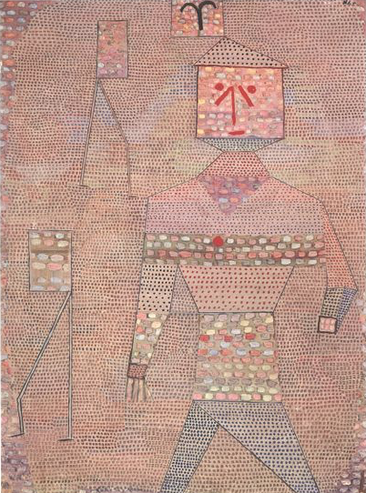
 General in Charge of the Barbarians, by Paul Klee (Switzerland) 1932 Commander in Chief of the Barbarians What will you do, steely man, after your warriors parade their stained flags through the smoking city? Your straight lines admit to nothing soft, but orphans wail, and someone must lay down his sword to learn the local tongue, the strange machines, new ways of stacking stone into walls and towers. And when you’re too old to ride all day, will you pension here? Will your daughters mince native dances while you drowse by a fireplace and its clever, glowing brickwork, oblivious to the next shudder of hoofbeats? 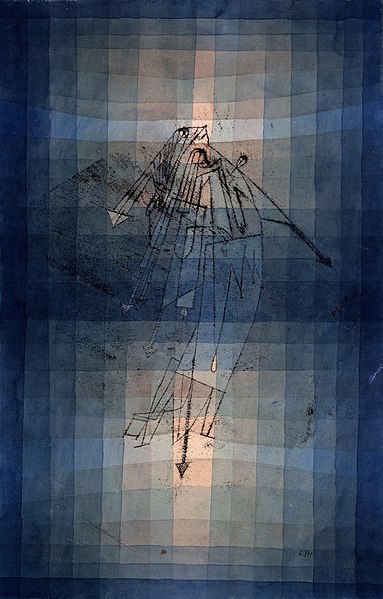 Dance of the Moth, by Paul Klee (Switzerland) 1923 Dance of the Moth A shaft of light impales you. Over and over, you throw yourself on it. What good is faith if I pray just on my good days, or bad days? I crave your constant, reckless spirit. A shaft of light impales you like a bright Roman nail. You fly upward to take the hit. What good is faith if I pray like a moper to get my way while you get used up, to the last bit? A shaft of light impales you, but not as a specimen pinned in a tray. You’re lively as light, on the good foot of good faith. So I pray to say my prayers the way the Irish fling, or the hip hop it. A shaft of light impales you good. You’re faith’s glad prey. 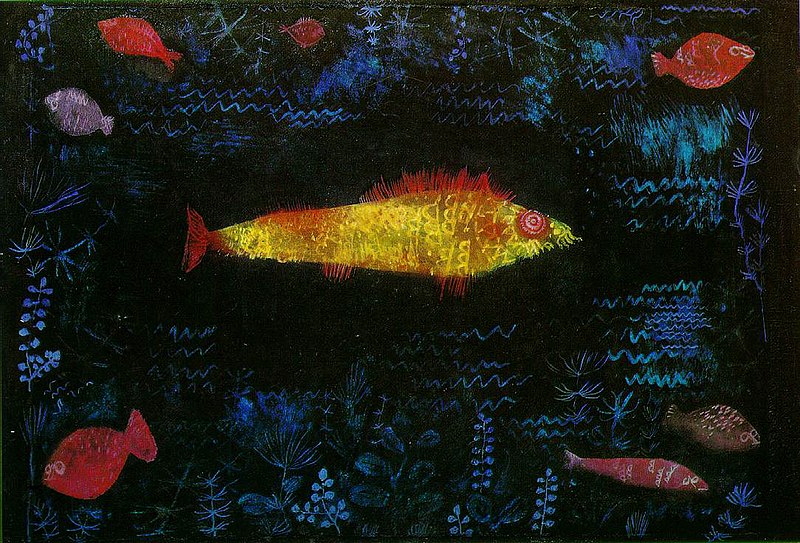 The Goldfish, by Paul Klee (Switzerland) 1925 The Goldfish The centre burns with a fish of gold. Blue-green murk wets its flesh of gold. A body electric, Whitman’s pet, shocks the dark with a flash of gold. Muted juniors swish to the edges, fleeing a light so flush with gold. If I touch it, will I shine too, like a son of fish, refreshed by gold? 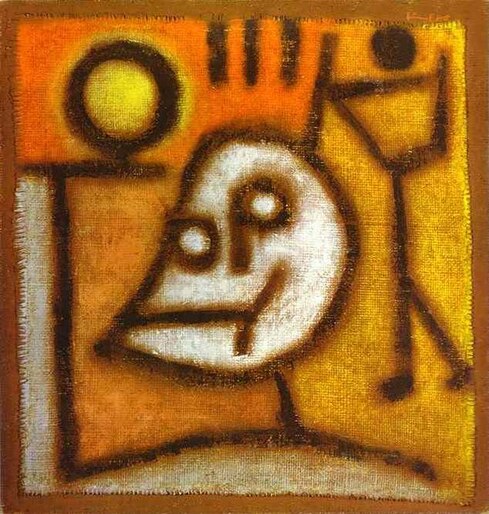 Death and Fire, by Paul Klee (Switzerland) 1940 Death and Fire From Klee’s epitaph: "I cannot be understood in purely earthly terms. For I can live as happily with the dead as with the unborn.” Was this another epitaph? What were you saying when you painted TOD, your native word for death, on the face of a man smiling crookedly in fire, more a skull than face, more an oven’s serene red-yellow glow than woodpile blaze, as if you had crematoriums on your mind in nineteen forty, the year you died, just as your persecutors, who branded you degenerate, had turned industrialists, burning entire peoples. Perhaps you were imagining Nebuchadnezzar’s furnace, where three faithful men didn’t die. Weren’t you burning inside walls of hardening skin, finesse deserting your stiffened fingers? Your brush managed rough black lines, perfect charrings for the characters of death, which you painted twice, once on the ashen mask, its very eyes and mouth spelling TOD, and again with the man’s upraised arm and right-angle palm, a golden orb on top, like a nimbus waiting for its saint, the lopsided face itself forming the final letter. Words live on in the fire. The smile, however mangled, persists. And above, in the corner, a stick figure strolls into the colorful heat, as if of its own free will. You might be saying welcome. Then paint me in. Robert Lowes Robert Lowes is a writer in St. Louis, Missouri, whose first collection of poetry, An Honest Hunger, was published in 2020. In 2017, he took up the guitar, acoustic and electric, and began playing songs by artists that he had never really appreciated before- Tom Petty, John Mellencamp, David Bowie. He hopes to rock on for a long time. You can find samples of Robert's poetry and journalism at robertlowes.com.
0 Comments
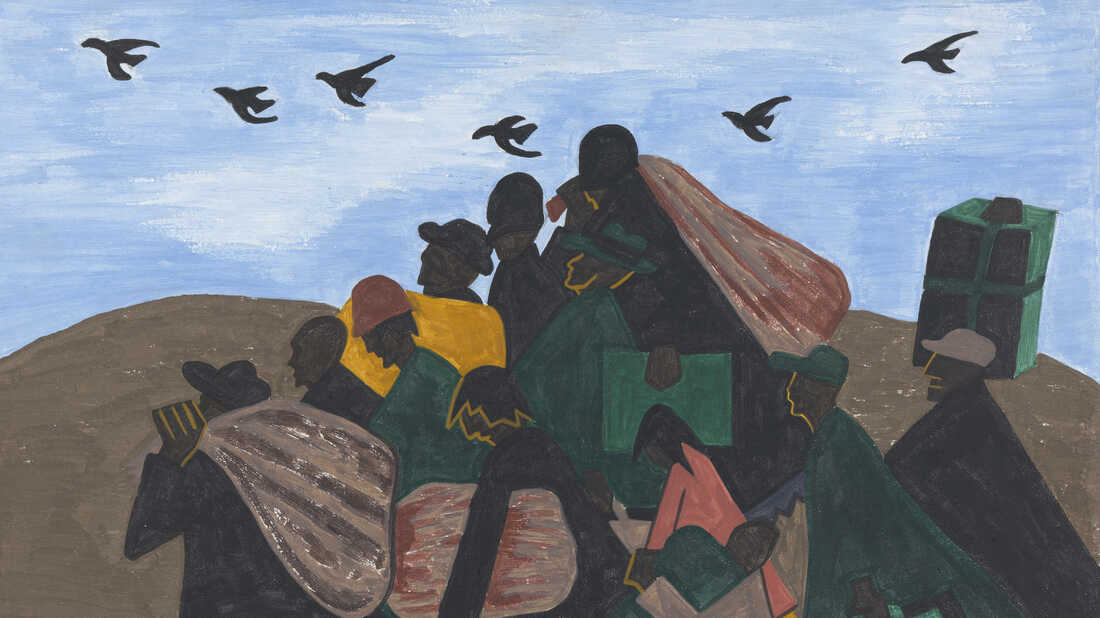 Migrating North, by Jacob Lawrence (USA) 1941 Migrating North "In every town Negroes were leaving by the hundreds to go North and enter into Northern industry." Jacob Lawrence That stuff you learn in school about those geese flying south in winter usually leaves the story at that. It's more complicated why a creature leaves what looks like home. And what is home? You might have been born in a place, but nothing links you to it. Like my kids. One born in Brooklyn, another in Baltimore. Not to mention, the Boston I was born in, the memory of my first 9 years there, with no resemblance to Boston now, 60 years later. Where are you from? is the first question we hear when traveling abroad. I don't know how to answer, how to explain I don't want to belong to the country where I was born. I like the big picture of living on this planet. Like those geese who don't say, we're summer residents of Canada, fly to our second home in the South in Winter. No, they understand you need to find conditions that allow you to survive. For geese, this means a large body of water so those goslings can feed, dive or swim away from danger. They know being flightless is risky. Like those enslaved in the South understood, migrating North to jobs, better food, education, communities where they could vote, where hope feels a little more connected to possible. How do we get to where that's at? Kitty Jospé Kitty Jospé, retired French teacher, active docent, received her MFA in poetry (2009 Pacific University, OR) Since Feb. 2008, she has been leading workshops on art and word, and moderates weekly sessions to help people to be more attentive and appreciative readers of good poems. Prolific writer, popular reader and workshop leader.  This week we dive into the archive to find poetry and prose that use perspective in some extraordinary way and leave you feeling safe, warm and inspired to do your own ekphrastic work. … Edge of the World, by Kendall Johnson An artist-poet inspired by coluor and a dormant volcano: “As you walk, you think other abstract things” https://www.ekphrastic.net/the-ekphrastic-review/edge-of-the-world-by-kendall-johnson ** Sin Collector, by Rajani Radhakrishnan The title of this poem, a Van Gogh painting, and love are brought together into a poem I will be re-reading for days to come: “an improbable love, too big to fit into that slim hipped flask” https://www.ekphrastic.net/the-ekphrastic-review/sin-collector-by-rajani-radhakrishnan ** Anonymity, by Carol Alexander The poet takes the perspective of the painter in this stunning and compassionate poem: “she is on her way to Paris to live among the lindens” https://www.ekphrastic.net/the-ekphrastic-review/anonymity-by-carol-alexander ** Memory is Organic, by Janet St. John Grief, beauty and longing inspired by Van Gogh’s Irises: “blacked out beneath the surface until strong sun penetrated, woke them” https://www.ekphrastic.net/the-ekphrastic-review/memory-is-organic-by-janet-st-john ** Convergence, 1952, by Michael Estabrook A Jackson Pollock painting inspires this poem: “like the infinite chaos of the early universe” https://www.ekphrastic.net/the-ekphrastic-review/convergence-1952-by-michael-estabrook ** Painted by a Drunk in Gumboots by Mercedes Webb-Pullman This poem captures the ekphrastic writer experience so well: “it’s far enough away to scan the canvas all at once moving only eyes” https://www.ekphrastic.net/the-ekphrastic-review/painted-by-a-drunk-in-gumboots-by-mercedes-webb-pullman ** Ad Mariam, by Julia Rocchi The writer contemplates a sculpture of Mary: “Is she merely a conduit, a bridge that rises on the hour” https://www.ekphrastic.net/the-ekphrastic-review/ad-mariam-by-julia-rocchi ** Personal Assistance, by F.J. Bergmann This poem suggests: “Maybe every beauty needs an incubus” https://www.ekphrastic.net/the-ekphrastic-review/personal-assistance-by-fj-bergmann 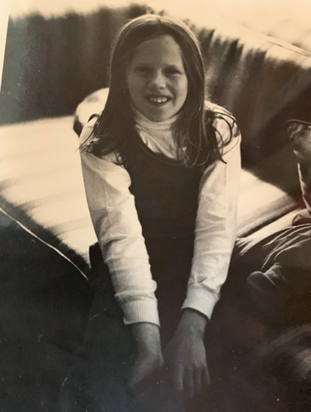 Wee Marjorie. There are almost eight years worth of writing at The Ekphrastic Review. With daily or more posts of poetry, fiction, and prose for most of that history, we have a wealth of talent to show off. We encourage readers to explore our archives by month and year in the sidebar. Click on a random selection and read through our history. Our occasional Throwback Thursday feature highlights writing from our past, chosen on purpose or chosen randomly. We are grateful that moving forward, Marjorie Robertson wants to share some favourites with us on a regular basis, monthly. With her help, you'll get the chance to discover past contributors, work you missed, or responses to older ekphrastic challenges. Would you like to be a guest editor for a Throwback Thursday? Pick 10 or so favourite or random posts from the archives of The Ekphrastic Review. Use the format you see above: title, name of author, a sentence or two about your choice, or a pull quote line from the poem and story, and the link. Include a bio and if you wish, a note to readers about the Review, your relationship to the journal, ekphrastic writing in general, or any other relevant subject. Put THROWBACK THURSDAYS in the subject line and send to theekphrasticreview@gmail.com. Let's have some fun with this- along with your picks, send a vintage photo of yourself too! 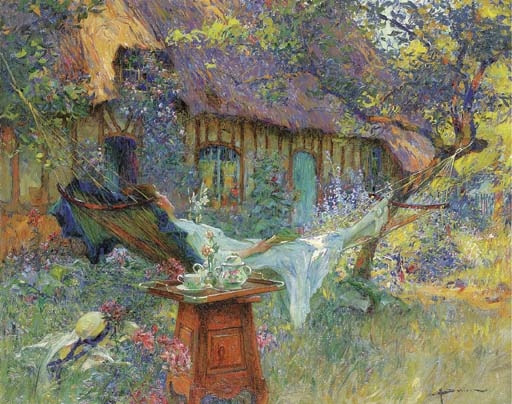 A Lazy Afternoon, by Henri Gaston Darien (France) before 1926 Savour The smell of charcoal—summer’s quintessence—lengthens the hour before supper, suspending the grasp of clock’s hands. Tossed with hollyhocks it underscores wren and towhee recalls a hammockside sip of smoky lapsang souchong dreams sun’s heat from sky, inscribes stone lintel under marriage’s thatched roof. It is the day’s enough. Nancy K. Jentsch Nancy K. Jentsch’s chapbook Authorized Visitors and the collaborative ekphrastic chapbook Frame and Mount the Sky, in which her poetry appears, were published in 2017. Her collection Between the Rows debuted in 2022. Since beginning to write in 2008, her work has appeared in journals such as Amethyst Review, Panoply, Tiferet Journal, and Zingara Poetry Review. In 2020 she received an Arts Enrichment Grant from the Kentucky Foundation for Women. She has retired after 37 years of teaching and finds a bounty of inspiration in her family and her rural home. More information is available on her website: https://jentsch8.wixsite.com/my-site. Outrenoir It’s November and Pierre Soulages has passed. I’m no authority on Soulages or the colour black, but I’m into black’s versatility, how he committed to black. Found light leaping from black—like finally exiting the movie. How black can be snow or slats so dark the black takes over. Soulages, who challenged the connotation of black and the man in black like an ambassador of night, walking to his canvas with a smile, sensing blackout. His oeuvre in motion, catching glints of dark blue, black as a glacier. Eric Steineger Eric (Charles) Steineger teaches English at East Nashville Magnet High School. For ten years, he was the Senior Poetry Editor of The Citron Review, and his work has been featured in Waxwing, The Los Angeles Review, Rattle: The Poets Respond, The Night Heron Barks, and other places. He lives in Nashville with his daughter. 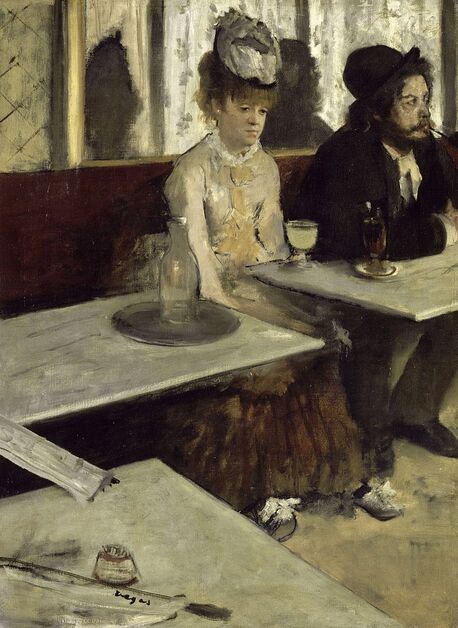 The Absinthe Drinker, by Edgar Degas (France) 1876 Dose by Dose No longer the coquette she was, she sits beside a shaggy-headed man and stares above the glass of absinthe which impairs her health and happiness. Sometimes she quits the stuff, but doing so gives rise to fits of longing, then surrender. No one cares enough to help her sort out her affairs, or so she claims when any chance permits. But mostly she is silent while she drinks herself oblivious in the same café of shadows every disappointing day. She slumps—arms limp, legs crossed—and barely blinks as though a measured potion might assuage her sorrows either on or off the stage. Jane Blanchard This sonnet by Jane Blanchard of Augusta, Georgia, was first published in The French Literary Review. Jane’s new collection of poetry is Sooner or Later (Kelsay Books, 2022). 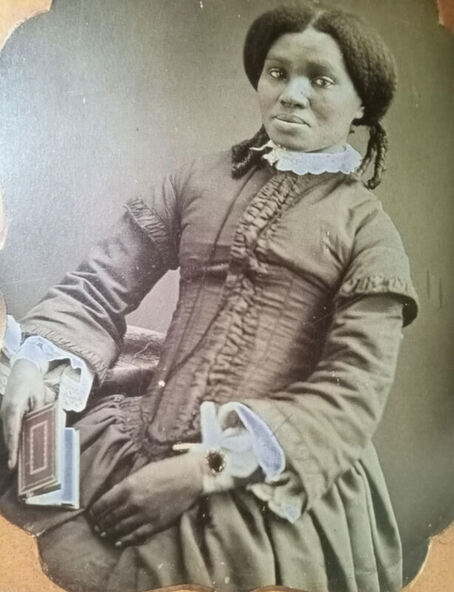 Unidentified Black Woman, photographer unknown (USA) c. 1850. George Eastman House collection. Portrait of an Unidentified Black Woman, c. 1850 no i am not your slavery question no house girl mule wench i record prophecies & passwords & proverbs curses & abolition-talk in my demure pocket-book i'm not propped up in this chair for your 15 minute emancipatory politics my hands wide as oars row through slave rolls span continents & octaves command servants like moses come down shape the finest pastries more delicate than the northern star reverend said the stowaways devour them with both hands like as if they were the christ-body how do you like my plaits? i straighten them as best i can don't want to scare you with my kink unruly as the irish (harpooned in this whalebone corset what i wouldn’t give for my cotton nightgown embroidered with the pink violets the one i wear in the garden on spring nights while the homestead sleeps to let the warmth creep into my spiraling moss) how am i doing? am i developing nicely? i want not to make a bad impression my silver-plated spirit doused in mercury finished in gold chloride affixed as your white scalding skin daguerreotype of I [unknown black woman] dark as the ocean bed’s secrets & no i will not smile for the camera Alexander Perez Alexander Perez has published poetry in Blue Unicorn, South Florida Poetry Review, Queer Toronto Literary Magazine, and elsewhere. He has a chapbook entitled Immortal Jellyfish forthcoming in 2023 from Finishing Line Press. Alexander is a member of the Hudson Valley Writers Guild and resides in Upstate New York with his partner James. For more, feel free to visit perezpoetrystudio.com 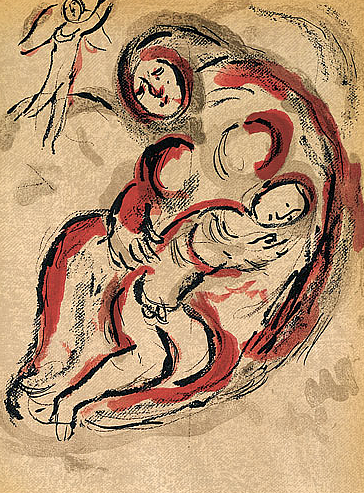 Hagar and Ishmael in the Desert, by Marc Chagall (France, b. Belarus) 1960 Hagar, Comforted You’re telling me my son will live? Your words offer a bottomless well of cool, fresh water to us in this parched wasteland. My only sustenance these last hours has been the warmth of his body against mine. Although his limbs lately have become like shoots in the first warmth of a spring sun, he still fits snugly in the circle of my embrace. The One Who Sees must have ears as well. I rocked my boy, smoothed his matted hair. We clung to one another as if to ropes that could haul us out of a dark, earthen-walled pit. I could not bear to see his listlessness, his lips dry as blown dust. Yet hearing his cries as I crouched far off cracked open my heart, unleashing my own wails, the last bitter drops of water on earth drying to salt flats on my face. All this because I did what was asked. Neither the wrinkles carving my master's face like gullies nor his grizzled beard were enticements. I admit I grew haughty, but soon I was taught to remember my servitude. Still, the All-Seeing's unsought promise succored me. My master's eyes softened whenever he beheld my boy, but spiteful Sarai swelled with venom as if from an asp's bite. Young as he is, my Ishmael is handy with a bow. If we could find a spring in this wilderness near which to forage, we could stay here gathering strength, just as my child once sojourned in my womb. Our burning thirst now slaked, when he wakes I will cradle him, the mercy of the One Who Hears anointing him like costly oil, comforting him even as I have been comforted. Patricia L. Hamilton Patricia L. Hamilton, the author of The Distance to Nightfall (Main Street Rag), is a professor of English in Jackson, TN. She won the Rash Award in Poetry in 2015 and 2017 and has received three Pushcart nominations. She has new work in Soul-Lit, Fare Forward, and The Windhover and work forthcoming in Bindweed and Broad River Review. She enjoys travel, jazz, and cappuccino. 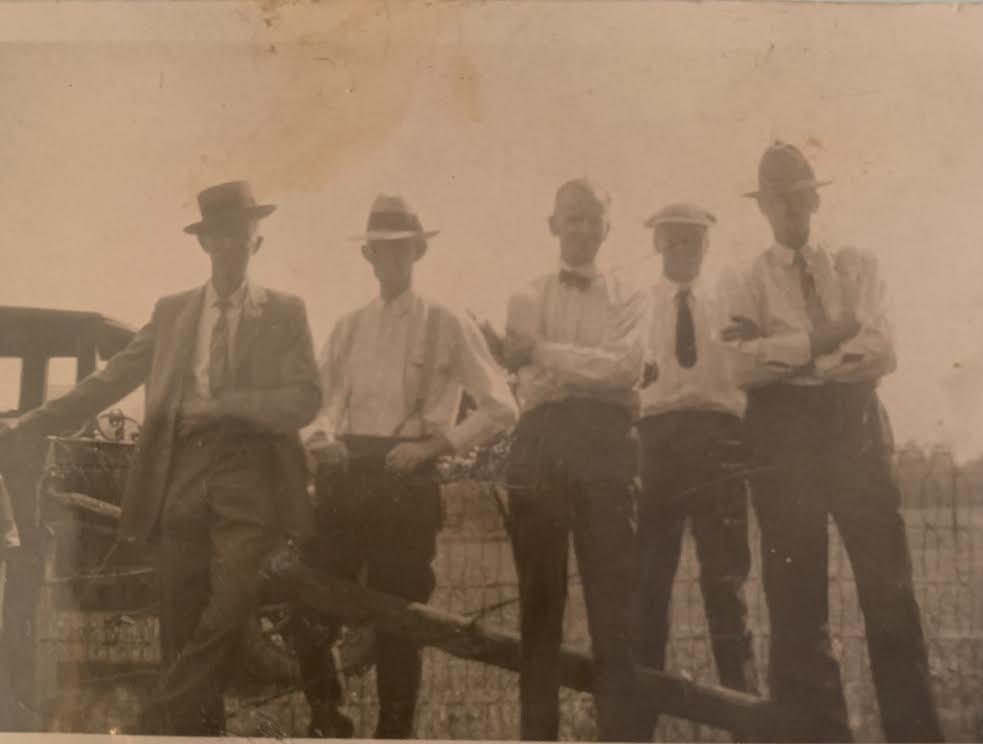 The Higgins Brothers (Date Unknown) from the private collections of MaryBeth Brockley and Nancy Jack, Indiana The Higgins Brothers, Five Irish Bachelors from a Family that Didn’t Talk about the Past The Higgins brothers wore fedoras and neckties on their days off from Interurban runs on the Tecumseh Arrow. Patrick, or was it John, preferred bow ties, knotted on a white shirt. Crooked, by design. Peanut never cottoned to Herbert Hoover chokers. Instead, he sported those yellow suspenders his girlfriend gave him. The hash slinger he carried on with in the Indian Nation. Folks from Rose City said the Higgins boys drank in speakeasies where they cozied up to hoochie-coochie dancers. That they hung out with Baby Dodds from King Oliver’s Creole Jazz Band. What with William doing odd jobs for Gennett Records and such. William, large in the background. The muscle. Hard-boiled. His name left off the backs of photographs. Joseph dressed like a drugstore cowboy in a Sears catalog suit. Folded his left arm across his stomach. Flexed his legs the same way he held his body when he played poker and pitched woo. Rumor had it they favoured gingers. Except Peanut who flattened lucky pennies on the rails chasing after that waitress in Okmulgee. They lived in a two-story on the Irish side of Bridge. In the shotgun with the profile of a caboose turned on its end. They stayed skinny to pass each other in the halls. Except William. The roughneck who kept a red banty rooster to lord over a flock of ornery hens. Peanut tended a crop of sunflowers in their backyard. Bragged about the chokecherry sunflower pies the Nation gal baked. Any one of them would spit between your legs if you took a shine to Hoover. For family photographs, they stared into the camera with mugs blurred. As if leery about leaving clues. The type of men who crossed their arms when the deal didn’t square. Peanut’s right leg cocked, Okie style. John’s Cord rumbling in the background with a tankful of Fire Chief octane, primed to challenge the hairpin curves in the road ahead. Michael Brockley Michael Brockley is a retired school psychologist who worked for 33 years in the schools of northeast Indiana. He lives in Muncie, Indiana where he is looking for a dog to adopt. Over the course of his 73 years, Brockley has companioned five German shepherds and a shih tzu. Since retiring, he has been submitting poems to small market and literary journals. His most recent poems have appeared in Shorts Magazine and Syncopation Literary Journal. Poems are forthcoming in Gargoyle. 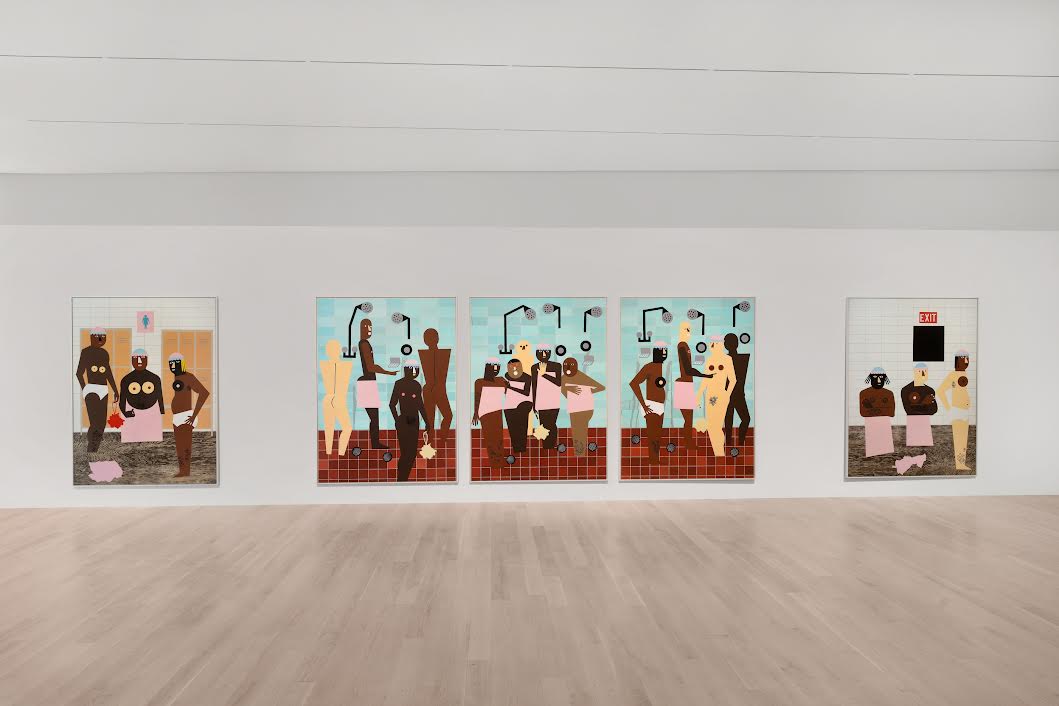 You Spot It, You Got It, by Nina Chanel Abney (USA) 2022. Collage on five panels Papersize: 96x72 in., each Framed size: 971/2x731/2x13/8 in., each. Courtesy the artist, and Pace Prints, and The Institute of Contemporary Art, Miami. Photo Zachary Balber. PORKY'S OBSCURA & ART WEEK MIAMI 2022 Nina Chanel Abney Turning the Artworld Upside Down at ICA 1. Have you ever seen the '80s movie Porky's? A group of immature high school kids travel to a brothel named Porky's and get taken for their money. Get this: the brothel owner is the bad guy for not letting the kids have a prostitute for an hour. The movie is outrageously awful. But in the pre-internet, pre-Blockbuster world of the '80s, scoring a VCR tape of Porky's was one of the best chances you'd get at seeing naked boobs. No one I knew even watched the movie Porky's, except for the rapid blur of fast-forwarding between nude scenes. The makers of Porky's are the reason remote controls were invented with pause, fast-forward, and rewind. Filled with cringe-worthy racism, anti-Semitism, and a heartbreaking scene where a young Kim Cattrall character gets compared to a dog due to her howling during sex, people never seemed to notice any of these negative elements about Porky's until recently. But everyone knew all about the infamous shower scene. Porky's was America. Porky's was as American as apple pie before the American Pie movies were even pitched to a production company. How American was Porky's? Picture Ronald Reagan wearing a cowboy hat and singing at the Porky's premiere: "Oh, give me a home where the Porky's girls roam, and the showers have peepholes all day." Just think: naked boobs were once a rarity and not as common as spam emails and telemarketing calls. Secret routes to seeing bare nipples were something you once whispered to friends or strained to overhear. A generation of Americans could identify with that peep-through-the-wall shower scene. Not because they were necessarily voyeurs. But because of the impressive Raiders of the Lost Ark-style adventuring they'd done to score a VCR tape copy of Porky's in the first place. Listen: Is there any more fitting symbol for the annual spectacle of Art Basel Miami Beach than outsiders peeking through a hole in the wall to take in the sultry and forbidden? Is there a more apt representation of trying to catch the week-long decadence than the fast-forward blur required to experience even a small part of the massive show during a trip to Miami Beach? 2. For everyone who fought through those Miami late-night parties and near-collapsing exhaustion, there was a light at the end of the tunnel–or a green light flickering across the water of Biscayne Bay: Abney at the Insitute of Contemporary Art, Miami. Anyone who missed Nina Chanel Abney's Big Butch Energy during Miami Art Week has dozens more chances to take in the most important works of capital B Basel, as the show runs through March 12, 2023. But in the context of Spring Break for hedge funders, mega collectors, chic celebrities, and the art elite, Abney's signature collage style and pop references did more to render the unique experience of insider/outsider, viewer/subject, and voyeur/exhibitionist that is explicit in any trip to Miami Beach during Art Week. With Big Butch Energy, Nina Chanel Abney affirms her unheralded prominence as a new pop pioneer with the unique ability to capture the now while dismantling tradition. Squint across Biscayne Bay for hope. Like the stream of light erupting from a movie projector, Nina Chanel Abney lights the way. Nina Chanel Abney flicks on the neon sign. 3. There were eventually four Porky's films in total. Thank the makers of Porky's for the endless sequels to the Police Academy and American Pie movies. The Porky's people set the standard. Maybe even thank them for the countless inside references to Marilyn Monroe and other pop art icons during Miami Art Week, 2022. At some point, these pop references become an echo of an echo, a Porky's-squealing sequel of a sequel. The inside jokes and fast-dashed representations beg the question: How many versions of Frida, Basquiat, and David Bowie can you see? Or, at what point does pop art become unpopular art? Riffs on Basquiat, Warhol, The Simpsons, and Murakami bounced off exhibition wall dividers during Miami Art Week, kicking off with the previews at SCOPE. The whole thing begged another question: How much McDonald's can one gorge themselves on visually? Call it unconscious bias. Chalk it up to the fact that I was probably the only person in Miami Beach who had ever actually worked at a McDonald's for art supplies. But the fries seemed like they'd been out too long at times; and without the benefit of heat lamps. While there were notable and exceptional exceptions, the ritzy, fun art party on the beach made me wonder (at first) if neo-pop had popped. In terms of temperature: when does cool get chilly? Even a pimply-faced kid who figured out how to palm 20s from the cash register to buy those art supplies (drugs) knows that when the fries are cold, you make a new batch. You'd never serve bad fries to Marilyn Monroe. Unless the masterful Ben Frost is serving them, the answer is: No, I do not want any more fries with that, thank you. 4. On Waldo: The funhouse of pop art sequels at Basel's associated fairs was so homogenous at times that the striking resemblance between Keith Haring and the infamous Where's Waldo seemed like no cosmic coincidence. The trick in many of the Art Week pieces was finding the reference to Haring, Warhol, or Murakami in the art on display. Where's Waldo? In one canvas, a woman had painted a self-portrait of herself, painting a Keith Haring knock-off. There were so many imitation Waldos that when a real Haring appeared, it felt like an oasis called hope. I had a poetry instructor once who said you had to watch out when referencing the masters. Lead in with Elizabeth Bishop, Robert Frost, or Maya Angelou, and your reader will compare your work against them the entire time. It would be hard to win that battle. So, did anyone mention to these artists that taking on Warhol or Haring would be a bloodbath? McDonald's might be an easy match. But to lead with the chin against Frida Kahlo is a disaster in the making. God, please let the new artist American Pie kids out of their contracts. Please, let's just watch the original and let Jason Biggs have his way with a pie. When an art fair becomes less interesting than a trendy t-shirt shop, you stare around at all the Marilyn's screen-printed on cotton blend and hope that you'll make it to Nina Chanel Abney on Sunday. 5. In defense of my press passes: Art Basel Miami Beach is proof God exists and wants us to be happy. Make that Art Basel proper, as Art Basel may be the eye's equivalent of getting cleaned with a glamorous and magical Q-tip, but all the other cotton swabs on the shelf we call Q-Tips too. There's SCOPE, Aqua, Untitled, yacht shows, INK, exclusive shows, CONTEXT, unheard of shows, Art Miami, installations, private parties, not-so-private parties, hotel shows, elaborate galleries erected on the beach, Design Miami, and more. Colours, costumes, and contagious enthusiasm permeate the event, from every grain of sand to every flickering light drone creating art above the Miami Beach Convention Center. To place it in context, the legendary Paris Salon drew about 450,000 people a year. For those to whom even 1981's Porky's is ancient history, The Paris Salon was the unprecedented art event of the world. Not only could it make or break art careers, but the Salon was also a scene. Think 19th Century Coachella or Burning Man, Paris-style. Think Art Basel Miami Beach. In the days and times of streaming services and social media, who knew people even looked at art anymore? In those echoes of the overdone, there is tremendous magic in Miami every year. For each snobby, "Is this where hotel art comes from?" SCOPE sets the pace for the week with standouts, knockouts, and an all-star cast. Machine Gun Kelly bought a Riffblast, a Jonas Brother made an appearance, Roy Jones Junior stopped by. But the best guest star of all Art Week was the dragonfly trapped inside the luxury tent at SCOPE. If we have to die, let each of us see heaven as a dragonfly buzzing past throbbing bass beats, neon flashes, and champagne cocktails in the middle of the night in a magical art structure specially constructed on the beach. 6. The greatest gallery achievement of 2022 Art Basel Miami Beach was the curatorial excellence on display at the mother of the Miami Beach art fairs during Art Week. Think you've seen pop in the other locales around the beach? Nope. Acquavella's placement of Andy Warhol's Self-Portrait (fright wig), 1986, stared out and reminded us all who our god is, still. He glowered a welcome to everyone from Entrance B, in maybe the best placement of the fair. Acquavella also had Tom Sachs' Master Blaster, 2022, with stages of corporate icons Trojan, Chanel, and Hermes announcing what great pop is now, something in a different universe than many of the pieces from the smaller fairs. At Pace, Robert Longo's Untitled (Ghost Stadium) in charcoal on mounted paper from 2022 was the perfect take on Covid life. A huge image with empty seats and beckoning darkness looming, there were omens and premonitions. It goes further than a reminder of early-Covid days, taking on the atomic level of white blood cells in darkness: a stylistic pointillism of white dots swimming in a vast vacuum of black. It was paired with the vital and energetic Lynda Benglis, Power Tower, 2019, a White Tombasil bronze melting reflections from every passerby. There were a few similar Benglis' scattered around Basel. They are all beautiful. But when placed close to the Longo, Pace has given a narrative voice to the Basel audience emerging into art madness. Together, they showed the before and after, humanity and emptiness. Together, a generation in attendance was bound between these two moments of virus, decay, blooming, and rebirth. There was also a Keith Haring baby around the corner and maybe the most beautiful Julian Schnabel of all time: The Moon and Sixpence, 2022, made up of oil, gesso, modeling paste, and bleach on velvet. It recalls Van Gogh trees from The Sower. We reap what we sow. 7. In his first major art event since being released from prison, Arthur Oswald Fischel could not stop yammering about old masters throughout Art Week. Also, the famed art dealer and conceptual artist would respond "camera obscura" as a non sequitur. -How's your hotel room? Camera obscura. -Did you see the ATM machine from Brooklyn art collective MSCHF? Camera obscura. But on the day he experienced Nina Chanel Abney at the ICA, Fischel was speechless. 8. A camera obscura would have been used by all sorts of artists who exhibited at the famous legendary Paris Salons. A predecessor to modern cameras, the camera obscura is as simple as poking a pinhole through the wall of a dark room. The light coming in will project an image of what's on the other side of the pinhole on the opposing wall. The paintings of Degas and the Impressionists certainly have a warped-lens feel of a camera projecting. Monet had a room on his studio boat where he could use a camera obscura to render the images projected. But the Impressionists, Leonardo da Vinci, and Johannes Vermeer didn't invent the camera obscura. Eastman Kodak didn't either. God did. 9. God created a pinhole in every person's eye. This hole takes the image you see and projects it on a movie theater screen inside your head. There are remnants of popcorn and french fries on the floor. Sometimes you can hear your sneakers stick to the old Coca-Cola spills on the concrete. But the images are shown upside down. Your brain has to flip them right side up. Everything in the world is flipped upside down in your head and then right-side up before you even know it. You can read about the masters and camera obscura in a book titled Secret Knowledge by the contemporary master David Hockney. Actually, the text will be flipped upside-down and right-side up before you even know it. 10. On books: One of the most important pieces of 20th Century American Literature is The Great Porky's. In the book, Jay Porky fulfills the adolescent dream of every cis white guy. After she leaves him for another dude, Jay Porky gets super rich and wins his ex-girlfriend back. In the book, a huge billboard stares down. The billboard features a pair of eyes (camera obscura) that are the eyes of God (original model camera obscura). God's pinhole camera is different from yours and mine. When God looks, she flips everything right-side up right away. 11. The town the main character in The Great Porky's lives in is split between two sections, West Egg and East Egg. Jay Porky buys the most badass house possible in West Egg. It sits right across the channel from where his ex lives with her husband in East Egg. Of course, there's a pinhole mark in the velvet black, there across the water, emitting green light. It's like a star or a torch or the small spot where a camera obscura lets in the light and flips an image for tracing, rendering, and selling down the road. Through his tiny green light, Jay Porky projects this strange, upside-down version of what he thinks money and success are. He builds an upside-down house. He makes upside-down friends. He lets out upside-down sighs. His house hosts parties as fabulous as the Paris Salon. Art Basel Miami Beach hasn't been invented yet. In Miami, there's a piece of land to the west on the mainland. There's a piece of exclusive land to the east called Miami Beach. The Miami Beach Convention Center hosts Art Basel (East Egg). In between these two is the water of Biscayne Bay. During Art Basel and Miami Art Week, Nina Chanel Abney's work in the ICA is across Biscayne Bay from Miami Beach. Of course, her show made a pinhole across the water. Of course, the water is a wall. Of course, people keep looking through the peephole in the wall. When Jay Porky finally gets his ex back in the book, she leaves him. Women! You gotta drill a hole in Biscayne Bay just to see a pair of boobs in this town. 12. From the press release of Nina Chanel Abney's Big Butch Energy: "With reference to the traditions of baroque portraiture and fraternity composites and to scenes from popular slapstick comedies like Animal House, Abney deploys the culture of Greek student life to mine and trouble norms of racial and sexual desire in the U.S. In this series, Abney pays special homage to the figure of the Black masculine woman, suggesting, alongside Abney's recent exhibitions, the artist's affinity for Black women and men who abstain from hetero-and cis-normative performances of gender. The resulting paintings explore the tension between respectability and vulgarity, and how this tension often rests precipitously on a ravenous desire for social belonging." 13. In the original Porky's, a group of hetero men design a camera obscura by drilling a peephole through the wall in a women's shower. They flip the women's images and distort the world. Jay Porky created a pinhole in the night by staring at a green light. He fashioned a camera obscura across the wall of water separating West Egg from East Egg. Nina Chanel Abney designed a camera obscura through the wall of Biscayne Bay, with her pictures observing the opulence of Art Basel across the water. The figures in her 5-panel picture If You Spot It, You Got It stare back. No teacher scared Nina Chanel Abney off from taking on the masters. And not just with some '80s-style VCR-riff on television camera obscura. In You Spot It, You Got It, Abney presents the image of a group of naked women in the shower, staring at the viewer. Those of us who know the reference are given many choices in this pivotal moment:
Each of the panels is 96 x 72 inches. The quiet space of the ICA may have been the only hush in all of Art Week, save for the powerful Untitled by Glenn Ligon at Basel, a rendering of the letters AMERICA in white neon with all the letters X'd out except for ME. This quiet allows Abney to take over. It allows these pieces to swell and expand in their life-sized scale. They stare back. Who is the observed, and who is the observer? Note: At no time during The Great Porky's does God shove her penis through the peephole. 14. In The Impressionist Porky's, a group of 19th Century young male artists get together and use cameras and peepholes to assist them in making art. One example is The Great Bathers 1884-1887 by Pierre-Auguste Renoir. Part of the permanent collection of the Philadelphia Museum of Art, the painting renders an adolescent fantasy of women in the nude. Rather than a slow-motion pillow fight, Renoir presents a VCR-paused moment when one bather with great boobs playfully threatens to splash her Victoria's Secret model companion. Other hotties pose and primp and seem ready to launch an OnlyFans page as soon as the internet gets invented. In the movie, Renoir, Degas, Cézanne, and their buddies keep returning to the peephole at the bathing hole. They watch Bathers Standing and Bathers Drying Themselves. They giggle at Bathers Stepping in a Tub. Bather Admiring Herself, Bather With a Rock, Bather Wiping a Wound. Hundreds upon hundreds of times, the guys keep returning. In the original Porky's movie, some adolescent boys make a camera obscura by drilling a peephole into the women's showers. Eventually, one of them actually jams his penis into the hole of the camera obscura. "I paint with my prick," as said by Pierre-Auguste Renoir. 15. Arthur Oswald Fischel's friends often referred to him as "Arthur Actually" during Miami Art Week. He seemed incapable of not jumping into any conversation without saying, "Actually…" "Actually, the Saint Lauren presentation of Madonna's photographs in the pop-up gallery on the beach was a perfect Marilyn Monroe redux. Those fries are still nearly too hot to eat. "Actually, the best conceptual art I saw through my camera obscura eyes was the number of times the General Manager at my overbooked hotel tried to sell me on a different room. We walked up and down the halls in an artistic version of Let's Make a Deal. "Actually, speaking of Renoir's quotes on his phallus: There is an artist named Pricasso from Australia who really does paint with his penis." "Just think about the chafing." 16. If anyone gave a similar warning to this great contemporary artist, not to mention the masters on their canvases, thankfully, Abney didn't listen. The ICA works, through the lens of '80s movies, take on the whole of art history, the hetero-normative representation of the nude (and the viewer), and the role of the artist in advancing culture. Staged, sexualized, flipped-over, and distorted, the woman's role in most of the arc of art history was to be painted with the prick. The figures in You Spot It, You Got It, stand ready to reach through the picture, grab hold of whatever Renoir is pushing through, lean back, and pull. The figures in You Spot It, You Got It, pull on our sense of pop culture and art history so hard that Renoir and his buddies leave drywall silhouettes after they're made into metaphorical wrecking balls. Nina Chanel Abney invites us to step through to an intimacy of self, unencumbered by the wall, the unwanted gaze, and the role of the outsider or object. 17. Not all of the realizations in Abney are optimistic. True to the journey of challenging the past, we must contend with the truth we find. In Porky's List, the series took a dark turn. Contending with Holocaust deniers, the movie featured an extended shower scene. Women are marched to the dreaded concentration camp showers. Shirts tight against their breasts, fabric sliding over naked flesh, they strip en masse. We look through the porthole/peephole as the door slams and seals. When the water spurts instead of Zyklon B gas, there is a relief more excruciating than hope. The eye of God turns everything right side up. 18. Like everyone, Arthur Fischel was always fascinated by stars. Not just the celebrities everyone flocks to see. Not a glimpse of a Jonas in the art show or a Marilyn on the wall. Even as a young boy, Arthur took every chance he got to stare up at the millions of shimmering pinholes swarming in the night sky. Each pinhole star was emitting images of another world. When he was barely pubescent, Arthur's older sister asked if he'd like to see stars in the middle of the day. "Impossible," he said. "No. We will zip up a jacket. You hold one end of a sleeve to your eye. I will stretch the other one way-way up in the air. It works like a darkened telescope. Here," she said. "Lay down on the ground." His sister climbed up on a footstool. Arthur lay in the sharp summer grass. "You must cover your other eye too. The key is to get as dark as possible." Arthur knew she was right. Things had to be perfectly dark to see the stars; to see the pinholes opening into a million-million other worlds. Her words were muffled through the coat and the distance of the stool. "Can you see the blue of the skies?" she said. "Yes," he said. She poured a pitcher of water down the sleeve and into his face. 19. In Miami, we look through the peephole to see the art. We look through the peephole to gawk. At Jay Porky's house, the people and the costumes are just as interesting as the architecture. In AMERICA, with everything crossed out but ME, we look through the television peephole to gawk. We glow in the casting light. We are a crew of kids in Poltergeist getting pulled into the screen. 20. The truth is, everyone feels like an outsider at Art Basel Miami. People name their private jets OUTSIDER. They approach Miami airport and peer down through the oval windows at a world of lights poked through the velvet sky. The pilot has to trust their altimeter to keep the plane from turning upside down. The rich aren't artists. The artists aren't rich. The rich aren't rich enough. The artists aren't artsy enough. The artist's art isn't rich enough. The rich artists aren't art enough. The art isn't rich enough for the rich. The rich aren't rich enough for the art. The world keeps getting flipped upside down. No matter how much you are, there is always more. And no one knows what to wear. Spoiler alert: Jay Porky dies in the end. 21. At its best, Art Week Miami (Basel) gave everyone thousands of pinholes poked into the sides of walls; squares to peer into new flipped and rendered realities, realizations of another possibility for experiencing the world. Leonardo Hidalgo spun a diver over a pool, mashing Hockney & Lichtenstein. On the day after James Rosenquist's birthday, there were beautiful echoes of his work to be heard in the Paul Rousso pieces, which are great. Robin Kid's Bless Our Broken Home blended structural grating with dramatic gun violence, a melding of machine-sized sculpture, and larger emotion. Jeff Koons' bowl of eggs captured both East and West Egg and danced all the more with the dark-suited, dark- shaded guards sprinting from side to side so no reckless observer could break their enormous shells. Every curve of a glimpsed-at Kara Walker allowed the world to reconsider shape. Arthur Fischel even settled his decades-long search for the Where's Waldo inheritor, an artist to carry on the much-needed spirit of Keith Haring all these years away as Ken Nwadiogbu's The Migrant and Journey Mercies brought a signature handling of colour and lines into 3 dimensions; a whimsy of palette mixed with intense subjects and themes. But the 20th Sequel to Art Basel Miami had its best moments in being looked at. Not like the woman in the Madonna Saint Laurent show who kept getting caught taking unauthorized photos and saying "oh, I didn't know," but the staring out of artworks that could tell you anything about your life: Sesse Elangwe's figures on bright backgrounds looking through you, Warhol's portrait of Lichtenstein–the master of presenting dimensional pinholes–reminding the world of his twin camera obscuras and the indebtedness each pinholed wall art owes to his creeping grin. Even then, it's not until Abney that the world has all its eyes. 22. Getting it and Gotting It The haves and have-nots. The gaves and gave-nots. The gits and the git-gots. You spot it; you got it. Art Basel is the International States of America. In jail, famed art dealer and conceptual artist Arthur Oswald Fischel attended 12-step meetings just to get out of his cell. One of the attendees' favorite sayings was, "You spot it, you got it." He might say, "My mother was overbearing." "You spot it; you got it." "These tater tots are gross." "You spot it; you got it." "You know what? You're being a real dick." "You spot it; you got it." Camera obscura. The question is: Who wants what you got? The question is: What is Miami Beach during Art Week but a series of peepholes? What are the best canvases on the walls but pinholes poked into a waiting, different world? Kurt Cole Eidsvig Kurt Cole Eidsvig's poetry and art criticism has been included in regular columns for publications like Big Red & Shiny, ArtsAmerica, SpinRecords, and Examiner.com. He has been featured and published in The Boston Globe, Slipstream, Hanging Loose, Borderlands, Main Street Rag, Poets Reading the News, The Improper Bostonian, The Southeast Review, NBC, CBS, and ABC. Eidsvig has won a Massachusetts Cultural Council Fellowship, a Warhol Foundation/Creative Capital Award, and the Edmund Freeman Award. He has taught art and writing at UMASS Boston, the University of Montana, and the Isabella Stewart Gardner Museum. A visual artist as well as a writer, his work is part of numerous private and commercial collections and has been included in exhibitions in LA, Boston, Key West, and Sydney. He is the author of the books Art Official, OxyContin for Breakfast, and POP X POETRY. 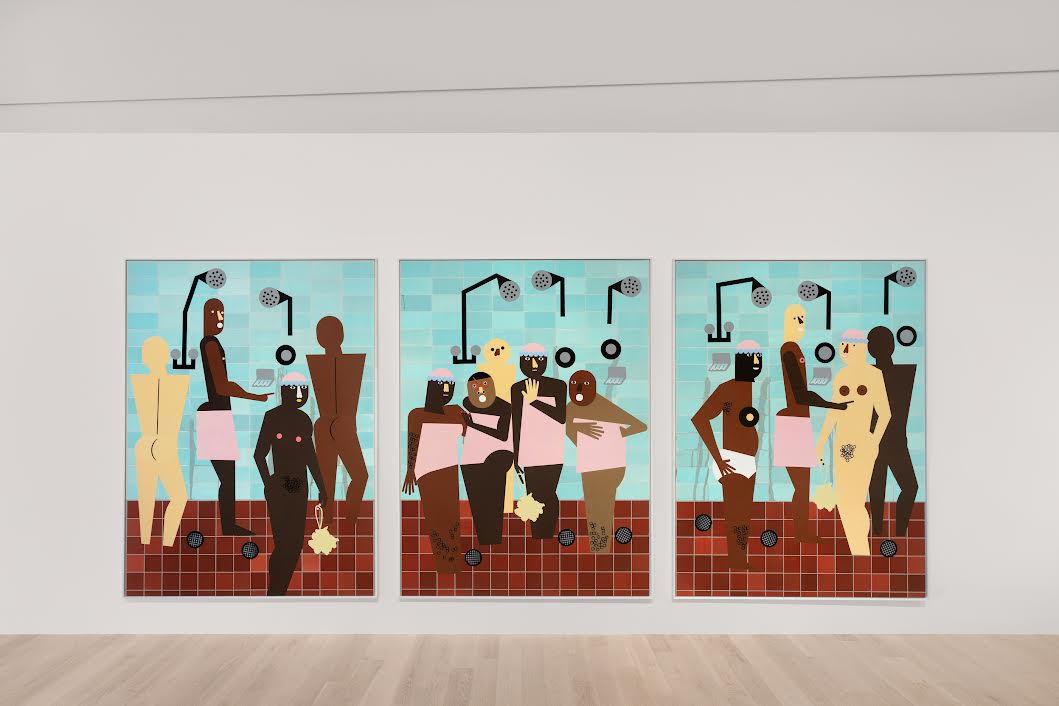 You Spot It, You Got It, by Nina Chanel Abney (USA) 2022. Collage on five panels Papersize: 96x72 in., each Framed size: 971/2x731/2x13/8 in., each. Courtesy the artist, and Pace Prints, and The Institute of Contemporary Art, Miami. Photo Zachary Balber. |
The Ekphrastic Review

COOKIES/PRIVACY
This site uses cookies to deliver your best navigation experience this time and next. Continuing here means you consent to cookies. Thank you. Join us on Facebook:
Tickled Pink Contest


April 2024
|