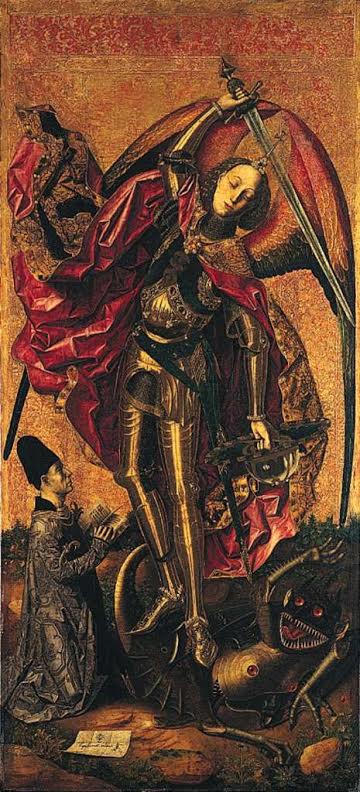
 Saint Michael triumphant over the Devil with the Donor Antonio Juan, by Bartolomé Bermejo (Spain). 1468. Saint Michael Triumphant Over the Devil, With the Donor Antonio Juan
Oi, Mr. Patron Saint of Bankers, won’t you take your foot off my tail? It’s hardly a fair fight, is it: I’m much smaller than you and made of duller metal like some discarded robot, a machinic sob story, that’s me. Show some respect for your elders. Here you are, head in golden sky, Jerusalem on your chest like bling, while I’m rusting and writhing on my belly in the mud like it’s something I enjoy or my job. As if that isn’t enough, I have to listen to your mate over there droning on with his psalms while you dismember me with a sword which cost more than all of my rust put together. What a way to go: chopped up and bored at the same time. I thought I might go with a bang or with a Jezebel (which is the same thing). You seem to forget there’d be no swords, psalms, gold, bankers without me. You lot make me sick. You make my stomach bring up snakes. What you gonna do when I’m dead, hey? Kill the frigging painter, poor Bartolomé? Well, watch out. I may be a goner, but there’ll be plenty of others coming after. There’ll be plenty who’ll take my place: other robots, underlings, small Satans. You can’t win because you can’t do without us, however you detest us. And for now, you self-righteous sod, I’m at least going to bite your foot. Jonathan Taylor Jonathan Taylor's books include the novel Melissa (Salt, 2015), the memoir Take Me Home: Parkinson's, My Father, Myself (Granta, 2007), and the poetry collection Musicolepsy (Shoestring, 2013). He is director of the MA in Creative Writing at the University of Leicester in the UK. His website is www.jonathanptaylor.co.uk.
0 Comments
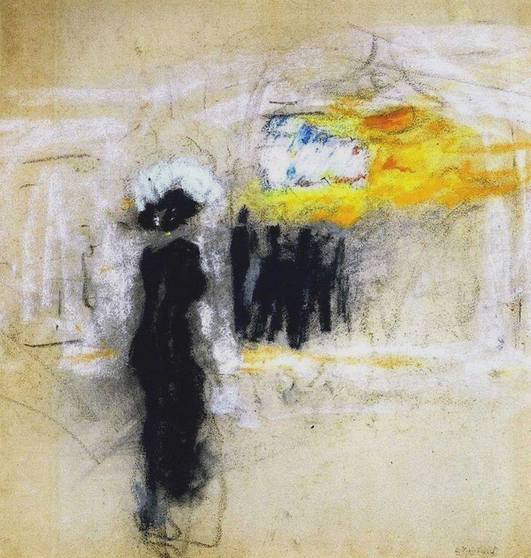 Femme, by Edouard Vuillard (France), 1908. He Flatters Me I am smudge, but somehow, the artist renders me elegant, a chiffon darkness on a heat-shimmering beach, my aloneness foregrounded, sightlines strengthening my distance from the crowd. He swaddles us all with a gentleness reserved for the newly-born, cradling us where we are. A golden heat rests briefly on our heads before trickling elsewhere. Like any heliotrope, I turn towards it, marking where drops have fallen. I will gather them up into a book, later to revisit the time I was so beautiful. Devon Balwit Devon Balwit writes in Portland, OR. She has five chapbooks out or forthcoming: How the Blessed Travel (Maverick Duck Press); Forms Most Marvelous (dancing girl press); In Front of the Elements (Grey Borders Books), Where You Were Going Never Was (Grey Borders Books); and The Bow Must Bear the Brunt (Red Flag Poetry). Her individual poems can be found in The Cincinnati Review, The Stillwater Review, Red Earth Review, Tule Review, The Ekphrastic Review; Noble Gas Quarterly; Muse A/Journal, and more. Please look for her on Facebook. 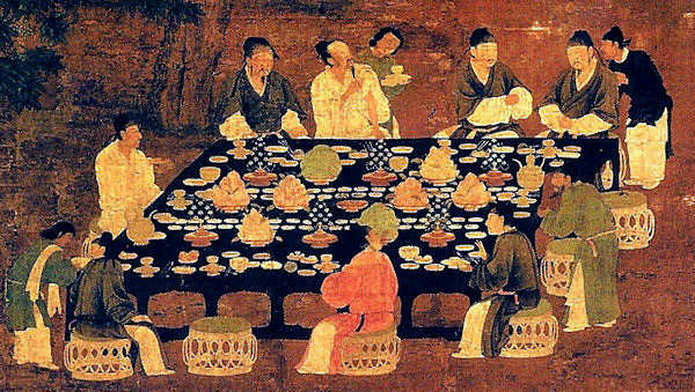 An Elegant Party (detail), attributed to Emperor Huizong of Song (China), 1100? On First Reading Li-Young Lee’s "Eating Together" I hold the page that holds the poem under my breast where it rests against ribs. My heart with its resonant thump makes itself felt in its cage. Its pulse on the page shakes the words ginger sesame fingers and I feel the warm fragrance of this meal that a family takes together weeks after their father dies. Alive, he held his food deftly between fingers the way my father did. I know the light touch. The father dies in the poem lonely for no one. But my father, on a fine June day, went to his office and shattered his life all over the x-ray room. Understand how a quiet death blanketed in snow is music that eases this dangerous lesson. The notes come from a place where it’s possible to trust the silence that follows. Judith Bowles This work is in response to the aforementioned poem. The painting was selected by the editor and did not prompt the poem. Read Li-Young Lee's poem that inspired this one, here: https://www.poetryfoundation.org/poems-and-poets/poems/detail/43015 Judith Bowles lives, writes and gardens in Washington D. C. She has an MFA from the American University in short fiction and taught creative writing there. Two of her stories were selected for the Pen Syndicated Fiction Project. Her poems have been published in The Delmarva Review, The Innisfree Journal of Poetry, and Gargoyle. Her book, The Gatherer, was published by WordTech Communication’s Turning Point in November of 2014. 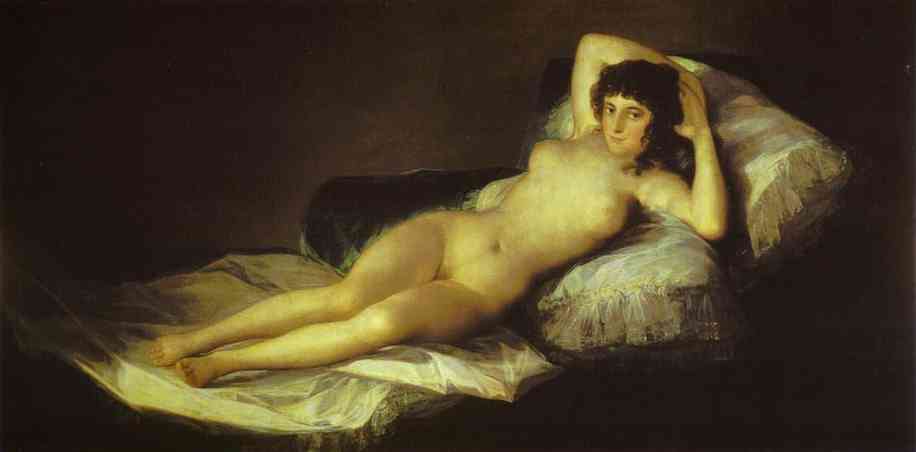 La Maja Desnuda, by Francisco Goya (Spain), 1797-1800. La Maja Desnuda You recline wet and nude on my canvas a perfect success of curves and the bent knees of submission. I close the blinds on the eyes of the world so only I can watch you slowly dry, your damp hair and sweaty skin. But eyeing the pallet like one last drink, I give in to a drunkard’s temptation. Pushing for a beauty beyond perfection I try adding to you, thickening your lips or making them tremble. I mix paints with tiny bird feathers, ashes of my journals, salt from my sweat, beach sand to match my stubbled throat, and glass, ground fine as pollen to sparkle your cheeks. I search for new brushes: a thin brush to tickle you, a flat hard reed to mold you, a heavy housepaint brush to smear you and prove my detachment from your image. I search the house for new tools, my toothbrush, my babyteeth, my backbone, a scorpion to see if you jump, if its trail would slur new patterns of delight onto your wet skin or if he might be dazzled and drowned in your colours. I fear I’ve gone too far. I want to remove that sharp edge of your beauty, the heavy breasts, the willful cross of the arms, the dazzling eyes. My hands shake. I cannot work quickly. I run through the house turning on the stereo, television, radio, dishwasher, trying to lure my senses from you. I sweat for you through the din. I return and throw my whole body against the canvas, falling back stained with your image. I paint in deafness. I paint out your eyes and make you a beggar with bloody knees. I try to secret a flaw on the canvas so the drying paint will peel back and flake away. I shake the canvas to see what you’ve been hiding, expecting secret pentimentos to fall from your mouth. My knees finally weaken and I slump in the chair. I paint your eyes back in and they shine in victory. I wipe the blood from your knees and find your thighs flushed. Your chin juts out defiantly beyond the canvas. Your hands could mold me into submission now, holding my brush and turning it to thicken my mustache or deepen the blue of my eyes. I look up to see you reaching toward me. m.j.smith m.j.smith teaches literature, mythology and writing courses at City College of San Francisco. smith's recent work has appeared in Alba: A Journal of Short Poetry and Corners of the Mouth: A Celebration of Thirty Years at the Annual San Luis Obispo Poetry Festival. smith works in the Mission district of SF and lives at the foot of Mount Diablo in Concord. voyagecities.wordpress.com 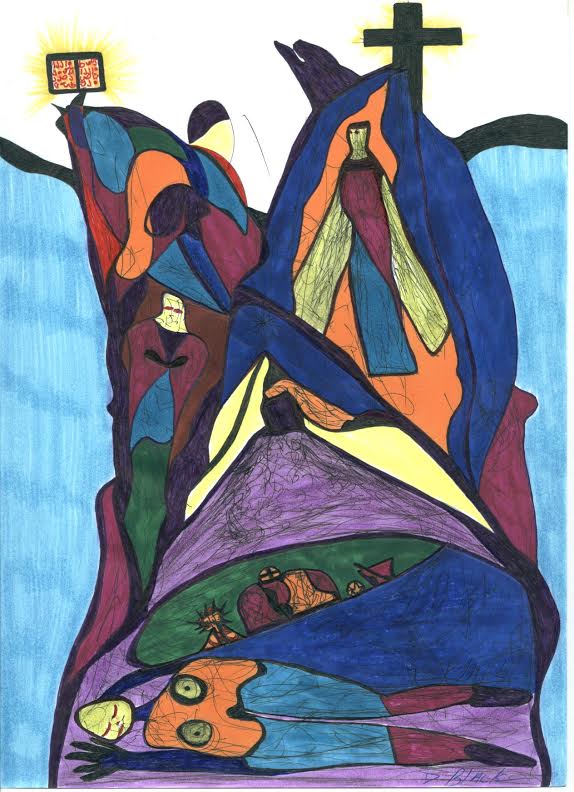 Archeological Dig, by Darrell Urban Black (Germany, b. USA). Contemporary. Click image for artist website. http://darrell-black.pixels.com/
"My name is Darrell Urban Black born in Brooklyn, New York, I grew up in Far Rockaway, New York...As a child, I made spaceship models eventually placing my artistic visions on paper resulting in some 500 drawings. Phantasmal spaceships eventually carried me to unique wonderland of strange forms and colours. In 1982, I joined the National Guard...In 1988, I joined the army and served another four years. I earned my Bachelor Degree in Science of Criminal Justice Administration at the University of Phoenix. In April 2001, I was nominated by the German government as a "candidate of the year's prize for promising young artists." ...I had many local, national and international group art exhibitions. I have artwork permanently displayed in a number of art galleries, museums and other institutions in America and Germany. My artwork has been displayed in Veteran Art Shows including one at Intel® Corporation in 2014. I live in Frankfurt, Germany and continue to draw and paint in pursuit of my artistic dreams. I'm a member of the Veteran Artist Program abroad (EuroVAP)." 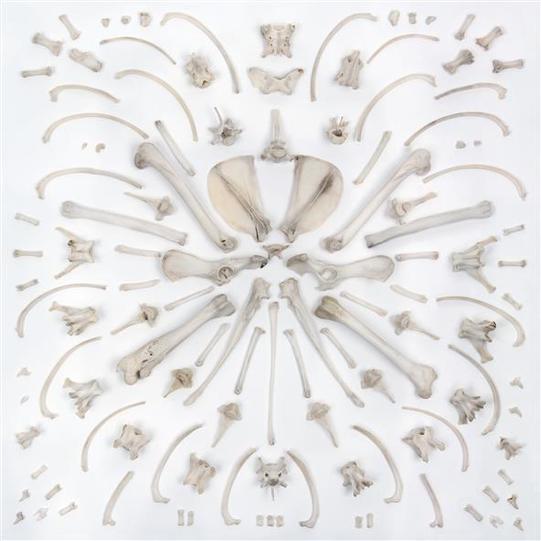 Untitled #4 (fox bones – pattern), by Jessie Imam (Australia). Contemporary. Click image to visit artist website. As the Fox Bones Speak
Under the whitest moon she finds the body of a fox, shot, the bullet hole like punctuation By midnight she has scoured the forest for the missing bones. Arranged the skeleton of Vulpes vulpes beneath a tree. Her neck’s bristling, which means a man has crossed her path. Her legs freeze. He’s pressed to the earth in front of her, squinting over the lip of a ridge; nose twitching, stink rising, quickening the air. It’s a week since he jumped ship and started hacking his way back to his slim-hipped vixen waiting for him in a hidden cabin. She’s sick. It takes him a month to reach her. A month to lay out the bones he’d taken from the woman in the forest—tarsals, carpals, fibulas, tibias, ulna, sacrum, distal phalanges, ribs, scapular and skull—rearticulated to form the mandala she’d bewitched into being. Done, he turns to his dying lover. Traces her like the fox. Begs the bones to speak. Marjorie Lewis-Jones Author's note: "I saw Jessie Imam’s Untitled #4 (fox bones – pattern) and it made me think of oracle bones, and how ancient Celts and shamans inscribed questions on bones, and believed that bones have voices (much as some people today still believe their dead ancestors speak to them). Imam hoped her artwork portrayed ‘acceptance of our bodies’ inevitable destruction, rather than one of fear’. But I’d already conjured a man who could not accept the destruction of his lover’s body—and was desperate enough to resort to many things, including ‘scrying the bones’ (in his own way), to try to heal her." Marjorie Lewis-Jones is an award-winning Sydney writer whose poetry and prose has been published by Spineless Wonders, ABC Radio National, Picaro Press, Poetry Australia, Cordite, Uneven Floor, Hunter Writers Centre, Best Australian Writing 2015, the ACU Prize for Poetry 2016, and other anthologies. She runs the literary blog, www.abiggerbrighterworld.com  Photo by Clem Onojeghuo (UK). Contemporary. Glass Slipping Through Fingers Heat sand enough, burn and char it like scorched earth and it will melt and ooze. Kiss and slip into a new form Where once its home was an hourglass, slowly ticking away the minutes, a processional. Grain by grain. But now we’re both blistering together in our own personal supernova, forced to forgive time and instead gaze Upon one another’s reflections. Where you were onyx, you’ve now become supple and soft. Where I was fickle, I’ve now Become stone. Where we grew and waned together, there is a chasm. And the only way to bridge the gap Is to break the glass. Sarah Clayville Sarah Clayville: "My work has appeared in journals such as The Threepenny Review, StoryChord, 1:1000, and others. I am a high school English teacher and freelance editor for several online journals." This poem was inspired, "by a series of photographs documenting disturbed graves where bones weren't taken but rather scattered in an almost beautiful fashion. I found them in a set of antique National Geographic magazines as I was cleaning an archive." The original photos were by Gregory Jennings in "Buried Beneath Time," October 1952. The photo shown here is a phenomenal photograph by Clem Onojeghuo, but it is not the original source of inspiration. 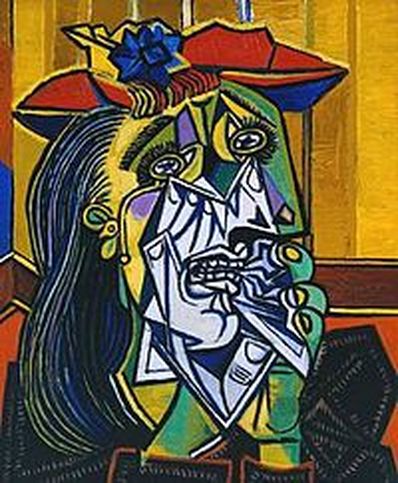 The Weeping Woman, by Pablo Picasso (Spain), 1937. Disconnected Picasso paints my insides with the outsides of his weeping woman: her violet, cobalt, tourmaline hair sweeps to jigsaw colours cutting deep. White skewers, green clamps, blue creases, purple, yellow pleat her face into angles that say don’t touch. Such a lonely place. I want to ask her if she is clenching her handkerchief with her teeth to express grief, or if those three green fingers claw at it, as two yellow eyes of fingernails look on with that jagged white stovepipe of a thumb. What rips at a mind like that? What can repress it? Energy weeps in colours chiseled into shapes—they cut the chords in the throat. Kitty Jospé Reprinted from Kitty Jospé's 2012 chapbook, Mosaicq, with permission from Finishing Line Press. Kitty Jospé: "After retiring as French professor, I completed a low-residency MFA at Pacific University in 2009, and teach ekphrastic writing in summer to teens at our local literary center which is a short walk from the University of Rochester museum, Memorial Art Gallery where I have been a docent since 1998. I also give lectures on bringing poetry alive by careful study of art." 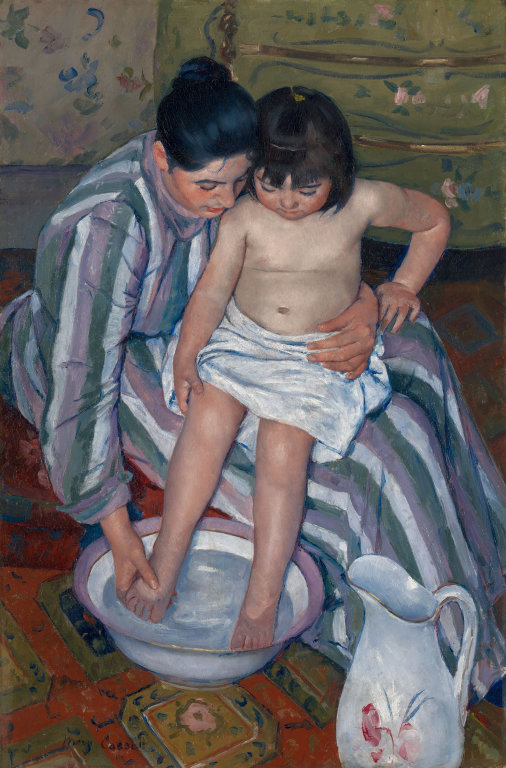 The Child's Bath, by Mary Cassatt (USA), 1893. Mary Cassatt
Mary, you forged new worlds. Choosing art over marriage, motherhood, and men, You created life in the sphere To which you were oft times Restricted. You painted us absorbed In our work, Our children, Our craft And defined our moments Of self, Solitude, And strength. Untraditional Mary Cassatt Who valued tradition With strokes as discerning as our mothers’ voices, You elevated us to Milton’s Aonian heights. We are commanding and dignified, At ease on your canvas. Jo Taylor Jo is a 35-year teacher whose favourite genre in the classroom is poetry. In the past several years she has found herself writing poems alongside her students, and their submissions of their work to one-line journals and other contests have encouraged her to do the same. Jo’s favourite hobbies are writing and hanging out with her two-year-old grandson. She and her husband live in a small community outside of Atlanta. 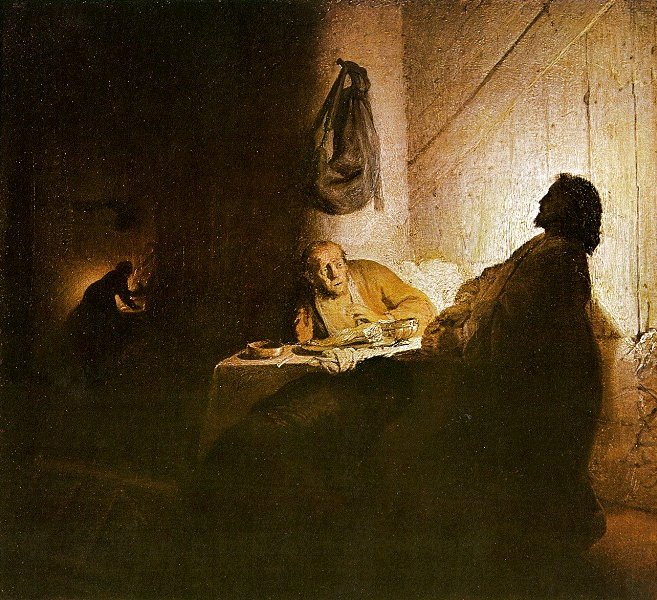 Supper at Emmaus, by Rembrandt van Rijn (Netherlands), 1628. Rembrandt's First Emmaus Begin at the tiny woman, attending in far left’s dark distant background. Always begin at any tiny woman, seemingly shrouded with inconsequence, because that tiny woman is probably the presence who makes everything else fall into place and flourish. That tiny woman in the Rembrandt, haloed and thereby sacred in her ministrations, obvious source of the tabled silver. You’ll notice she leans forward now into her work, at the same angle the foregrounded Christ reclines, relaxed no doubt because of her and what she’s served. Christ and the woman sway together, even at a distance, making everything else possible. The facing man canted opposite against them both, still of this world, as if counter-balancing, aghast, and knowing at last he’s never been in control, with his own astounded doubt that has always thrown him off-kilter. His gesture is almost fearful, hands nearly defensive. Is this then Cleopas from the Book? His dubious mouth and startled eyes? And then, his friend from the journey, now become the adoring darkened supplicant, suddenly part of that shadowed obscurity that contains now all of the Christ. Everything sweeping into that new-dimension dark miracle, the other-worlded shadow, the chin-whiskered, exuberant Christ, cast by unseen light that might be of His own creation. Tilted back, cast back playful, relieved at last of earthly burden, to enjoy at last the brilliance of a realized Being. Could this be? Rembrandt must have seen it when he painted. How the shadowed foreground has been newly transported from a realm somehow beyond his earth-bound palette. And what is it of the slanted paneled wall so brilliant and un-cross-like in the light that knows to point beyond the crumbling stone — back and up to Heaven? Harry Youtt Harry Youtt is a frequently published poet, three times nominated for Pushcart Prizes. Since 1990 he has been teaching in the UCLA Extension Writers’ Program. Among his other accomplishments, Harry officially coined the phrase: Plain-speech Resonance Poetry. He is most proud of this. |
The Ekphrastic Review
COOKIES/PRIVACY
This site uses cookies to deliver your best navigation experience this time and next. Continuing here means you consent to cookies. Thank you. Join us on Facebook:
Tickled Pink Contest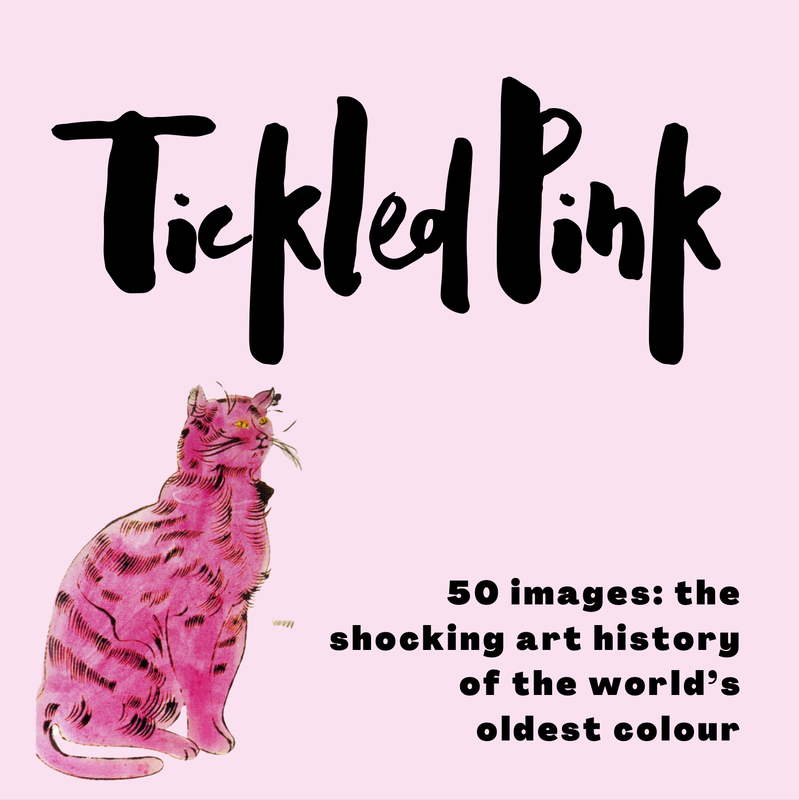


May 2024
|