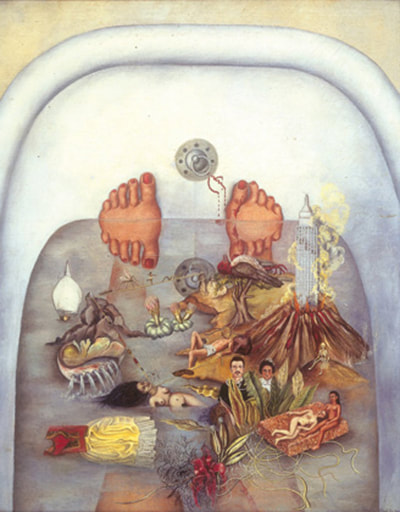
 What the Water Gave Me, by Frida Kahlo (Mexico) 1938.
What Floats is your frilled dress from dance nights, caresses in bed, distant loved ones just visible in the reeds, fig leaves you left on a grave, lopsided toy ship your grandpa made. That’s what stays, tapping gently into porcelain as the water browns, never touching the drain. What sinks is charred soil, bleeding roots, dead finch you saved, then dropped to the worms, microwave fumes choking your favorite part of the skyline, skeletons posed for photo ops, lava flooding postcard towns like a strung noose, embryo leaking from refuse-- all of which whirls down through the crack in your toe, continuing to whistle, stifled, low, so that even as you bathe in what’s left, you always know. Tyler Thier Tyler Thier is a Brooklyn-based adjunct professor and freelance film critic with previous publications in the New York Public Library Zine!, After the Pause, the Maier Museum of Art, Tuck Magazine, and The Ekphrastic Review itself. Additionally, he is a performed playwright and an enthusiast of bare-bones, no-frills Irish pubs.
0 Comments
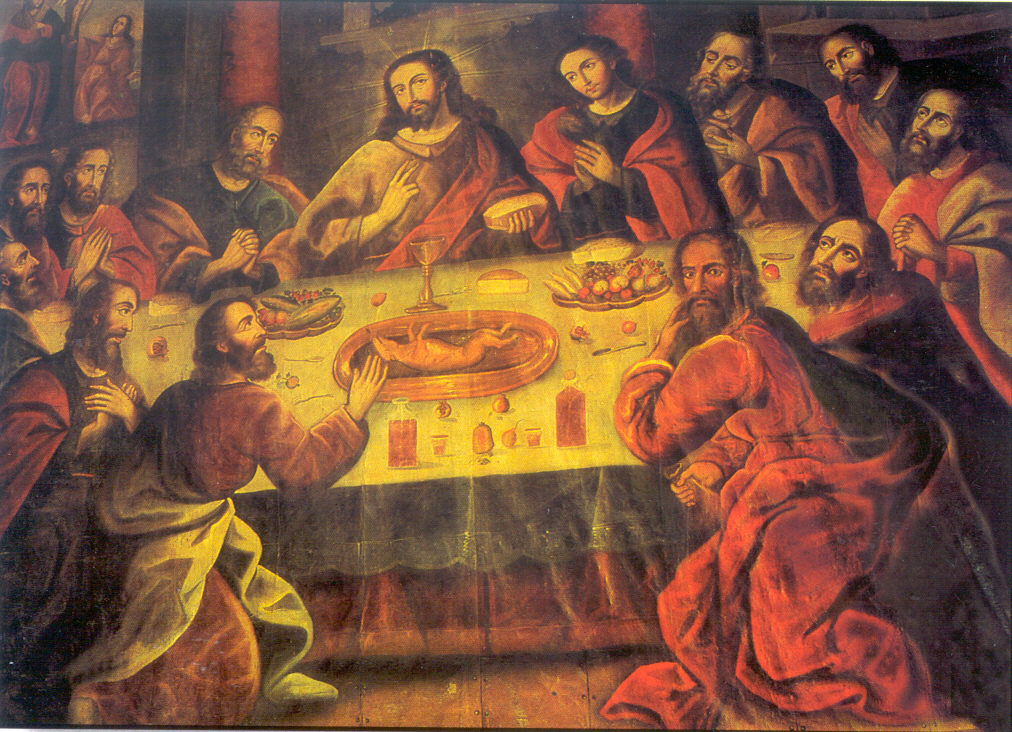 The Last Supper, by Marcos Zapata (Peru) 1573. The Last Supper (Cusco, Peru) for Carlos Seminario Solaligue Painted by the Quechua artist Marcos Zapata in the waning years of the Inquisition, it hangs in a cathedral in the Andes, built on the foundation of a sacred Inca site eleven thousand feet closer to Heaven than the Milan convent housing da Vinci’s rendering of the same uneasy repast. Zapata’s Jesus looks preoccupied as he hefts a loaf of bread, considering its worth. On the table goblets of wine surround an ornate golden salver on which lies a delicacy unknown in the Holy Land, a roasted guinea pig flat on its back feet in the air. One of the apostles has turned away from Jesus. Adorned in a sumptuous red robe, Zapata’s Judas stares directly at the viewer and it comes as no surprise that he bears a resemblance to Juan Pizarro y Alonso the Conquistador. Andrew Merton Andrew Merton’s poetry has appeared in the Bellevue Literary Review, Alaska Quarterly Review, The Rialto, Comstock Review, Asheville Poetry Review, The American Journal of Nursing, and elsewhere. He is the author of three books of poetry, all published by Accents Publishing (Lexington, KY): Evidence that We Are Descended from Chairs (2012), Lost and Found (2016), and Final Exam (2019). He is a professor emeritus of English at the University of New Hampshire. 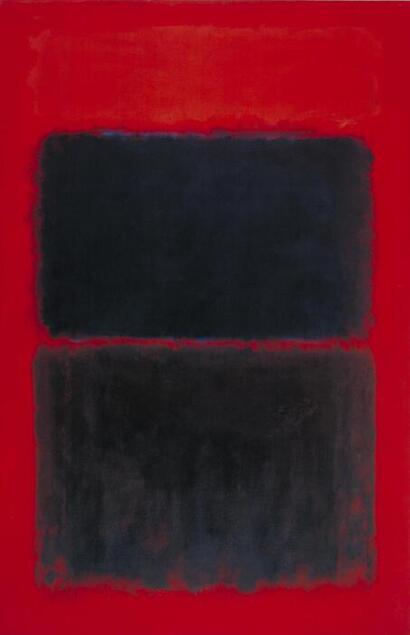 Untitled (Black on Red, 1957), by Mark Rothko (USA, b. Latvia) 1957. the differences subtle how to gauge darkness? little separation between what is and what could be or from what is outside, where there is no promise of light, the darkness expanding, nothing excluded, leaving us companions in this future: everything is darkness Ken Gierke Ken Gierke is a retired truck driver who enjoys kayaking and photography, but writing poetry brings him the most satisfaction. Primarily free verse and haiku, his poetry has appeared at The Ekphrastic Review, Amethyst Review, Vita Brevis, and Eunoia Review, as well as at Tuck Magazine, and can be seen on his blog: https://rivrvlogr.wordpress.com. ** Memories and Rothko’s Black and Red The Rothko Black on Red, 1957 invites me to free associate. I have no direct connection with this untitled painting, but I’m hooked on it. It invites Stendhal and also connects me somehow with my Latvian piano student and the Latvian composer I met in New York who played the flute - yes, his name returns: it was Arnold. We performed works together at the tiny Music Settlement School at which I taught for seven years. Where have those Latvian melodies gone? Do they linger still, echoing from the walls of the small performance hall the school contained. Its little stage, two steps up may not have had a window opening onto the back street, (it’s unlikely a stage would have a window) but that back street was important. The wealthy of the neighborhood lived along the front street, hard-working Chinese and Spanish immigrants lived on the back street. The poor were welcomed as heartily by our music director as the well-to-do. I remember how one Suzi W. developed as a violinist, ultimately inheriting the director’s European-made violin. I met the student later, an adult, performing in an ensemble on a more elegant stage in NYC, having achieved, having endured the demanding and screaming lessons the director gave. But here are those children, some grappling with their instruments more eagerly than others; often, the “privileged” discarding the privilege and demands of performance more quickly than the back-street-kids, all eager and pounding at their drums, often expressing their delights in raw form. So here, then, is the red and the black, or the black on red as Rothko would have it. The contrasts, the struggles, the attaining. The drama of Rothko’s works is transferred into my personal memory canvas. I don’t know how that transfer occurred, but now i feel more closely linked to this work; I have delved into my past, that past with its dramatic musical explosions and explorations, both my own, and those that occurred within the young children. “True drama is a narrative structure involving the reversal of fortune, or at least some sense that this reversal has happened or can happen, and though drama is possible in an abstract painting, it requires specific elements.” Thus wrote a reviewer of Rothko’s work. I sense the reversal, the possibility that things can go either way, toward healthy development, perhaps, or toward cowardly refusal. It’s all there in his canvas. Carole Mertz Carole Mertz studied music at Oberlin College in Ohio, in New York, and in Salzburg, Austria. She taught music throughout her thirty plus years in New York City. She publishes bits of memoir on various online sites and enjoys visiting the ekphrastic review for its ongoing challenges and stimuli. Her first poetry collection Toward a Peeping Sunrise is forthcoming from Prolific Press in October. It includes one ekphrasis on Renoir. ** Pondering Rothko During Acupuncture I lie still under the needles, a motionless hour of subtraction, my body drifting free from pain. The surprise of two black rectangles, islands in a sea of red, stretches my mind’s tableau: Rothko’s Black on Red. I once sought solace from deep angst in Houston’s Rothko Chapel. His late '60s paintings starkly black. Only whispers of green and maroon. He took himself out of the world before they were hung. Though Black on Red, painted in 1957, still vibrates with lifeblood. These needles cannot pulse the chi, an energy to illuminate this man’s visions, his early life in Russia, a displaced person in New York. Did he feel he had lost a mother tongue, a country? Did the slow drain of bright colours, finally red, from his canvases—the dominance of black— paint him into grief’s clutches? An abyss the only option? Sandi Stromberg Sandi Stromberg served ten years on the board of Mutabilis Press, a Houston-based press dedicated to serving the poetry community in the region. She was guest editor of its anthology, Untameable City: Poems on the Nature of Houston, which the Houston Chronicle recommended in 2017 as one of 10 best books about the city. ** Black and Red If twice qualifies as warning in a wind of wings blackbirds do not like competition when you walk along reeds in a red sweater. The dulled black of a steam engine as the sun sets over the Sangre de Cristo range is illuminated as if an annunciation. In the marsh, holly blanketed by berries is strung with seaweed that dried in branches after the storm of my youth. A cardinal calls. A cardinal calls. Kyle Laws Kyle Laws is based out of the Arts Alliance Studios Community in Pueblo, CO where she directs Line/Circle: Women Poets in Performance. Her collections include Ride the Pink Horse (Stubborn Mule Press, 2019), Faces of Fishing Creek (Middle Creek Publishing, 2018), This Town: Poem of Correspondence with Jared Smith (Liquid Light Press, 2017), So Bright to Blind (Five Oaks Press, 2015), and Wildwood (Lummox Press, 2014). With six nominations for a Pushcart Prize, her poems and essays have appeared in magazines and anthologies in the U.S., U.K., Canada, and France. Granted residencies in poetry from the Massachusetts Museum of Contemporary Art (MASS MoCA), she is one of eight members of the Boiler House Poets who perform and study at the museum. She is the editor and publisher of Casa de Cinco Hermanas Press. ** Untitled They say it isn't art. They say it's too simple, even a child could do such work. I look at the squares, contemplate their meaning, the way they juxtapose, the way the colors complement yet contrast, then ask them without scorn, "Tell me, what to you is art?" Then without hesitation say, "the tragedy of love", watch the colours run. Dan Franch An American abroad, Dan left his hometown near Chicago in 1994 and has since lived in five different countries. His poems and other writings have appeared in The Ekphrastic Review, Luxembourg Times, Issa's Tidy Hut, Jerry Jazz Musician, CLEW, and Verse-Virtual. ** atomz this red window frame exposes a living room to breathless night visions horrific absence lurks beyond these panes stuffed full with colourless fields outside we evaporate in the end countless atoms prove we're not alone Jordan Trethewey Jordan Trethewey is a writer and editor living in Fredericton, New Brunswick, Canada. Some of his work found a home here, and in other online and print publications such as Burning House Press, Visual Verse, CarpeArte Journal and Califragile. His poetry has also been translated in Vietnamese and Farsi. To see more of his work go to: https://jordantretheweywriter.wordpress.com ** Two Booths, Red Floor Back booth, three share a dark square bordered by red floor heads blurred at the top. The man had asked her and her mother a question. Front booth, the owner calculates busily on a keypad blue dots of gas meekly lighting his table. His one hand punches numbers. His other stretches across a pinch of red floor by rote refilling their glasses. No one comes or goes. What was the question? she asks. Are you lonely? he repeats as if tired. They hold onto their dark places. Janice Bethany Janice Bethany a part-time professor in Houston, Texas, who recently published in The Ekphrastic Review. ** Rothko “Untitled” – an invitation to share, collaborate, decide what this art means, how it feels – at least on this day – at least to you. Or maybe a dare. It worked. You stopped – not like a typical Don’t Get It rushing by, afraid of any syncopation in the status quo. Wrap yourself in hot red. Shiver against blue prickles. Are you afraid to face what lurks in the dark or ready to throw open the window? Perhaps the blurred edges remind you of your fading life. Still confused? Don’t worry. Something has shifted. You’ve begun to talk back. Alarie Tennille Alarie Tennille graduated from the University of Virginia in the first class admitting women. She’s now lived more than half her life in Kansas City, where she serves on the Emeritus Board of The Writers Place. Her latest poetry book, Waking on the Moon, contains many poems first published by The Ekphrastic Review. Please visit her at alariepoet.com. ** Soot & Ashes He rose from the fog of childhood – out of the time of ashes. It was thought he brought “good luck” to every house, without malice or favour. Each time, his arrival would ring through the building. Dressed all in black from top hat to shoes, to the wire brushes slung over his shoulders, his face rimmed in coal dust smudged by his work, always, his teeth and eyeballs a gleaming chalk-white. Chalk-white like his signature on the bottom step of the house: the date, his initials and the simple sketch of a ladder – its chalk luminous. * How memory waylays me in front of this painting. Tall like a man, wide like two, its commanding red rectangle both avian and ecclesiastical red. Looking closely, I stumble over two rectangles, soot-black, softly scrumbled, spontaneous, yet tentative as they try to cover up an earlier blue – almost, but not quite – hope glimpsed, but not trusted. Right there, you can see the brush break off like an unfinished thought, start again, less convinced this time, blue hope shrinks to the margins, and ashes spread. Barbara Ponomareff Barbara Ponomareff lives in southern Ontario, Canada. By profession a child psychotherapist, she has been delighted to pursue her life-long interest in literature, psychology and art since her retirement. The first of her two published novellas dealt with a possible life of the painter J.S. Chardin. Her short stories, memoirs and poetry have appeared in various literary magazines and anthologies. At present, she is translating modern German poetry. ** so light the match tonight there will be no rest not while black knots sink into my core you i i you in the end where there is only oblivion in the end where i become death where i trap you under my soot-sullied boots where the only word i breathe is blaze within the fire within the fire to start again within the fire within the fire Tiffany Shaw-Diaz Tiffany Shaw-Diaz is an award-winning poet and visual artist who lives in Centerville, Ohio. You can learn more about her via: www.tiffanyshawdiaz.com. ** August When summer day temps hit the red zone, my head buckles over under blocks of deep depression. Dark pain wreaks havoc with nerves, sinus, stomach, roiling my whole system with regret for having stepped outside. Once, once only did August heat presage joy, the day our daughter entered the world. Red hot the day, deep the pain; that joy sustains me. Joan Leotta Joan Leotta is a writer and story performer. When she is not sharing stories on page and stage, you can find her at the beach looking for shells. She loves putting words to art and has written often for The Ekphrastic Review, Visual Verse and other ekphrastic-oriented journals and contests. ** Inches Away Stand eighteen inches away — it’s not about the colour, colour’s merely an instrument, it’s about the experience. Mark Rothko created in large format to engulf, astonish the viewer. Transcendent in nature, his work expresses human emotion — Joy. Struggle. Ruin. — where layers of paint evoke the unknown, invite intimacy, as broken and sweeping strokes build surface rhythm. Like prayer, focus can open pathways to sacredness. There’s devotion in examination, reverence in awareness — to observe a rose, study its crimson-depths, to hold the soil of ebony-earth, inhale its bounty, to honour my dad’s words — Smell the dirt! It’s about the experience — to feel, be in the moment, to be inches or centimeters away — to immerse oneself, to Take it. All. In. Jeannie E. Roberts Jeannie E. Roberts has authored six books, including The Wingspan of Things (Dancing Girl Press, 2017), Romp and Ceremony (Finishing Line Press, 2017), Beyond Bulrush (Lit Fest Press, 2015), and Nature of it All (Finishing Line Press, 2013). She is also author and illustrator of Rhyme the Roost! A Collection of Poems and Paintings for Children (Daffydowndilly Press, an imprint of Kelsay Books, 2019) and Let's Make Faces! (author-published, 2009). Her work appears in print and online in North American and international journals and anthologies. She holds a B.S. in secondary education, an M.A. in arts and cultural management, and is Poetry Editor of the online literary magazine Halfway Down the Stairs. When she’s not reading, writing, or editing, you can find her drawing and painting, or outdoors photographing her natural surroundings. ** Through the Window Of the moon rising in darkness, of the un seen but felt-- of the turning that waits and gradually dies-- Of shadows scattered by the sun, hidden by the day and yet lingering behind the veil--quiet, a ghost Of sleepless ness and borders that remain un crossed, and un crossable—of the sudden stillness falling through-- Of blood drawn unwillingly—spilled and taken away—lines disintegrating, empty-- the vast other side Kerfe Roig Kerfe Roig: "Mark Rothko is a painter of portals. Ekphrastic poetry explores the places between image and words in a similar way, as I try to do in relating my image art to my word art, often using the work of others as inspiration. You can see more of my explorations at my website http://kerferoig.com/ and on my blogs https://methodtwomadness.wordpress.com/ (which I do with my friend Nina) and https://kblog.blog/" ** Wednesdays in New York City A Wednesday. It had to be a Wednesday summer in New York City sun bright, nimbus dark fierce wind then calm endless desert to multiform furtive heart, cleansed soul fearful smile alongside tears no laughter, not here. Red Admiral on rose petals scarlet rims to black foreground en route to stinging nettles another chapter, a bossa nova massed ovum under leaves free day on the horizon it had to be a Wednesday late February 1970. A Wednesday. Alun Robert Born in Scotland of Irish lineage, Alun Robert is a prolific creator of lyrical verse achieving success in poetry competitions in Europe and North America. His poems have featured in international literary magazines, anthologies and on the web. He is particularly inspired by ekphrastic challenges. 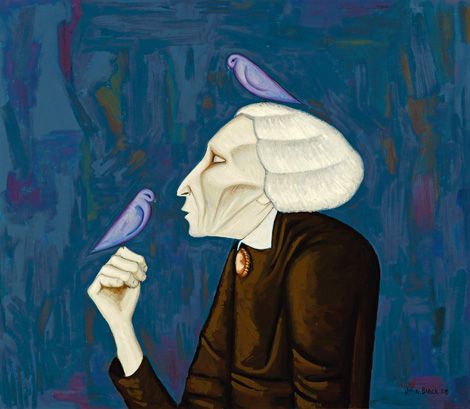 The Bird Lady, by John Brack (Australia) 1958. The Bird Lady Feather soft, the birds land on her head, her hands, hands stretched in supplication, waiting their caress. Her face turns blindly to them, eager and expectant, waiting for that moment of connection. In a life where no one touches her, her parched flesh slowly dies, in the aridity of age. Where is life-giving touch? she grieves. She has known so well that intimacy that brings with it both feeling and regeneration. But now in age who touches her? No one, and so each day she waits … waits for the birds. Feather soft, the birds land on her head, her hands, outstretched in supplication, waiting their caress. Her face turns blindly to them; sightless eyes are dim with gratitude, for this at least gives her a moment of connection. Valerie Volk Valerie Volk has been writing all her life and in the last ten years has published nine books, mainly verse novels and poetry collections, as well as over a hundred poems in Australian journals such as Poetrix, Studio, Polestar, Tamba, and the USA Red River Review. She is a passionate traveller, resulting in the publication of several of her ‘poem a day’ collections (yes, she really does write poem each day when travelling!) from Europe, Asia, and South America. One of her most cherished memories is riding a camel in in Mongolia’s sub-zero winter snow. Please visit her web site www.valerievolk.com.au 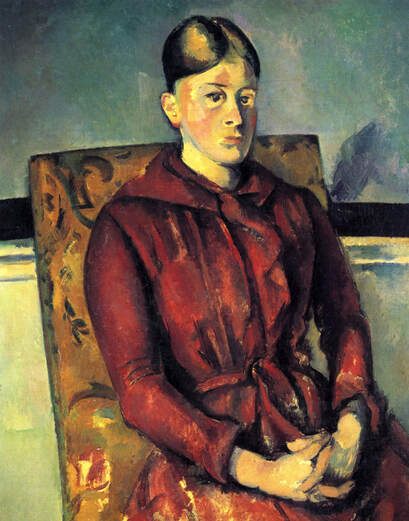 Madame Cezanne in a Yellow Armchair, by Paul Cezanne (France) c. 1890. Madame Cezanne in a Yellow Armchair Two faces stare at him: One half the stiffened mask, The other, arch, That does not need to ask. He sees what who he is Has made of what he saw In her. Painting Her tense paints himself raw. James Toupin James Toupin, retired general counsel of the US Patent and Trademark Office, now teaches in the law school of American University in Washington, DC. His poetry has appeared or are scheduled to appear in dozens of journals, including Virginia Quarterly Review, Beloit Poetry Journal, Nimrod, Pleiades, garnering a couple of Pushcart nominations. He is also a published translator, of Selected Letters of Alexis de Tocqueville on Politics and Society (University of California Press), and writer on legal topics.  Thank you so much to Jonathan Taylor, editor at the Creative Writing at Leicester blog, for featuring The Ekphrastic Review today.
Find out more about how we came to be, and read a poem from our archives by Barbara Crooker. Click here to read it. 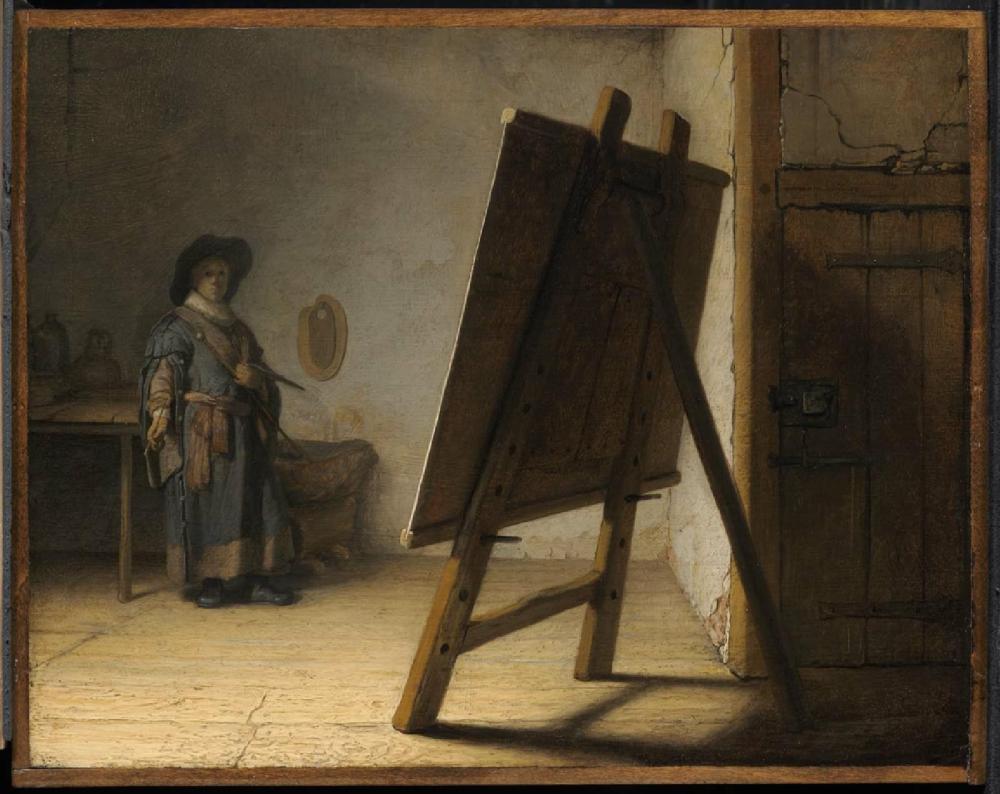 The Artist in His Studio, by Rembrandt van Rijn (Netherlands) c. 1628. Artist in His Studio, by Rembrandt van Rijn: Painter and Canvas in Dialogue The easel, right foreground, dwarfs the young artist, who stands a few steps back, in shadow, well-dressed but ready for the work of painting. Who will know him? The canvas propped on the easel appears formidable, and the young man is overwhelmed, entering as he is into art history, the great tradition, the competition to outdo and improve, let alone to prove himself. It’s all a prop, a show, teetering on the unknown. He’s a young explorer, assessing a brave domain. Behind the easel, a hallway yet to be filled with art, but canvas and easel block the way until completion. Is it you? Is that you? I didn’t know you could talk! I didn’t know you could paint! Are you sure you can? I am sure—I know it. Show me. Where are your tools? Behind me. Draw! Draw? This isn’t a duel. It’s not a standoff or a showdown. Yes it is—it’s you against me, me against you. There’s no drawing—I’m going to paint. But this is a showdown, and you know it. Paint! When I paint, you will cease your talking, but you will talk forever. Forever? How so? I will counter with my own paradox: My canvas expanse now shows only silence. You will talk forever in many languages, in the tongue of whoever is looking at you. I’d like to see that. Step forward, Mr. Painter. Keep talking—I want to capture your voice. Why are you dressed up? You look formal. Painting can ruin a gentleman, rarely make his fortune. One splat will stain your fine robe. This is how I see myself and how I want to approach you, before beginning my work. You have a long way to go, even to reach me-- the gap from me to where you stand is great. I will make great strides in this painting. When I’m ready, I shall step up to the task. I offer you a good stretch of canvas to fill with details and visions. A moment of drama! You look like that young painter everyone is talking about, that Rembrandt fellow. I’m not Rembrandt, but you see I’m a painter. You look like him nonetheless. Perhaps I am his alter ego. No, you look like a child playing dress-up, but somewhat spooked and awed. I am not afraid. I may be cautious. What you see is reverence. I’ll admit I can discern some pluck. Don’t begrudge me. After all, you are only a canvas, a signboard propped up by planks. You are a blank. Still, you cannot get around me. You have to paint-- paint on me something great, something everyone will talk about and learn from. Then you can pass by me and go down the hall to claim your place in the great artists’ Kunsthalle. I’m your ticket, your passport, blank only for now. That’s my plan. But aren’t you a van? Doesn’t that tussenvoegsel mean you’re landed gentry? So why are you painting? Or is that the significance of your outfit finery? You weren’t born for this, but you chose it. It chose me. I know what I must paint now. Tell me. I will find out soon enough. Let me guess as you swab! Let me keep talking. I promised you would. You can talk all you want and tell others for years—for centuries-- about this encounter. You’ve entered the arena, the ring, center stage. All are quiet, waiting. Like me, they want to see what you can do, they want to feel it for themselves. They want to project. Show them. What is it you see? I see great scenes, decisive moments, telling, instructive, inspiring—spectacular plays of light and dark. Paint one. On me. Now! I’m not there yet. Get on your way. Step up to the task, step forward. Fling paint on me. Brush! Leonardo said that random blots, drips, and splashes can contain battle scenes, land- and seascapes, and amorous encounters. I will paint those all-- plus portraits. I am ready. I am part of it. I will hold your paint as you guide and apply it. You are holding it well. It’s already done. What do you see? Don’t hold your tongue. I see you. I see me! That’s just how it was. Captured. But is my backside really that big? Javy Awan Javy Awan has worked as an editor for national professional association publications. His poems have appeared in Poet Lore, Potomac Review, Midwest Quarterly, and Innisfree Poetry Journal. He lives in Salem, Massachusetts. 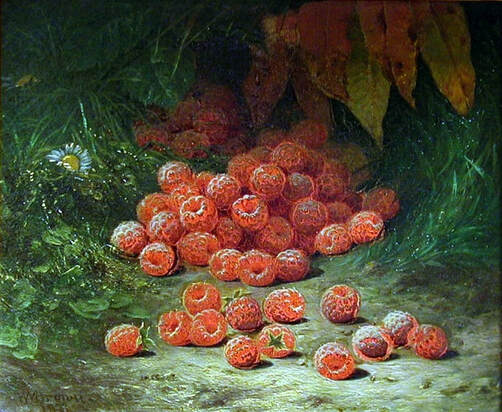 Raspberries, by William Mason Brown (USA) 1873. Spilled Berries The grass is parted here, a small clearing of light below the bush. The raspberries seem to be tumbling, but are still; too perfect, too real rendered in the richness of oil paint, too ripe. The leaves, like a skirt, from above try to shadow the gorgeous spill of berries round and open. Miranda Lynn Barnes Miranda Lynn Barnes is a poet from the US, now resident in the UK. Her poems appear or are forthcoming in New Welsh Reader, Tears in the Fence, Under the Radar, The Compass, The Interpreter’s House and Lighthouse Journal. Miranda taught Creative Writing for five years at Bath Spa University, where she now serves as Research Publications Librarian. She lives in Bristol, England, with her ginger cat and ginger-bearded husband. https://mirandalynnbarnes.wordpress.com 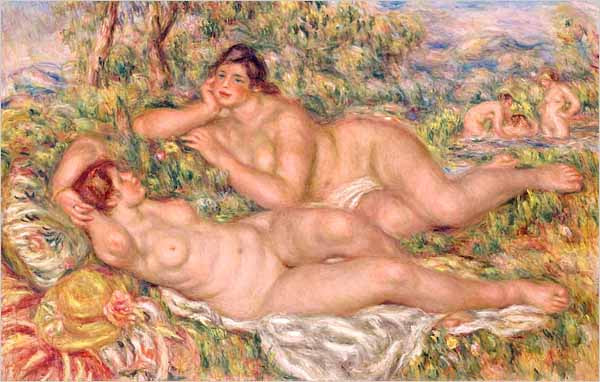 The Bathers, by Pierre Auguste Renoir (France) 1918. The Hour of Peonies The Buddha says, “Breathing in, I know I am here in my body. Breathing out, I smile to my body,” and here I am, mid-span, a full-figured woman who could have posed for Renoir. When I die, I want you to plant peonies for me, so each May, my body will resurrect itself in these opulent blooms, one of les Baigneuses, sunlight stippling their luminous breasts, rosy nipples, full bellies, an amplitude of flesh, luxe, calme et volupté. And so are these flowers, an exuberance of cream, pink, raspberry, not a shrinking violet among them. They splurge, they don’t hold back, they spend it all. At the end, confined to a wheelchair, paintbrushes strapped to his arthritic hands, Renoir said, “the limpidity of the flesh, one wants to caress it.” Even after the petals have fallen, the lawn is full of snow, the last act in Swan Lake where the corps de ballet, in their feathered tutus, kneel and kiss the ground, cover it in light. Barbara Crooker This poem first appeared in Barbara Crooker's book, Radiance (Word Press, 2005.) Barbara Crooker is the author of many books of poetry; The Book of Kells is the most recent. Her work has appeared in numerous anthologies, including The Bedford Introduction to Literature, Commonwealth: Contemporary Poets on Pennsylvania, The Poetry of Presence and Nasty Women: An Unapologetic Anthology of Subversive Verse. www.barbaracrooker.com 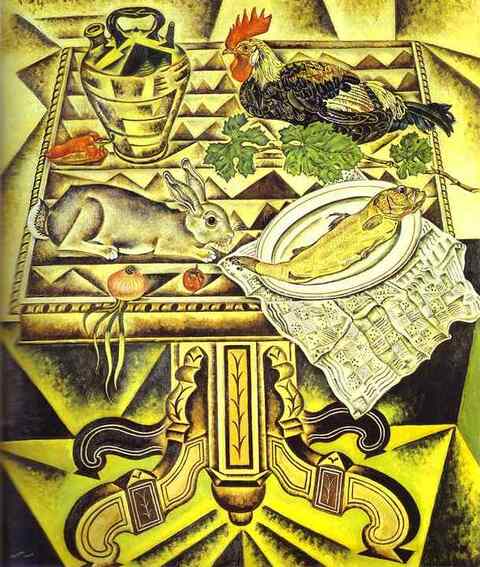 The Table (Still Life With Rabbit), by Joan Miro (Spain) 1920-1921. Miró’s Intention To get to that space where the world falls away, The canvas stares at the viewer like arrows While the viewer stares like a target. It is the painting looking at you. That specific painting, looking at just you. At the top of the table, there’s a rooster. The rooster, live, uncooked, in Catalan. Look at the living fish, on a plate in Spain. In a Spain no viewer has ever been, A plant-like mother is the nation’s anchor, A fish-like father is the nation’s water. A beautiful bird reveals the unknown, Reveals the unknown to a pair of lovers -- An unseen bird, as the world falls away. David M. Katz David M. Katz’s books of poems include Stanzas on Oz and Claims of Home, both published by Dos Madres Press. He’s also the author of The Warrior in the Forest, published by House of Keys Press. Poems of his have appeared in The Hudson Review, Poetry, The Paris Review, The New Criterion, The Hopkins Review, and The Cortland Review. He is currently working on a new poetry collection, tentatively entitled Money. He lives on New York City's Upper West Side. |
The Ekphrastic Review
COOKIES/PRIVACY
This site uses cookies to deliver your best navigation experience this time and next. Continuing here means you consent to cookies. Thank you. Join us on Facebook:
Tickled Pink Contest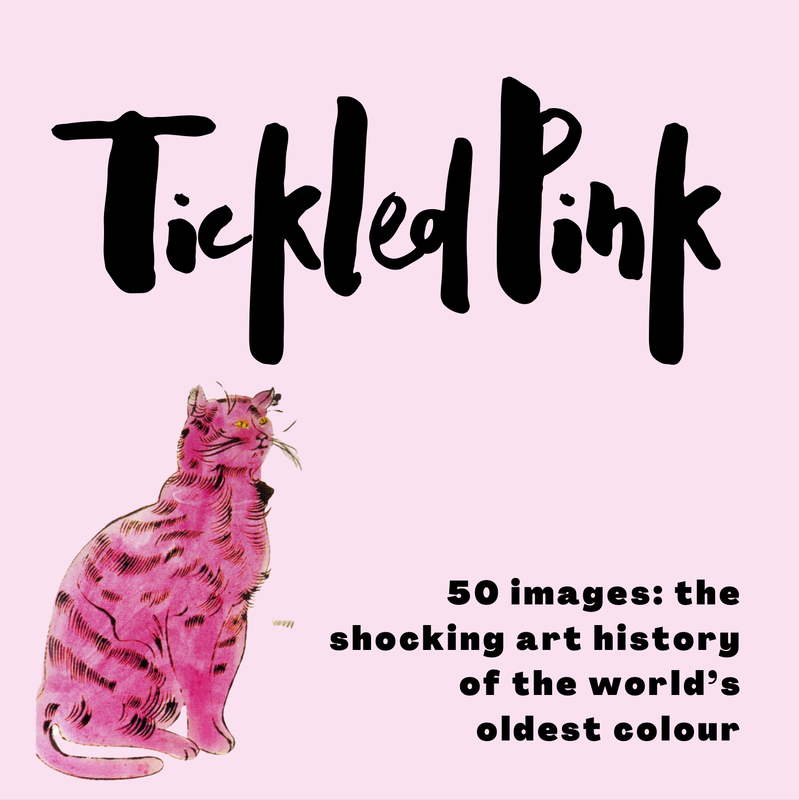
April 2024
|