 New Contest! The Sound of Music, with Guest Judge, Jonathan Taylor The Ekphrastic Review is pleased to announce a new contest for poetry and flash fiction, on the theme of music. We are delighted that Jonathan Taylor, a TER contributor well-known for his musical writing, will act as our judge. Selected flash fiction and poetry will appear in a showcase in The Ekphrastic Review. A winner in either flash fiction or poetry will be awarded first place and $100 CAD. ** Jonathan Taylor is an author, editor, lecturer and critic. His books include the poetry collection Cassandra Complex (Shoestring, 2018), the novel Melissa (Salt, 2015) and the memoir Take Me Home (Granta, 2007). His book Kontakte and Other Stories (Roman Books, 2013), was shortlisted and long listed for multiple awards. It is a collection of music-themed stories, a consistent theme in his poetry and fiction. Taylor directs the MA in Creative Writing at the University of Leicester. His website is www.jonathanptaylor.co.uk. ** Rules 1. Write short fiction or poetry inspired by any of the works of art in The Sound of Music ebook. You can interpret or use the art in any way you are inspired to. It can be about the painting, artist, or subject, or take you in any other direction. 2. 1000 words maximum per piece, whether fiction or poetry. 3. Submit up to five works per author, fiction, poetry, or assorted. 4. Attach works as Word documents. Do not put your name on documents. Any legible font and presentation is fine. 5. Include a publication ready bio of 100 words or less in the body of your email, in the event your work is chosen for our showcase. 6. Editor and judge decisions are final. Showcase will be published sometime in April, and winner announced at the same time. 7. Wining writer will be paid by PayPal. 8. Send entries to [email protected] with MUSIC in subject line. 9. Deadline is midnight, EST, March 25, 2023. 10. Purchase of music ebook is $10 CAD and qualifies you to enter up to five works. You can enter as many times as you like.
0 Comments
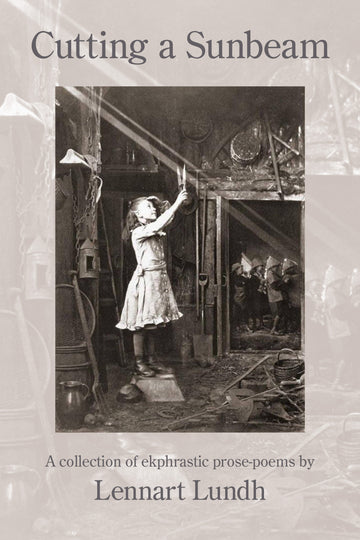 The Ekphrastic Review: Tell us briefly about how Cutting a Sunbeam came together for you, about its inspiration and evolution to a finished collection. Lennart Lundh: In need of a publisher whose layout aesthetics and distribution practices matched mine, I sent a prose-poem manuscript to Karen Kelsay that was released in early 2020. By the spring of 2022, I had more than enough to offer them another all prose-poem collection, this one all ekphrastic. With one exception, none of my full chaps and collections are thematic or spring from a single inspiration. Whatever organization there might be in Sunbeam is a mix of source image date and when the poems were written. Karen Kelsay and her team have twice trusted my judgement, only asking for tweaks to match their layout standards, and I’ve been equally pleased by their part of the process. The Ekphrastic Review: What is your ekphrastic process like? How do you choose paintings or other artworks to write about? How do you approach them? LL: The process is no different from any of my other works: I come across something that my brain sees a story in. (More than anything, I view my poetry as storytelling, or a part of a conversation with the reader.) If a line or two doesn’t get immediately triggered, I move on. I approach the source object as the poem directs: I can follow literally or let my imagination soar on an image-tether. A scarf in an ad can be just a scarf (if you wear this / remember me / as I do you), or it can be the link between the cruelties of 1943 Germany and 2017 America. The Ekphrastic Review: Tell us about prose poetry. Why prose poetry versus other forms of poetry, or fiction? LL: I’ve written prose fiction (not to be confused with the fictions in my poetry), and been frequently told it’s too much like poetry; I guess generic prose shouldn’t be lyrical or sensuous, although the late Patricia A. McKillip’s work told me it truly can and should. I’m not formally trained as any kind of writer, beyond the degrees that led to the five books of history I’ve researched and written: Not a single class that dared to move, in terms of craft, beyond Shakespearian sonnets or 19th century American fiction. I write unrhymed free verse and haiku because it lets me focus on getting the words in the right place at the right time. I write more and more prose-poetry because it also gets the words right while it fosters the sense of conversation, and because I really, really, hate line breaks that serve no purpose. The Ekphrastic Review: You include a number of films and also photography as ekphrastic inspirations. Tell us about your attraction, as a writer, to these forms. LL: They’re valid, incredible sources for the visual version of The Trigger, every bit as much as art hung on a wall (and let’s not forget sculpture). They’re just as critical in the transformation or translation of visions to words, every bit the lead capable of becoming gold. The Ekphrastic Review: From the artwork selection and your writing, it is apparent that one of the topics that is often on your mind is war, something you experienced personally in Vietnam. I can only imagine how this becomes a permanent part of your psyche. Tell us what it means to you to contemplate and to create art and poetry about war. LL: I actually have three overarching themes: love, war, and how the end of any world (big or small) is a very personal thing. I’m jokingly known for almost never telling an audience which are which, and it’s not always a clear or single choice. To your point, war is certainly imbedded in me. I still have bits and pieces of PTSD hanging around since 1968 and 1969, nightmares on a finally irregular basis, and some physical scars that are more service-related than war wounds (from a shipboard fire and a storm at sea). As a rarity, I left the military as a conscientious objector. Ultimately, what it means to me to contemplate war and create from it is no different than the other themes: I focus on the personal (not to be automatically assumed as the autobiographical) rather than the larger scale of conflict and its costs. There is almost always a single narrator speaking of personal experience and aftermath; this is true even when the narration reports on what somebody else is experiencing. Of course, keep in mind that I write because of unexpected triggers, rather than from some sense of a daily goal to be met. The Ekphrastic Review: Do you have a favourite poem in this collection? Choose one that is most meaningful to you and tell us about that piece. LL: Do I have a favourite child or grandchild? (Great-grandchild is easy, since there’s only one.) In the case of Cutting a Sunbeam, there’s not a single piece I’m dissatisfied with, not a word I question in retrospect. So: Winner of the coin toss with “The other children,” which is informed by the cover image (and didn’t Shay at Kelsay Books work absolute wonders with it?), this time around I’ll point to “There’s a woman” as my pet. The image is very, very simple, but every word of the poem can be attributed to it without feats of magic or great leaps of literary license-faith. It represents a woman’s abilities and strengths, the heritage she is tied to and the future she’s helping create. It shows the trust between a child and an adult in the face of a sudden outsider. It speaks for the possibilities, created by a chance encounter, of friendship, happiness, peace between strangers and perhaps even different cultures, and myriad levels of future relationships and events. And it’s voiced by the observations of an unknown narrator, who could be any one of us, in a hybrid of prose and free verse. That’s the trigger and reaction, the vision and its words, that I speak of so often to audiences. I will never question another poet’s voice or their reasons for writing, but this piece is what I strive for, what I believe words are meant to do. The Ekphrastic Review: What’s next for Lennart? LL: During April of 2023, I’ll do the 10th of my annual poem-a-day fundraisers for the St. Baldrick’s Foundation, which finances research on cures for childhood cancers. I plan to do this as long as I can. I’m anticipating a fall 2023 release for my next, and quite possibly last, full-length collection, this one containing about 70 free verse ekphrastic pieces. I’ve got loads of poetry readings to post on YouTube, and even bigger loads of photographs to weed through for my Fine Arts America site. My biggest project, and probably the most important I’ve planned, is converting my self-published titles to large-print, e-books, and audio books for those physically in need of them. ** Get your copy of Cutting a Sunbeam from Kelsay Books, here. 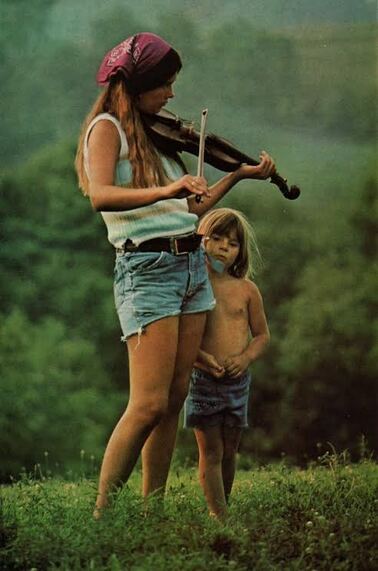 Photograph from National Geographic, 1967, details not known. 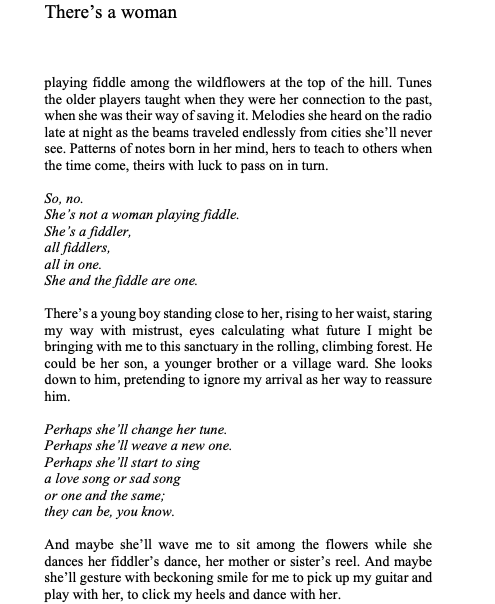  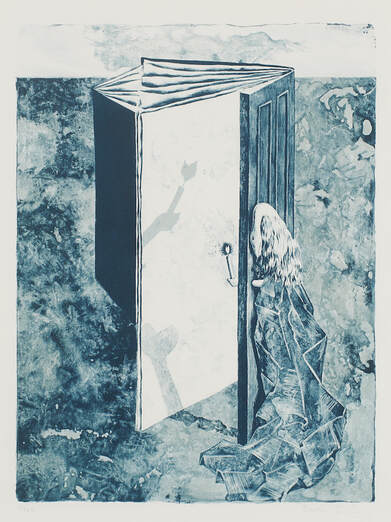 Premier Peril, by Dorothea Tanning (USA) 1950 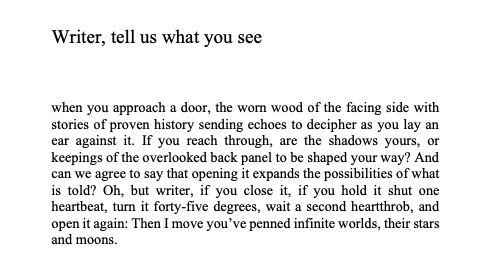 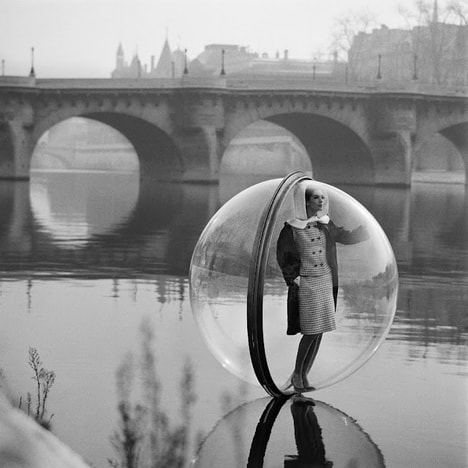 Girl in a Bubble, by Melvin Sokolsky (USA) 1963  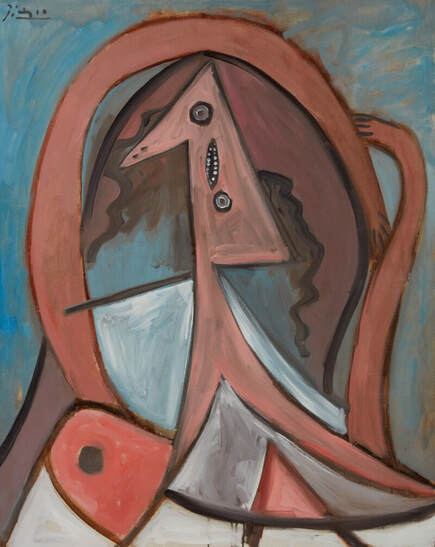 Femme Assise, by Pablo Picasso (Spain) 1929 Post-Roe Should they ask how I am sleeping now, in this racket of breaking news, please tell them I’ve been dreaming a mirror—absorbing its slap- dash displays, the after-hours flash of features I’ll catch, hanging about the plane of my face A snare of teeth, the loops of knotted pearls in pink- tinged green. In the dream I’ve found the once-familiar niceties may all be rearranged manually—that my whole composition has been kept in place with only a gentle adhesive It’s not unusual now, to observe my eyebrows applied upside-down, a hair or an arm at odd angles. Other nights I uncover a nostril, the swing of a nipple or two black moles—like pits for eyes. Parts that are interchangeable loose as the laundry quarters scattered on a bureau & my lips seem to slip constantly. See them peeling up from the edges two tired flaps that have all but lost their grip. In the dark and dreaming, it’s a wonder I haven’t mislaid them outright Kathryn Moll Kathryn Moll is an architect and California native. Her text-based drawings—collaborative works created under the name modem—have been shown at the Yerba Buena Center for the Arts in San Francisco, and the Cooper Union in New York City. She lives with her family in Cambridge, Massachusetts. 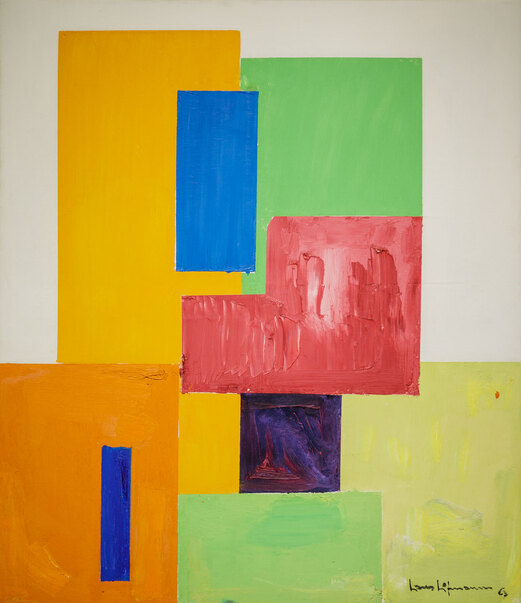 Elysium II, by Hans Hofmann (USA, b. Germany) 1963 Elysium II they are building a new Elysium to replace the old one redone an octave higher crossed with lines thick and thin in paint bright as magenta the lines will lie in close proximity an arm over a leg each stroke implying relationship – without relationship the painter tells us art is impossible Sarah Koenig Sarah Koenig lives in Seattle, WA with her family. She works at a retirement complex, where she plans programs and events for residents. In her free time she enjoys collage and book making. Her poetry has appeared in multiple journals, most recently Poetry Northwest and Faultline. 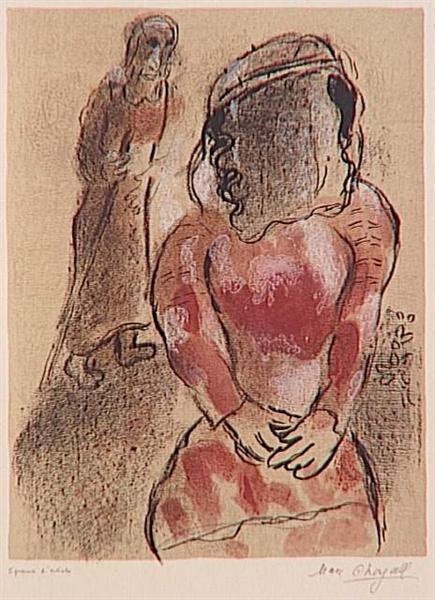 Tamar, Daughter-in-Law of Judah, by Marc Chagall (France, b. Belarus) 1960 Tamar, Waiting Across the marketplace he pauses, leaning on his staff, his eyes skimming past heaps of almonds and figs, gleaming grapes, earthen jars of honey warmed by the afternoon sun, to rove the crowd in search of a woman’s comely form, his face a leathery mask. He would disavow his need to assuage his ache. But I have watched his eyes follow the servant’s long black braid, her swaying hips. He is proud, his grandfather the "child of promise," though fulfillment was slow, nearly past all bearing. For too long this man has mouthed empty promises. My belly should have swollen many times by now, but my profile betrays a maiden’s slim waist. If I turn my head he will spy my veil, thinking it as blank as new papyrus, never imagining it could bear the inscription of his lust. My gown's crimson will lure him to me, the hue of birth-blood, heart’s cry. How he loves to trumpet his family’s "chosen" status, boasting of his father’s wrestling a blessing from Yahweh’s angel. We widows pat dough into plump loaves for the evening meal, whispering together, keeping alive the story of Yahweh’s favour to lowly Hagar, mother to a different child of promise. Soon this man will take a step toward me. I have so little to lose. Our women’s lore tells me the time is ripe; his staff will be my pledge. When the veil is finally lifted, he will see his face reflected in mine as in a pool of still, clear water: shame for shame. I shall bide my time a little longer, hands demurely folded, waiting. Patricia L. Hamilton Patricia L. Hamilton, the author of The Distance to Nightfall (Main Street Rag), is a professor of English in Jackson, TN. She won the Rash Award in Poetry in 2015 and 2017 and has received three Pushcart nominations. She has new work in Soul-Lit, Fare Forward, and The Windhover and work forthcoming in Bindweed and Broad River Review. She enjoys travel, jazz, and cappuccino.  Best Small Fictions Nominations 2023 The Best Small Fictions is the first award anthology to honour the best microfiction, flash fiction, haibun stories and prose poetry from around the world. The first edition was in 2017. Congratulations to our nominees! ** One Sleep, by Claire Bateman https://www.ekphrastic.net/the-ekphrastic-review/one-sleep-by-claire-bateman ** Changes, by Jane Dougherty (scroll down to find Jane's story) https://www.ekphrastic.net/the-ekphrastic-challenges/luristan-bronze-ekphrastic-responses ** Jessie’s Egg, by Kathryn Kulpa https://www.ekphrastic.net/the-ekphrastic-review/jessies-egg-1895-by-kathryn-kulpa ** Brighton Pierrot, by Anne Summerfield https://www.ekphrastic.net/the-ekphrastic-review/brighton-pierrot-by-anne-summerfield ** We Are Making a New World, by Emily Tee https://www.ekphrastic.net/the-ekphrastic-review/we-are-making-a-new-world-by-emily-tee 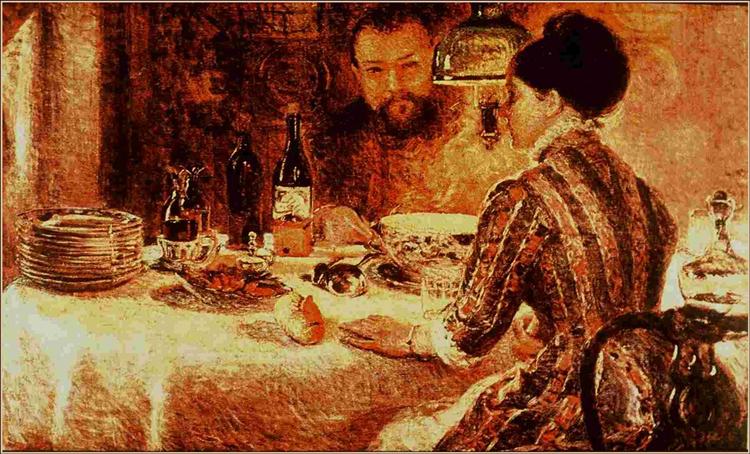 Under the Lamp, by Marie Bracquemond (France) 1887 Under the Lamp by Marie Bracquemond, 1887 Green lamp hangs low, close to the couple’s heads. They sit at a table covered with white embossed cloth, a stack of ten plates, cruets of vinegar & oil, two corked wine bottles, crystal dish of carrots, gravy boat, unlidded soup tureen—steam meets a spill of lamplight. He blends into the muddled brown background of a massive china hutch, but his illumined face floats. She wears a striped, fitted dress lace-collared and cuffed. Her hand rests near a hunk of crusty bread. Vivid light outlines the curve of her shoulder. Silhouetted, she stares into the distance. He gazes directly at her, searching. Did he ask a question that lingers between them? Is she deciding how to answer words she never expected? Karen George Karen George is author of three poetry collections from Dos Madres Press: Swim Your Way Back (2014), A Map and One Year (2018), and Where Wind Tastes Like Pears (2021). She won Slippery Elm’s 2022 Poetry Contest, and her short story collection, How We Fracture, which won the Rosemary Daniell Fiction Prize, is forthcoming from Minerva Rising Press in Spring 2023. After 25 years as a computer programmer/analyst, she retired to write full-time. She enjoys photography and visiting museums, cemeteries, historic towns, gardens, and bodies of water. Her website is: https://karenlgeorge.blogspot.com/. The Women of the Théâtre D’opéra Spatial Three women stand in the dressing room near the portal waiting for the performance to begin. They have used the written prompts. They have generated the image. They have presented the image to the machine. Here is what the machine gave them: Woman #1: A. There is a sensation in my head and in my belly. B. Those carvings and crenellations are unnerving. C. The portal itself is the star of this show. D. The machine created a landscape of dust and stone, and it's beginning to interpenetrate. E. I can barely breathe. F. And yet this gown... I can only call it sumptuous. Woman #2: A. Why am I always the most poised? B. Why am I always the only one in white? C. Oh yes, it's because of the need for deep secrecy and longing. D. I am still studying my lines. E. And will the audience join us or will we join them? F. The portal sucks at me like a slack wet mouth. Woman #3: A. Balancing on this plinth, I wonder if a cathedral would be more satisfying. B. Is there a god out of the machine? Are there words made flesh? C. Theater is a well-regulated art. D. Or is it a sport? E. The portal is delicious, poisonous, inscrutable. F. I am paid in golden light. That's all. That's all the machine generated based on the women's image. That will in fact be their dialog. The machine writes their parts. The machine carves them from undifferentiated matter. The machine is no more artificial than you or I. Alice Whittenburg Jason Allen used artificial intelligence to create his digital artwork and win a state fair artist competition. Learn more about the controversy here. Alice Whittenburg’s short fiction can be found online at Riddled with Arrows, Atlas & Alice, Eclectica Magazine, and elsewhere. Her essays appear in The Ekphrastic Review, 3:AM Magazine, The Journal of Working-Class Studies, and elsewhere. She is coeditor of The Cafe Irreal, an online magazine of irreal fiction, and of The Irreal Reader, Fiction & Essays from The Cafe Irreal. Her website is www.alicewhittenburg.com. |
The Ekphrastic Review
COOKIES/PRIVACY
This site uses cookies to deliver your best navigation experience this time and next. Continuing here means you consent to cookies. Thank you. Join us on Facebook:
July 2024
|