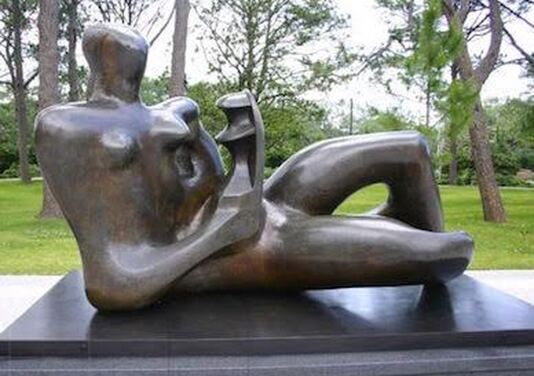
 Reclining Mother and Child, by Henry Moore (Britain) 1975 How Henry Sees Motherhood A sun-bronzed young mother stretches casually across the blanket she spread over the park’s newly mowed grass. Balancing on one elbow, she poses a tiny boy upon the pedestal of her still-round belly. They gaze adoringly at each other in an easy, familiar union. She is neither immodest nor grotesque in her nudity, her legs spread wide, solid and steady. Without reserve, she delights in her son, the center of her world, oblivious to passersby and their mumbled body-shaming remarks. This maternal queen owns the figure made more beautiful by motherhood, its fleshy hills and valleys made more vulnerable by loving completely her fragile creation. Leslie M. Rupracht Leslie M. Rupracht is an editor, poet, writer, and artist calling the Charlotte, North Carolina region home since 1997. Her words and art appear in various print and online journals (recently, Gargoyle and As It Ought To Be), anthologies, exhibits, and a chapbook, Splintered Memories (Main Street Rag, 2012). Longtime senior associate editor of now-retired Iodine Poetry Journal, Leslie also edited photography and prose for moonShine review, and was editor/designer of NC Poetry Society’s 2017 and 2018 Pinesong anthology. One of her poems is nominated for the 2020 Best of the Net. Leslie earned her English degree at State University of New York at Geneseo. She co-founded and hosts Waterbean Poetry Night at the Mic in Huntersville, NC.
2 Comments
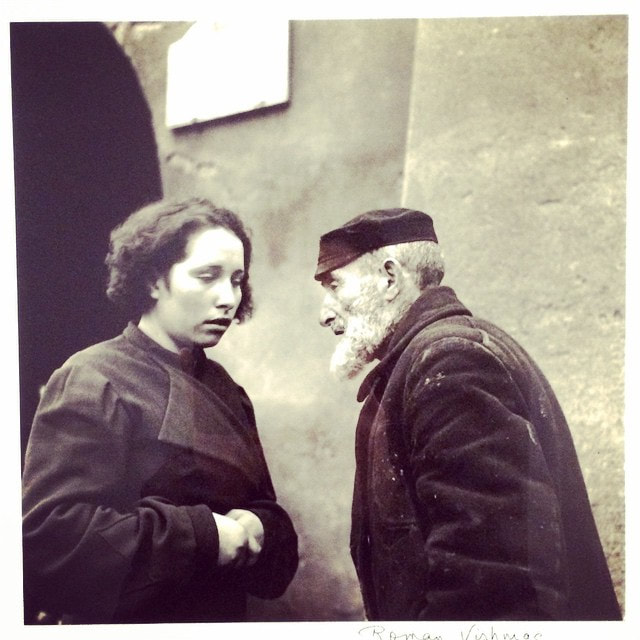 Grandfather and Granddaughter in Warsaw, photography by Roman Vishniac (USA, b. Russia) 1938 Roman Vishniac, Grandfather and Granddaughter in Warsaw, 1938 You woke and the woman who For fifty years had weighed down The left side of your bed— Each night as namelessly as love-- Was cold. Her cough you heard Some time in the night, And though the silence that followed it Seemed to you too simple to be called ‘sleep’, You dozed off and woke in the morning Once the spirit had flown. It will take two years before you know Her death was a gift. Now, Someone readies to weep in the next room. There are guests to gather, A rabbi to be summoned, This granddaughter to break the news to softly. Andrew Miller Andrew Miller is a poet, critic and translator with over eighty publications to his name. His poems have appeared in such journals as The Massachussett’s Review, Iron Horse, Shenandoah, Spoon River Review, The Ekphrastic Review, Laurel Review, Hunger Mountain, Rattle, New Orleans Review, and Ekphrasis. In addition, he has had poems appear in such anthologies as How Much Earth, Anthology of Fresno Poets (2001) and The Way We Work: Contemporary Literature from the Workplace (2008). Finally, he is one of the co-editors of The Gazer Within, The Selected Prose of Larry Levis (2001) and the author of Poetry, Photography Ekphrasis: Lyrical Representations of Photography from the 19th Century to the Present (Liverpool University Press, 2015). Presently, Miller resides Copenhagen Denmark with this wife and daughters. 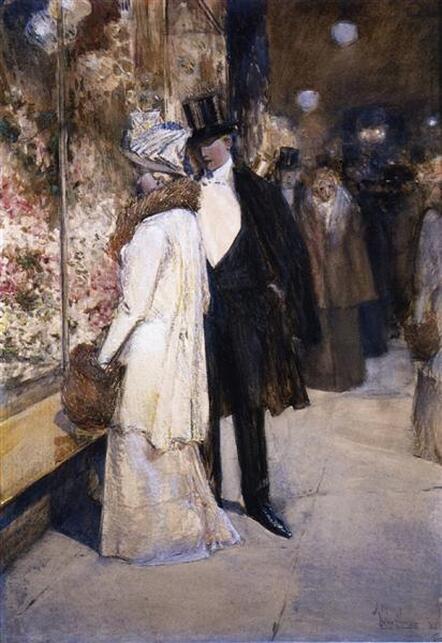 A New Year's Nocturne, by Childe Hassam (USA) 1892 A New Year’s Nocturne, New York He can’t imagine what she’s staring at; there’s nothing much to see through that plate glass— nothing as classy as his coat and hat or bright as her own dress. Why won’t she pass this dullness by, as others do, and stroll the year’s last hours away with him? He tries to coax her, but he knows he can’t control this woman he once charmed. Between his lies and her baffling rebellions, what remains between them is their duties and routines, and nothing more; a formal night out strains the roles they play in unconvincing scenes. In time she’ll turn to him, and stroll along, and smile, as if it hasn’t all gone wrong. 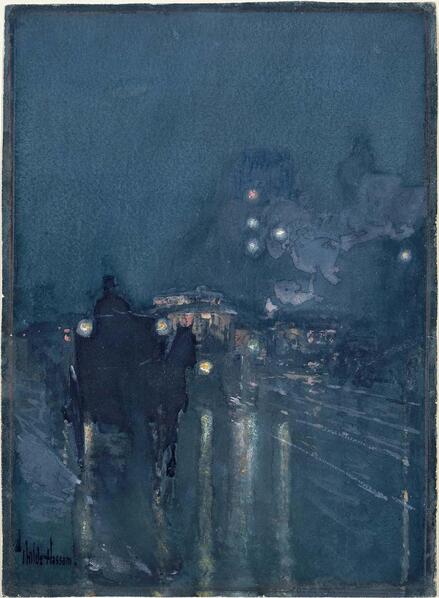 Nocturne, Railway Crossing, Chicago, by Childe Hassam (USA) 1893 Nocturne, Railway Crossing, Chicago Her friends—inside already—might suppose this ride unpleasant—but despite the rain, it’s cozy in this carriage, and she knows she’ll get there soon enough. The passing train has forced her driver to a stop; she wonders if others in her place would rather be aboard that charging iron horse; it thunders through town and field, each car lit brilliantly. She’s quite content just to observe the scene: the counterpoint of speed and stillness, light and dark; the air and streets washed clean; the vaguely dazzling puddles that invite reflection. She’ll be glad to see her friends, but not because that means this journey ends. 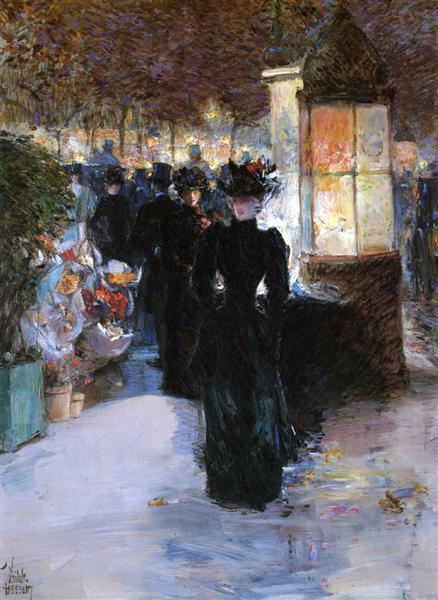 Paris Nocturne, by Childe Hassam (USA) 1893 Paris Nocturne Just like the crowd behind her, she wears black, but knows that on her it looks more severe, because she’s tall, because of her straight back and tiny waist. She knows she won’t endear herself to them by walking off this way, apparently rejecting friends and lights and flowers—she’s too moody, they might say— but what she seems to need most from these nights is just this solitary darkness. Wrapped in shadows, she remembers grief, and knows what Chopin meant; she senses depths untapped by those who would forget, and so dispose of half of music, much of love. Alone, she hears a silent nocturne of her own. Jean L. Kreiling Jean L. Kreiling is the author of two poetry collections, Arts & Letters & Love (2018) and The Truth in Dissonance (2014). Her work has been honored with the Able Muse Write Prize, the Great Lakes Commonwealth of Letters Sonnet Award, the Kelsay Books Metrical Poetry Award, a Laureates’ Prize in the Maria W. Faust Sonnet Contest, three New England Poetry Club prizes, and the String Poet Prize. 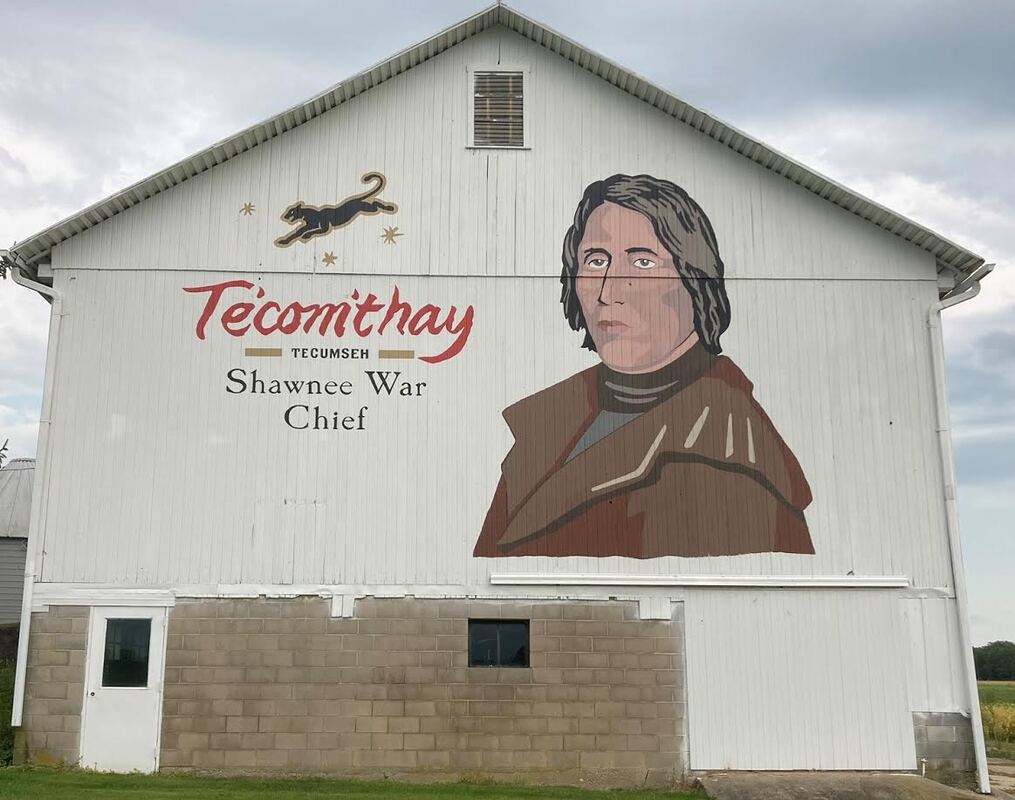 Tecumseh Barn Art, photo by Chris Bays, Artwork by Browning Design, and Painted by Scott Hagan Beyond Fallen Timbers White is the dominant tone of this barn painting that is larger than a combine harvester. On the left side, as from a cloud, a black panther leaps toward a name, the colour of blood, scrawled beneath its front paws. On the right side is the face of a man that looks white in the moonlight because of the cherry-pink paint on cheeks and nose. His colonial uniform adds to the illusion of race – like a white Jesus for a white congregation. But his eyes are painted black and at an angle to suggest both courage and sadness as they peer past the panther and across the road to where I am parked by a field. In block letters his biography is noted: Shawnee War Chief. Gold asterisks like frayed light beneath the panther add a nice touch for translating his name from Tecumseh to shooting star. However, there are no depictions of how he and his people were betrayed. I glance into the night. Lights from suburban sprawl dot the tops of trees in the distance. Those lights belong to Xenia, a city named after the Greek for “hospitality.” The Shawnee called that city and the surrounding land the “place of the devil winds.” But it wasn’t those winds that forced Shawnee families to flee Ohio over two hundred years ago. It wasn’t wind that caused them to stagger almost a thousand miles with children and elderly on their backs to lands not of their choosing in Kansas and Oklahoma. blazing comet … a snow-clad field filled with footprints Chris Bays Author's Note: This barn mural is part of the Ohio history barn program created by the Ohio History Connection. Artwork designed by Browning Design, whose work can be seen at dbrowning.com. Barn painted by Scott Hagan, whose paintings can be found at barnartist.com. Chris Bays is a father, college professor, art lover, chess player, foodie, and trekker. He received 1st place for Best Unpublished Haibun in 2017 and 2020 through the Haiku Society of America. In 2018 his poem “Waiting for Christmas in Ohio” won a Cottage Prize in the Genjuan International Haibun Contest in Kyoto, Japan. His haibun have been published yearly in the Red Moon Anthology of English-Language Haiku from 2017-2019. 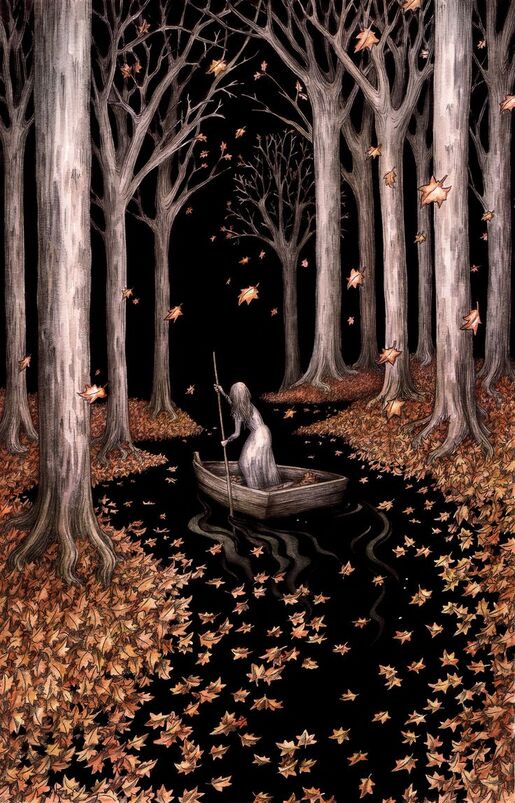 Driftwood, by Adam Oehlers (UK) 2017. Click image to visit artist site. Leaving Leaving this Earth, leaving everything, leaving this relationship, leaving friendships, leaving this situation- leaving my soul: snowdrops, trees with gnome doors, grape hyacinth leaves stretching above the grass, all the annuals, and the perennials already planted. I will not see your warm, dirty birth, forgive me, this does not mean I don’t love you. You see, with all that is going on here, leaving is better than staying. I have no fancy fórcola attached to my boat, this is not an oar, but a stick – I hear no opera in the thick, just the breeze detaching leaves, fool’s gold floating on water. I have not washed my hair in weeks, it hangs in streaks, battered branches. I’m Ophelia in Dickinson white. This dress does not fit, like most things. Goodbye. Nancy Byrne Iannucci Nancy Byrne Iannucci is the author of Temptation of Wood (Nixes Mate Review 2018). Her poems have appeared in a number of publications including Gargoyle, Ghost City Press, Clementine Unbound, Three Drops from a Cauldron, 8 Poems, Glass: A Journal of Poetry (Poets Resist), Hobo Camp Review, and Typehouse Literary Magazine. Nancy is a Long Island, NY native who now resides in Troy, NY where she teaches history at the Emma Willard School. 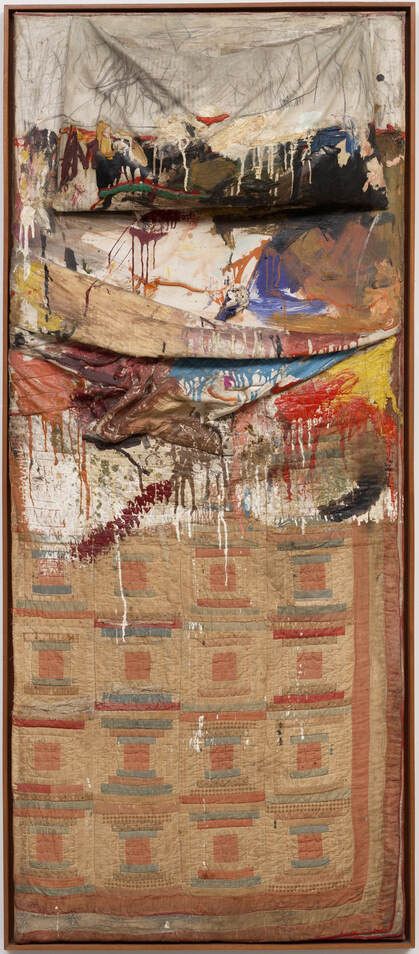 Bed, by Robert Rauschenberg (USA) 1955 Yesterday It’s a Sunday morning in January just before Groundhog Day and I’m waiting for my body to strip itself of this cold shudder; this silence without knowing what the sound of my voice tastes like when I go to sleep past midnight. I have a habit of sleeping in the tomorrow and waking up in the today. It has been years since I slept in the yesterday. I imagine that when I dream, mouth coats over in sticky honey. I am mummified in warm fluid, preserved resting corpse. I wonder how many of us die and are reborn in one night; how many of us rest into our graves. My mother sleeps later now in the bed she reigns over, the bed my father forfeited after she filed for divorce. I only turn my lights off after the shards of yellow peeking out from the corners of her door disperse into the shallow dust of our hallway. The dark used to terrorize me, the thick velvet of shadowed curtains swallowing me. I couldn’t fall asleep without knowing where I was falling. I have a habit of sleeping in the tomorrow and waking up in the today. It has been years since I slept in the yesterday. My mother tells me that I was born nameless. Before branding me, she wanted to feel the thump of my dry pulse, watch the way my soft bones bent between her fingertips. I only became something after emerging. What is a butterfly before emerging from the chrysalis? Worm wrapped up in a pocket of leaves, my brother used to squish warm bodies between his toes. What if, before emerging, I was just an ache in a quiet uterus? I have a habit of sleeping in the tomorrow and waking up in the today. It has been years since I slept in the yesterday. What if my mother’s body had ejected me without warning, like a sliver of poison too sweet, too tempting? Perhaps then I would have had a name without first shrieking into the light of day. Perhaps then I could have been buried with an etching on stone and my bald head in the earth. Perhaps then I could have been orphaned. I wonder what I might be if my mother had wanted to eject me without her body’s permission. I wonder what I might have been if I died just as I became life. I wonder how many mothers eject body from body just because they don’t know how to name a part of their body that they don’t know how to know, a part of their body that becomes its own body just as soon as it emerges from a wounded chrysalis. Divya Mehrish Divya Mehrish's work has been longlisted at the National Poetry Competition and commended by the Foyle Young Poets of the Year Award as well as the Scholastic Writing Awards. She has been recognized by the Columbia College Chicago’s Young Authors Writing Competition, the Gannon University National High School Poetry Contest, the Arizona State Poetry Society Contest, the New York Browning Society Poetry Contest, and the UK Poetry Society. Her work has been published in PANK, Ricochet Review, Blue Marble Review, Polyphony Lit, Tulane Review, Sienna Solstice, The Rèapparition Journal, The Ephimiliar Journal, Sandcutters, and Amtrak's magazine The National, among others. 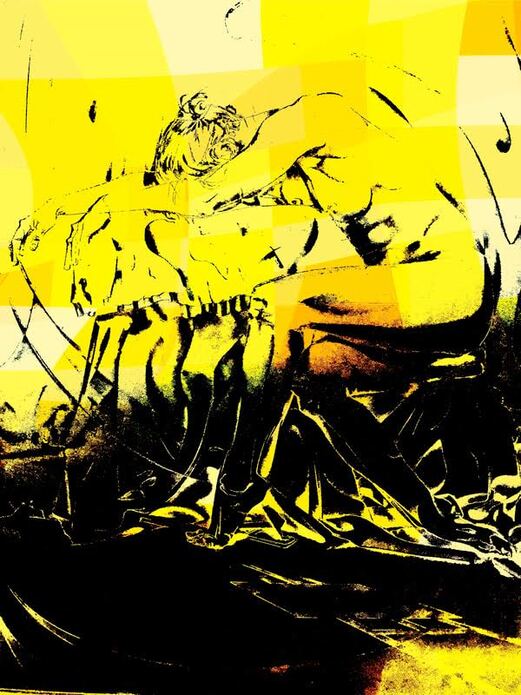 Nude Study, by John Di Leonardo (Canada) 2020 Join us for biweekly ekphrastic writing challenges. See why so many writers are hooked on ekphrastic! We feature some of the most accomplished, influential poets writing today, and we also welcome emerging or first time writers and those who simply want to experience art in a deeper way or try something creative. The prompt this time is Nude Study, by John Di Leonardo. Deadline is November 27, 2020. We are very pleased to have the artist, John Di Leonardo, who is also a widely published ekphrastic poet, as our guest editor! (Check out our recent interview with John here.) You can submit poetry, creative nonfiction, or short fiction. 1000 words max please. Guest editor: John Di Leonardo was born in Pescina, Italy. He is a visual artist and poet whose most recent ekphrastic poetry collection, Conditions of Desire, was published by Hidden Brook Press in 2018. He has published two award-winning chapbooks; Book of Hours (2014), and Starry Nights (2015). He is the recipient of The Ted Plantos Memorial Award 2017. He is currently working on his Corona, a series of large format drawings based on the Covid 19 pandemic, and is looking forward to the ekphrastic writing responses to his drawing Nude Study. John writes and paints in Brooklin, Ontario. You can visit him at johndileonardo.ca. The Rules 1. Use this visual art prompt as a springboard for your writing. It can be a poem or short prose (fiction or nonfiction.) You can research the artwork or artist and use your discoveries to fuel your writing, or you can let the image alone provoke your imagination. 2. Write as many poems and stories as you like. Send only your best works or final draft, not everything you wrote down. (Please note, experimental formats are difficult to publish online. We will consider them but they present technical difficulties with web software that may not be easily resolved.) Please copy and paste your submission into the body of the email, even if you include an attachment such as Word or PDF. 3. Have fun. 4. USE THIS EMAIL ONLY. Send your work to ekphrasticchallenge@gmail.com. Challenge submissions sent to the other inboxes will most likely be lost as those are read in chronological order of receipt, weeks or longer behind, and are not seen at all by guest editors. They will be discarded. Sorry. 5.Include DI LEONARDO WRITING CHALLENGE in the subject line. 6. Include your name and a brief bio. If you do not include your bio, it will not be included with your work, if accepted. Even if you have already written for The Ekphrastic Review or submitted other works and your bio is "on file" you must include it in your challenge submission. Do not send it after acceptance or later; it will not be added to your poem. Guest editors may not be familiar with your bio or have access to archives. We are sorry about these technicalities, but have found that following up, requesting, adding, and changing later takes too much time and is very confusing. 7. Late submissions will be discarded. Sorry. 8. Deadline is midnight, November 27, 2020. 9. Please do not send revisions, corrections, or changes to your poetry or your biography after the fact. If it's not ready yet, hang on to it until it is. 10. Selected submissions will be published together, with the prompt, one week after the deadline. 11. Rinse and repeat with upcoming ekphrastic writing challenges! 12. Please share this prompt with your writing groups, Facebook groups, social media circles, and anywhere else you can. The simple act of sharing brings readers to The Ekphrastic Review, and that is the best way to support the poets and writers on our pages!  The Ekphrastic Review is delighted to present our six nominees for the Pushcart Prize 2021. The Pushcart Prize honours the best of the small press. It has been an annual literary event since 1976. We are most grateful to Laura Cherry and Alarie Tennille for their assistance and suggestions in putting together this year's nominations. Reflection, by Barbara Lydecker Crane https://www.ekphrastic.net/ekphrastic/reflection-by-barbara-lydecker-crane My Mother and Andy Warhol, by Robert Donohue https://www.ekphrastic.net/ekphrastic/my-mother-and-andy-warhol-by-robert-donohue Photo of My Dead Son, Taken At The DMV, by Alexis Rhone Fancher https://www.ekphrastic.net/ekphrastic/photo-of-my-dead-son-taken-at-the-dmv-by-alexis-rhone-fancher Seven Sadnesses, by Kip Knott https://www.ekphrastic.net/ekphrastic/seven-sadnesses-by-kip-knott Horse and Train, by Lisa McCabe https://www.ekphrastic.net/ekphrastic/horse-and-train-by-lisa-mccabe The Addictive Futility of Hope, by Brent Terry https://www.ekphrastic.net/ekphrastic/the-addictive-futility-of-hope-by-brent-terry 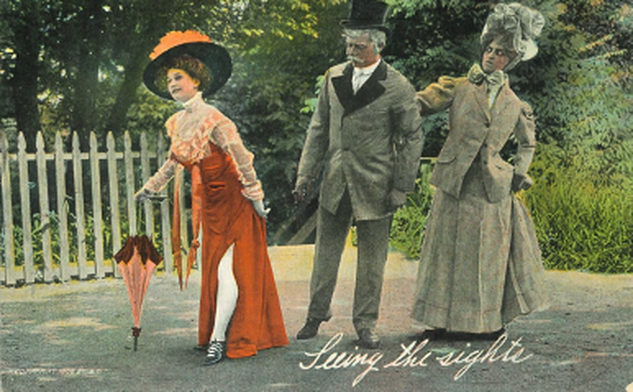 Vintage Postcard. Details unknown. Seeing the Sights Marriage is a trap women set. Men try to find their way out, but they’re doomed to fail. Witness the defeated old gentleman in a top hat. He’s poised, ready to spring for the new bait; his heels have left the ground, but lo! The fierce grip and gimlet eye of his bonneted missus hold him back. The battleax. The ball and chain who won’t loose her grip on the catch she reeled in 25? 30? 40 years ago and won’t let off the hook, even as he lists toward the new bait, the fresh and wriggling worm, the one spot of colour in our drab Edwardian vista of duns and greys. The young woman with parasol, flashing a glimpse of stocking (shocking)! Her colour, of course, is red. Her draped skirt, her beribboned bodice, the plumy feathers that wave bravely atop her hat. The old gent watches longingly, perhaps, although his downcast eyes suggest a man asleep on his feet. The young woman droops forward like a flower, leaning on her parasol. Was this the age of the monobosom, the fashionable S-bend? Eyebrows raised, mouth slightly curled: a Mona Lisa smile or a grimace of pain? Is she weary of being ogled, or simply pinched by her corset? Her face is inscrutable. Whatever she’s looking for is far away. But look closer at our doddering husband and his hatchet-faced wife. Aren’t their clothes padded, their hair powdered? Is his stoop-shouldered gait a pose, are the grim lines around her mouth penciled in? When the photo shoot is over, do they dash home, drunk on the joy of earning a week’s pay for an hour’s pose; do they peel off their bulky clothes, laugh at the mockery of age on their faces, revel in each other’s bodies, in their love that won’t be like a picture, because it will never fade? Kathryn Kulpa Kathryn Kulpa is flash fiction editor for Cleaver Magazine. Her stories are published or forthcoming in Atlas and Alice, Milk Candy Review, Smokelong Quarterly, and Wigleaf. Her work has been selected for Best Microfiction 2020. Violet Hill (in the artist’s own words, from the diaries and letters of Vincent Van Gogh, remixed) I have two views the gardens, and the asylum the walls are pale violet the floor tiles red the chairs fresh butter yellow still life: majolica jug with wild flowers I am doing my best I long to make beautiful things people will tell me mountains are not like that but in fact this expressed the remote, where there are goat herds, and sunflowers in bloom I am sure they do not mean badly they just don’t understand at all and probably think I am mad Delacroix, you know he said he discovered painting only when he had no teeth left the night café: ruin madness crime this dive of a bar in death there is nothing sad it happens in broad daylight there is no news every day is the same you must have noticed the sunflowers I painted, they are in Gauguin’s room please, just let me get on with my work I was thin and pale as a devil working from morning to evening I have been unable to stop myself I could not let go or take a rest here is the stack of orchards I had planned for you impasto lilac and first white blossoms white clouds in sunshine blue enamel coffee pot a cup on left, royal blue and gold six different blues, five yellows I went for a walk by the sea along a deserted beach how they sparkled bright green and yellow white pink bright and still opals, emeralds, sapphires one might say in the blue depths, these stars it is not easy to paint yourself it is different from a photograph you are searching for something more profound than what a photograph wants I am always laden like a hedgehog sticks, easel, canvas, equipment, yellow straw hat I am always dusty believe me sometimes I have to laugh at people who suspect me of all kinds of malice, of absurdities I would not dream of there is some sense emerging in me of colour something wide ranging and powerful how I paint I do not know myself we are having very beautiful weather chilly windy thunderstorms, rain how good it is to walk along the grey green sea when you are feeling depressed you have a need for something infinite, something in which you can see God my moods vary but I have acquired a certain serenity I have a strong belief in art it is a powerful current it carries man to a haven but he has to put in an effort too I will try to do great compositions the garbage dump with garbage men people lifting potatoes in the dunes the hands that hold the rope that rock the cradle I would rather paint the eyes of people than cathedrals paint the soul of a human being a poor beggar or many beautiful women in the city cobalt is a divine colour so is emerald it is no economy to deprive oneself of these colours when I get out I shall be able to get back to work I shall start on the orchards in blossom again the blue line of the alps the peach trees the farm houses everything is small if you can, see the olive trees right now the foliage old silver against the blue just done two pictures of the asylum a very long ward, with rows the floor in red brick a garden, a pond, very simple and eight flowerbeds Christmas roses with forget me nots I can’t help but dabble a bit with my picture, same fields ochre, violet under white or a moonrise pink dahlias dotted with orange and ultramarine: wallpaper but for the cypress tree the pink sky clumps of brambles wherever the sun beats down: this sulphur yellow the violet hill I saw all this like this from between iron bars it’s too beautiful for me to paint it or even imagine it Lorette C. Luzajic This poem originally appeared in Aspartame, by Lorette C. Luzajic (Mixed Up Media Editions, 2016). Lorette C. Luzajic is an award-winning visual artist whose paintings have been collected in over 25 countries. Her poems, stories, and essays have appeared in hundreds of literary journals and about a dozen anthologies. She has been twice nominated for Best of the Net, with one making it to finalist, and three times for the Pushcart Prize. Her story, "The Neon Raven," recently won first place at MacQueen's Quinterly, one of her favourite journals. Lorette is the editor of The Ekphrastic Review. Visit her at www.mixedupmedia.ca. |
The Ekphrastic Review

COOKIES/PRIVACY
This site uses cookies to deliver your best navigation experience this time and next. Continuing here means you consent to cookies. Thank you. Join us on Facebook:
Tickled Pink Contest

April 2024
|