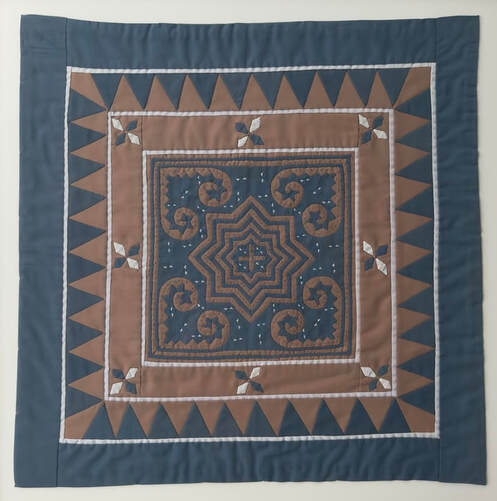
 Wall Hangings, Hmong artists (Vietnam) courtesy of the poet Hmong Hangings Sisters, you who sewed these pa ndau with your fleet fingered running stitches, with their neat folds of fabric on fabric. On one, the pleat of purple on black, the other--slate blue on brown and always the white skip of thread as they blossom out mandala-holy in their frames-- they watch over me to my right, to my left as I sit on my couch and watch my shows. They minmbly murmur Asiain chants-- elephant walk, heart-love, rams-head. To my left, to my right, they give me your gift. As I sit under the bland light-- they knit up and tuck in my unravel. Carol Siemering Carol Siemering has been published in a number of publications including the Artword Quarterly, the Anthology of Unitarian Poets, and Unlocking the Poem. A chapbook is forthcoming from Finishing Line Press. She lives in Newton, Massachusetts. 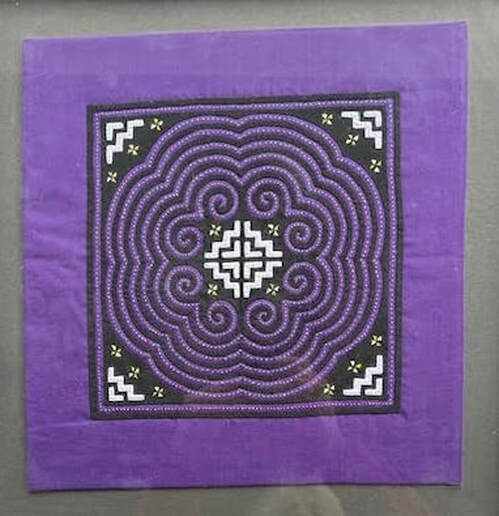
0 Comments
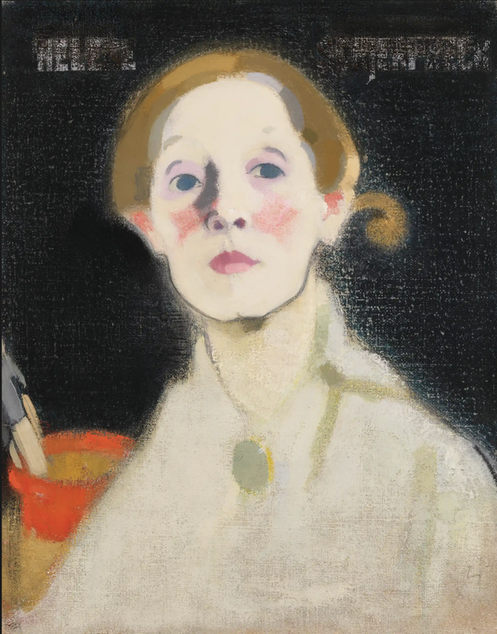 Self Portrait, by Helene Schjerfbeck (Finland) 1915 Code of Silence The sister hasn’t spoken in months, you say. More than that, actually, nearly a year. Things were just going along and then one day, she stopped talking. At first you thought she was playing some messed up kind of trick that you weren’t getting. Then you thought it was a protest. Sometimes she would write something down in the little notebook she’d started carrying around. But there would just be a few cryptic words like “the broken heart of Mexico” or “before they turn the summer into dust.” It took some figuring but eventually you caught on that these were snippets of song lyrics. Nothing in her own words, not even on paper. ** Urdu Translation ہیلن شیرف بیک (فن لینڈ) کی تصویر "ذاتی شبیہ" (۱۹۱۵ء) کی طرز پر خاموشی کا ضابطہ بہن نے کئی مہینوں سے کوئی بات نہیں کی، تم کہتی ہو۔ اُس سے بھی زیادہ عرصے سے، دراصل، تقریباً ایک سال سے۔ سب کچھ ٹھیک چل رہا تھا اور پھر ایک دن، اُس نے بات کرنا بند کر دیا۔ شروع میں ایسا لگتا کہ وہ کوئی الجھانے والا حربہ لگا رہی ہے جو تم سمجھ نہیں پا رہی۔ پھر ایسا لگتا کہ یہ کوئی احتجاج تھا۔ بعض دفعہ وہ یاداشت کی بیاض میں کچھ لکھتی جس کو اُس نے اپنے ساتھ رکھنا شروع کر دیا تھا۔ مگر وہاں صرف چند خفیہ الفاظ ہوتے جیسے " میکسیکو کا ٹوٹا ہوا دل" یا " اُن کے موسم گرما کو دھول میں تبدیل کرنے سے پہلے۔" کچھ اندازہ لگانا پڑا مگر آخرکار تم نے پکڑ ہی لیا کہ وہ گانے کے کچھ بول تھے۔ اُس کے ذاتی الفاظ میں سے کچھ بھی نہیں تھا، نہ ہی کاغذ پر۔ **
Transliteration Helene Schjerfbeck (Finland) ki tasweer Zaati Shabeeh (1915) ki tarz per Khamooshi ka Zabta Behen ne kayi mahenoon se koi baat nahein ki, tum kehti ho. Uss se bhi ziada arsae se, darasal, taqreban aik saal se. Sab kuch theek chal reha tha aur phir aik din, uss ne baat kerna band ker diya. Shuru mein aisa lagta ke who koi uljhane waala harba laga rehi hai jo tum samejh nahein pa rehi. Phir aisa lagta ke yeh koi ehtejaaj tha. B’aaz daf’a who yaadasht ki beyaaz mein kuch likhti jis ko uss ne apne saath rekhna shuru ker diya tha. Magar wahan sirf chand khufiya alfaaz hote jaise “Mexico ka toota huwa dil” ya “unn ke mosam-e-garma ko dhool mein tabdeel kerne se pehle.” Kuch andaaza lagana pera magar aakhir kar tum ne paker hi liya ke who gaanay ke kuch bol thay. Uss ke zaati alfaaz mein se kuch bhi nahein tha, na hi kaaghz per. Lorette C. Luzajic translated by Saad Ali & Nashwa Yaqoob Butt This poem first appeared (in English) in The Neon Rosary: tiny prose poems (Cyberwit Books). Saad Ali (b. 1980 CE in Okara, Pakistan) has been brought up and educated in the United Kingdom and Pakistan. He is a bilingual poet-philosopher and literary translator. His new collection of poems is titled Owl Of Pines: Sunyata (AuthorHouse, 2021). He has translated Lorette C. Luzajic’s ekphrastic poetry and micro/flash fictions into Urdu: Lorette C. Luzajic: Selected Ekphrases: Translated into Urdu(2023). He is a regular contributor to The Ekphrastic Review. He has had poems published in The Mackinaw and Synchronized Chaos. His work has been nominated for the Best of the Net Anthology. He has had ekphrases showcased at an Art Exhibition, Bleeding Borders, curated at the Art Gallery of Grande Prairie in Alberta, Canada. Some of his influences include: Vyasa, Homer, Attar, Rumi, Nietzsche, Freud, Jung, Kafka, Tagore, Lispector, et alia. He enjoys learning different languages, travelling by train, and exploring cities/towns on foot. To learn further about his work, please visit: www.saadalipoetry.com; www.facebook.com/owlofpines. Nashua Yaqoob Butt (b. 1984 C.E.) is from the Gujrat District, Pakistan. She is a teacher, social worker, and poetess. She holds an MA in Mass Communication from The Allama Iqbal Open University, Pakistan. She has authored two collections of poetry: Luminous Butterfly (2021), and Solitude: Silence and Self Identity (2023). Currently, she teaches Urdu and Social Studies (Secondary Level/Grade 9 & 10) at the Jinnah Public School & College, Gujrat, Pakistan. She has also been a part of a local Social Welfare Organisation (working for the empowerment of women in the region) as a Crochet Instructor. Her influences include: Rumi, Sylvia Plath, Ernest Hemingway, Amrita Pritam, and Rabindranath Tagore – to name a few. In her spare time, she pursues gardening, sketching/painting, writing, and crocheting. You can learn more about her work via her Facebook Author Page: www.nashwayaqoobbutt. 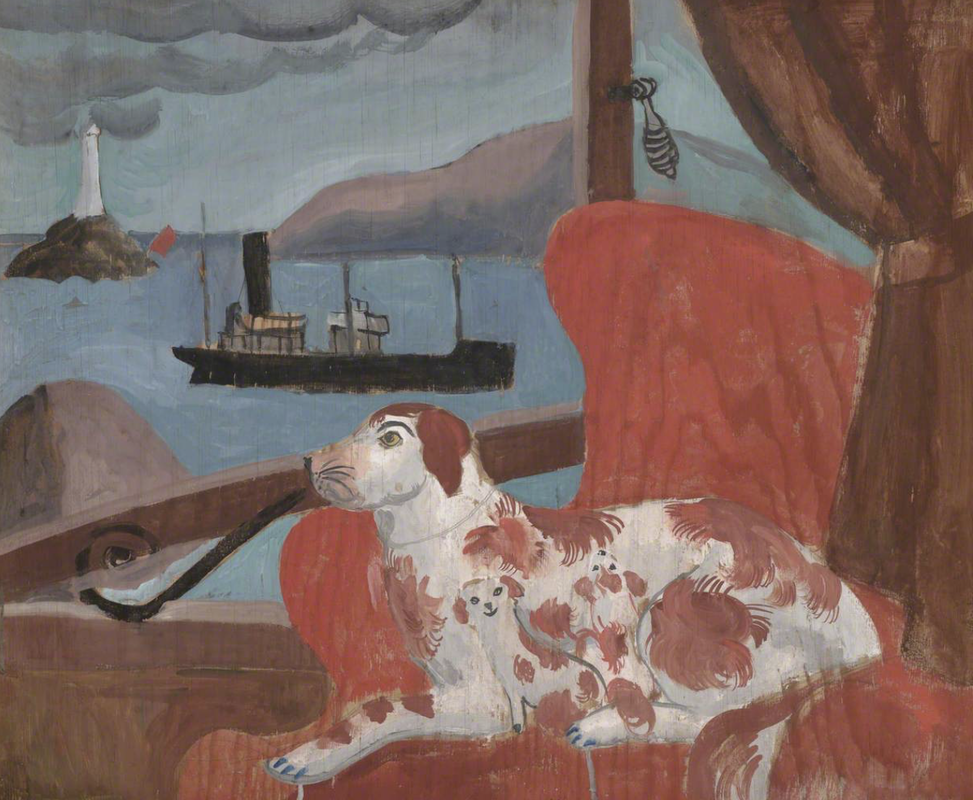 China Dogs in a St Ives Window, Christopher Wood (England) 1926 The Spaniel Pup Mother’s claws are blue, painted by an eight-year-old labourer. She is still in the chair, yellow eye fixed. Her daughter is smiling. Her son is clawing her stomach. He is climbing onto her back, slipping down onto the windowsill. Scents of salt and storm and hot dough are wafting through the open window. A boat is sailing between the boulder and the island. Clouds are dimming the lighthouse. A grey mass is bobbing in the waves -- hat or seal or drowned man? A red flag is clapping in the wind. The roof of the doughnut van is dirty. A boy is leaning against the van. He is biting a doughnut. His chin is stubbled with warm sugar. The pup leans too far falls breaks into four pieces. Gillian Fielder Gillian Fielder is a writer based in Wallsend. She has recently graduated from Newcastle University with a Master’s Degree in Creative Writing. She writes poems in response to a variety of existing materials —paintings, archaeological artefacts, medieval manuscripts. Her ekphrastic poem "Bird Song," after Wilhelmina Barns-Graham’s painting of the same name, appears in the pamphlet Beyond Abstraction, 2023, published by Newcastle University in collaboration with the Hatton Gallery. She lives with her husband and three school-age children. 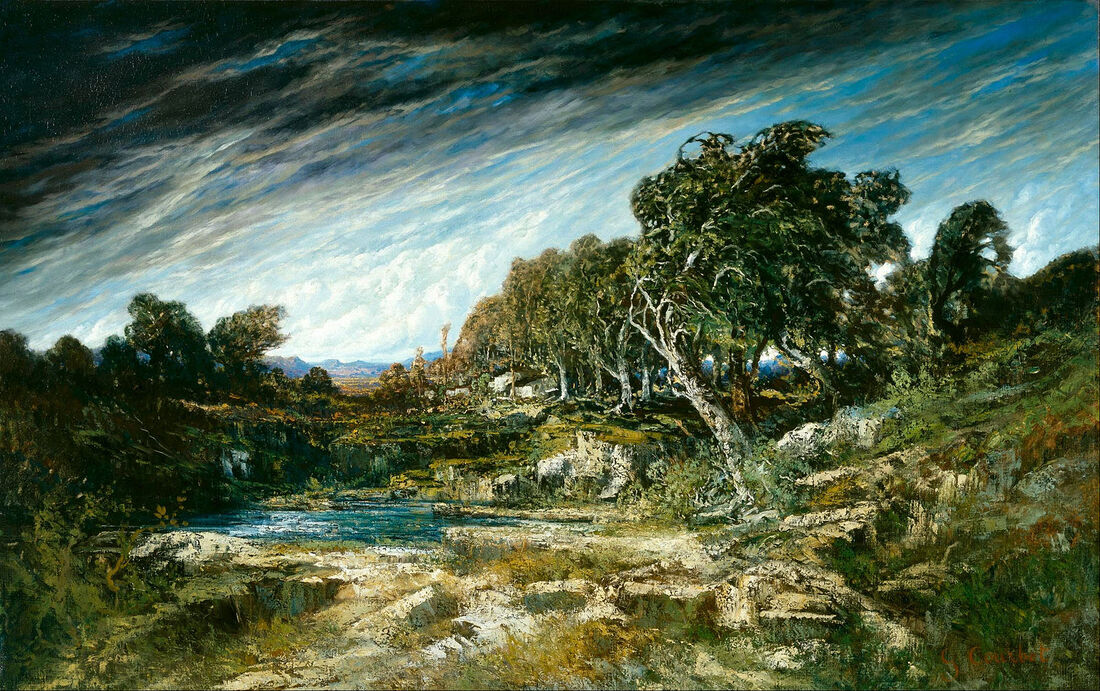 The Gust of Wind, by Gustave Courbet (France) 1865 The Realist Tutors his Eager Scholar But you talk like a Romantic. It is a "gust" not a "thrust" of wind. There is no intent. Nature is indifferent. Lightning lights on the highest point, the most accessible target in an open field. This verdant green evokes the O of a childish ego, hoodwinked by transcendental hoodoo, unaware that feelings are negligible. Trees don’t fight or submit to fate, skies don't weep, nor do storms ravish innocence. Pods fall, seeds spill against law or will. No need wonder about the drought before or after that shout of thunder, months of whispers, insidious, rasping, Will it ever rain again? Cruelty is man's domain. It requires effort, forethought, makes us the animal-namers, nature-rulers. Still, you ask, Why paint? If I am right, why commemorate something so fleeting, signifying nothing? I don't concede the point. Art stokes our illusion of control--that's the truth about beauty. Storms happen sans intention; we claim them for reflection. Such is the nonsense of romance. Forgive—or not—my rant: It is an infant’s sensitivity, my dear, though a most endearing flaw, your headstrong inability to process indifference. Kelly Ann Ellis This poem was first published in Friendswood Library's Ekphrastic Poetry Festival Anthology 2023. Kelly Ann Ellis holds an MA in English Literature from the University of Houston, where she also taught for over a decade. A member of the critique group Poets in the Loop, she is the co-founder of hotpoet, Inc. and the managing editor of Equinox. Her poetry, which has appeared in numerous journals and anthologies, was featured in the REELpoetry festival for three years consecutive years and showcased in the Houston Fringe Festival in 2019. She was twice nominated for a Pushcart prize in 2020, and her poetry collection, The Hungry Ghost Diner, was published by Lamar University Literary Press in 2023. 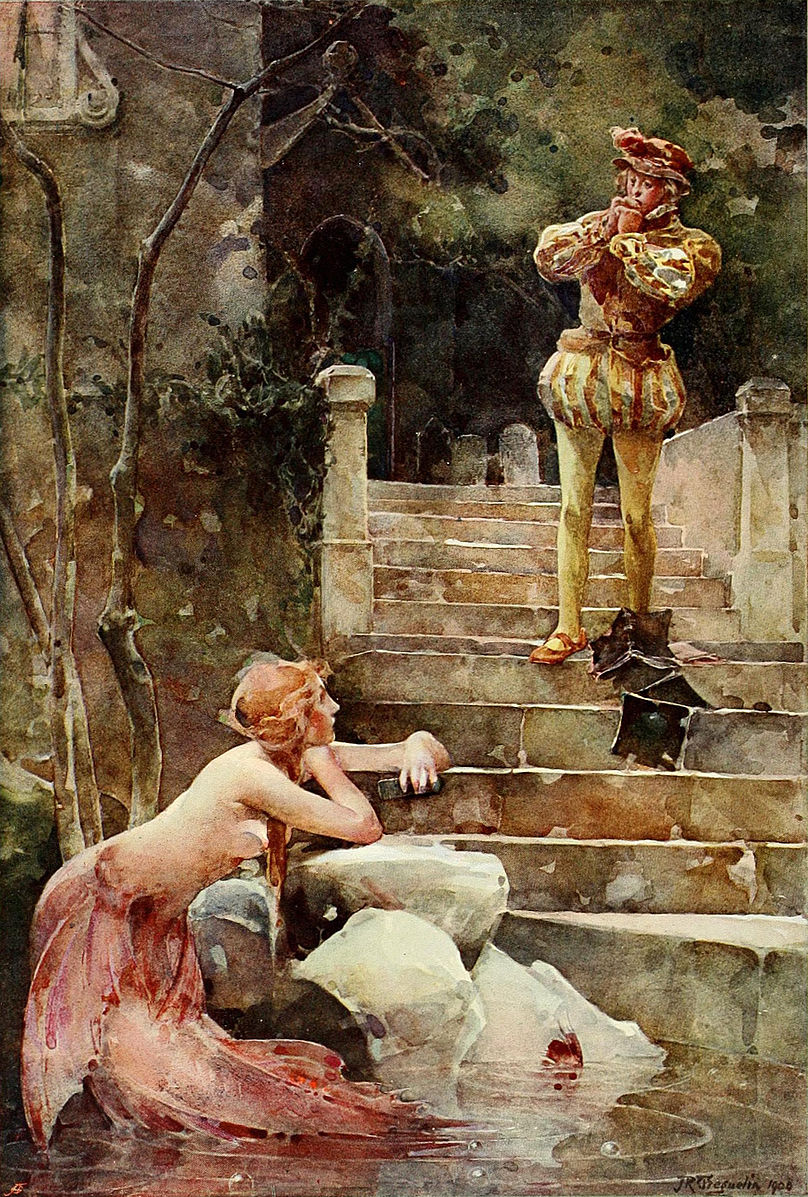 The Mermaid of Zennor, by John Reinhard Weguelin (England) 1900 The Mermaid of Zennor They make them so unforgiving, these pews, and so, well, functional. A little moulding, perhaps, a creature, myth or biblical motif would be nice. And how’s a girl to arrange herself? That’s the sting in the tail; the bottom line. The Church fathers could give a little more thought to the shape of things. I would rather not dwell upon their singing, those mournful and discordant dirges that ensued. How could I help but upstage them? My visits were few; the story has been embellished. I was never taken with liturgy or ancient myth, except one about a big fish swallowing a man. It was Mathey all along. One of the gentle folk, his music washed over me like the waves of the sea and I recognised him for a kindred spirit. He loved me for my voice though I was finely dressed, in proper Sunday rigout. It was only later, when I enticed him home, that he saw my other charms. It’s nice to have a voice. Never one to persuade a man by flaunting myself, I prefer to be taken seriously. After all, the job is for life. I believe that. They still remember me, how one night I begged their help. An anchor caught itself against my door; I tried to thank them but they rushed into the night, fearing themselves cursed. A touching gesture, carving that pew for my remembrance, where they like to think I sat to enjoy their sweet singing of a Sunday. Without a cushion, no chance of that. Julia Duke This poem was previously published at The Dawntreader and Poetry Wivenhoe. Julia Duke loves to experiment, with poetry, her first love, and with nature writing, memoir and a recent project on identity. Currently living in Suffolk, U.K., after fifteen years in the Netherlands and six on the beautiful west coast of Wales, she has found her inspiration in landscape and her fellow humans, from diverse artworks and quirky ideas. Her poems and articles are published in London Grip, Dreich,Obsessed with Pipework and various other anthologies and magazines. Conversations, her first poetry pamphlet, is published by Dempsey & Windle (2021) and tackles the knotty problem of relationships. 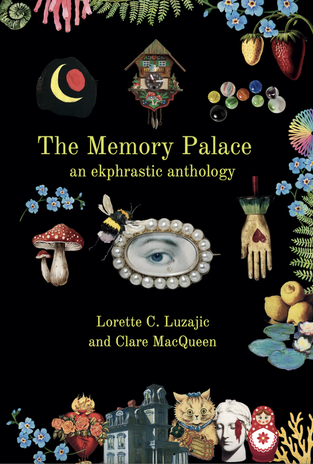 Click on image to get your copy on Amazon. At long last, we have arrived. The Memory Palace is here. What a journey it has been! This incredible collection of small fictions is the first print book of The Ekphrastic Review! I am incredibly grateful to Clare MacQueen, who agreed to help curate this collection and did so much more. We are so thankful to everyone who submitted their work. It was an extremely difficult task to choose. It's a stunning collection, with writers taking us down memory lane in many different ways. To make sure our writers get as many readers as possible, we have made the print copies as affordable as possible at $10 USD. A free e-book version is below for you to freely download. We invite you to send the e-book copy to all of your friends or anyone who loves flash fiction or ekphrasis or prose poetry of all of the above. Just a few treasures you'll find inside of The Memory Palace: -Christine H. Chen contemplates complicated connections in "Havana Nights" -Pamela Painter considers long friendships as her character turns 90 in "A Long Journey" -Hedy Habra is inspired by two surrealist women painters -Cassandra Atherton and Paul Hetherington meander through a few museums and centuries to explore the erotic and the ethereal -Margo Stutts Toombs uses her trademark blend of humour and poetry to look back over a life -Rebecca Weigold reflects on breast cancer and nighttime skies ** THANK YOU TO EVERY WRITER AND EVERY READER of The Memory Palace, and of The Ekphrastic Review and MacQueen's Quinterly. Get your copy today! 
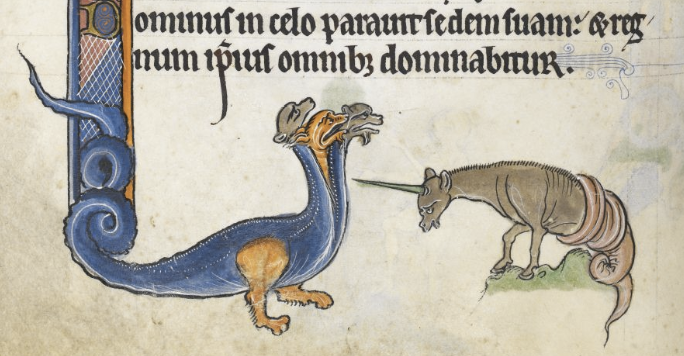 Magical beasts in the Rutland Psalter, artist not known (England) c. 1260 Misery i am pleased. i come here today with joy. no pain came with me. today is joy. my mountain is strong beneath me. in its joy my mountain threw off its cliffs its trees its rocky crags as i climbed. now i am the peak of the mountain and i am full of joy. joy of the strong. joy of the victorious. i bow my head before you in joy. i wrap my tail in joy. you who are beautiful do not know joy. you who are beautiful have three heads of beauty. i am here to bring you joy and you meet me with misery. misery of the feet misery of the tail misery of the mouth misery of the heads. you are so beautiful only three heads can present your beauty. you are blue when i am the colour of dirt. your legs stand straight and strong while my legs are bent beneath me. now you are beautiful but beauty makes you miserable. sick. sad. ready for death. the beautiful one is ready for death. the beautiful one knew i was coming. the doves were sent ahead to announce my approach. the beautiful could not prepare for my visit. the beautiful one can never escape misery. misery has devoured the heads of the beautiful one and only death can end its suffering. i am here and the beautiful one is here and now we will end suffering. 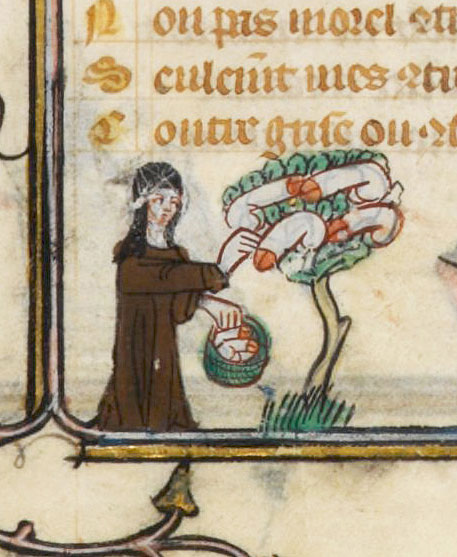 A nun plucks penises off a phallus tree in the Roman de la Rose, artist not known (France) c. 1325-1353 Gods and Penises to you watching we once had gods. gods of the storms and gods of the plants. gods of the lilac gods of the kiss placed on thin necks as we knelt and prayed to the gods to come to tell us what we needed what they needed and where we would find the joy to continue. sometimes with scarce food sometimes with rude men not gods. the men who thought they knew the way of the gods. men who know nothing of joy. we who clean and feed the foolish men with robes and gold crescents. we knew the joys of the gods the men could never know. we knew the graceful mornings the sweet nights the cries and murmurs. the explosions. now the gods are gone. all we have is a tree to care for and wait for each season to turn to fall. wait for spring's rains the wet water sluicing down shallow ditches to end. summer's loud storms to end. summer's thunder and wise lightning strikes. we wait through the seasons in silence with soft glances shared across anxious faces. the new god is silent and far away. our gods the gods we loved filled the earth with light and dark and green and arms and kiss soft hands rough hands. this god watches with suspicious eyes. this god is punishment. with the many gods our eyes opened with surprise and closed when spirits flew through windows. flew across fields and followed rivers to their birth and to their end crashing into the dark lakes. now spring has passed and the fields are full. the food is harvested the berries pick sweet apples press them into sweet cider. we alone send one in the dawn before the breakfast and the prayers to go to where joy once lived. where life was once bright. come to see our icon of the gods the icon of gone joy. 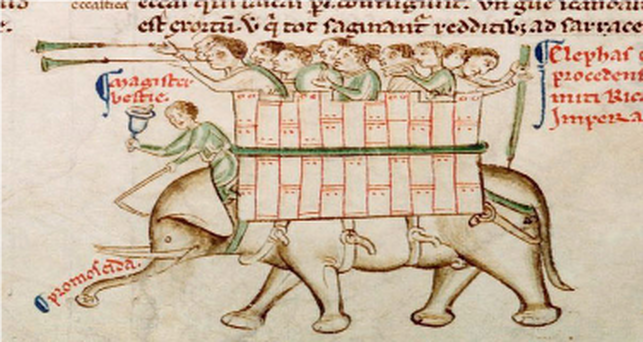 Elephant from Chronica maiora, Part II, by Matthew Paris (England) c. 1250s Town no more will contain us. we sound bugles ring bells cymbals and songs. our ride is full of cheer. see our eyes smiling forward. see our smiles on long lips. see the light of his walk the strength of his tail. inside the box we are free. inside the straps we are free. we see the rebellion of the one. our heads are turned forward and we see the rebellion of the one. we saw it in the morning and we saw it at noon. we see it now as we cheer and play as the town nears. we sing and cheer the town's gates to open. he is sad angry full of misery and hate. we see all of him. our beast sees all of him. he is foolish to think his spike will end our freedom. we know nothing will contain us. the walls of the box will open. ropes will be untied. we are free and we will not be kept prisoner by a fool with a needle. a fool with a spike. we are safe we are secure in our height we are secure in our music we are secure in our journey. town gates will open. we send music of greetings. music of greetings will welcome our entry. we are not fools and will not be bound by a fool. the gates of the town are empty we enter the town freedom and music enters the town. the fool will never enter. the fool will be left behind. John Riley John Riley lives in North Carolina where he rents his house from two of the most ungrateful dogs he's ever had the misfortune to encounter. He has published work in Literary Matters, Smokelong Quarterly, Litro Review, and other journals and anthologies. 10,000 Words, his book of 100 of his 100-word prose poems was published by EXOT Books in spring 2023. 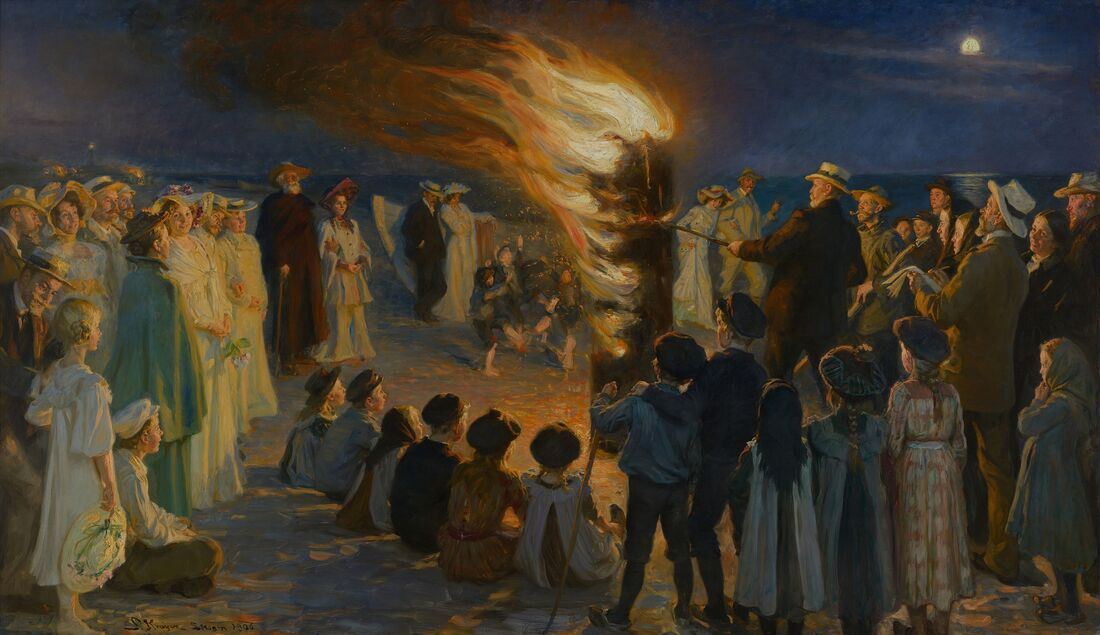 Midsummer Eve Bonfire on Skagen Beach, by P.S. Kroyer (Denmark) 1906 Our Family Fire The wind sends the flames bouncing and fluttering like strands of red hair. There’s a streak of red that all Bishops bear… even though Ma won’t admit it. “A touch of strawberry blonde is all,” she whispers. But when I ask about the fate of Aunt Bridget, Ma’s cheeks blaze like the bonfire. “And we’ll have no more talk of that, young man.” Before Mr. Randolph lights the bundle, there’s just the moon. Another far-away fire. Ma tells me not to sit too close, but I can’t resist the lure of the heat. I crowd forward with the other children, seeking a closer view of the logs and sticks tied high like a person. I picture my Aunt Bridget, from centuries ago, bound up tight. No one will speak about it—at least no one that’s allowed to come to the bonfire. It’s a strange thing to burn someone. To turn their flesh and bone to ash. Ma must have felt the same way when Granny asked to be cremated. After Granny passed, Ma pretended she knew nothing of the request. She buried Granny deep in the ground. Made sure the men shoveled her over with enough earth to smother any remaining flame. I think Granny wanted to connect with our past—to let the fires retrace our tree. But Ma kept our roots firmly planted. I listen to the crack and hiss of the fire battling with the gentle lapping of the waves and I wonder: Is this our town trying to reclaim its history? To pretend we’ve only ever burned wood? A spark reaches my cheek, as my tortured Aunt leans out of the fire to kiss her long-lost kin. Coleman Bigelow Coleman Bigelow is a Pushcart Prize and Best MicroFiction nominated author whose work has appeared or is upcoming in Bending Genres, Cosmic Daffodil, Dribble Drabble Review, Emerge Journal and Heavy Feather Review. Find more at: www.colemanbigelow.com or follow him on Twitter and Instagram 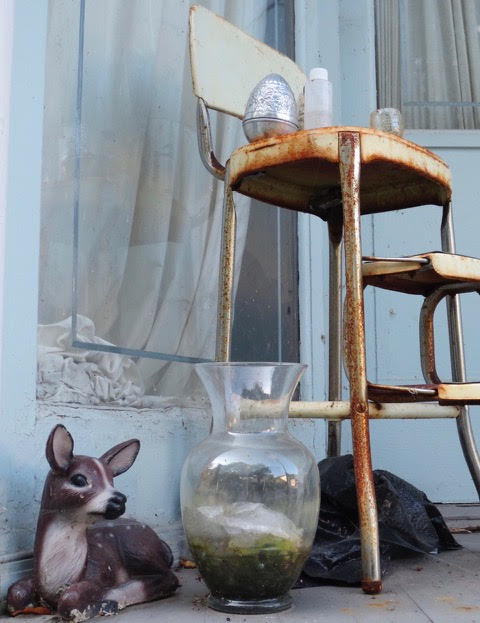 Untitled Tableau, by unknown maker (Upper New York State, US), photographed by Sharon Kirsch in August 2014 Flourish and Decay A fawn is to a doe as a minute to an hour, each an insinuation of a maturity hard won. The albumen of an egg may be dispersed in water and the future foretold according to the nascent shapes. Oomancy, divination by eggs, was once widespread. A white-tailed deer is fashioned to prevail, defying the maxim sink or swim. Endowed with hollow air-filled hair shafts, the even-toed ungulate floats without resistance, impervious to drowning. A doe at daybreak surrenders her fawn to a hidden bed, retrieving her secret cache at dusk. The aloneness of the fawn cracked open by daylight is as the loneliness of a relic expelled from a silver egg. Speculation: Within the vault of the precious egg may reside the baby teeth of Jesus, the Virgin’s milk evaporated, velvet from a buck’s antlers, the tatters from Mary’s veil, the hollow hair of a deer. Fact: Antlers are the fastest-growing living tissue on earth. Fact: The fawn, at birth, has four lower incisors. Certainty: Fawns arise and crest in spring and high summer, the season for bucks of antler development and growth. The fading of the spots runs apace with the shedding of the velvet enfolding the propulsive branches, tines, beams, and points. The curve of a fawn’s haunches, the slope of an egg, the globe of a vase yearning for the circularity of a crystal ball, the orb of time, the hungry capacity of a measuring cup—all are wanting. Having eyes on the sides of the head gives deer a wide field of vision, so wide that they are even able to see behind them when they are facing straight ahead. The hours to a fawn are as the ounces to a measuring cup, the seconds in an hourglass, the increments of fluid in a vase, the snippets that lend a reliquary its purpose, the promise of an egg. The fawn will sup on the algae. The rust will consume the chair. The egg has swallowed the relic. The liquid in the measuring cup has congealed. The future, ever restless, plays tag with the algae-tinged vase, once a sanctuary for long-stemmed roses. “Ruminant,” a word worthy of deer, originates in the Latin ruminatus: “to turn over in the mind,” or, more prosaically, “to chew the cud.” Sharon Kirsch Sharon Kirsch is the award-winning author of two books of creative nonfiction: The Smallest Objective, a mother-daughter memoir, and What Species of Creatures, a work inspired by historical writings about birds and “beasts.” She has lived in the US and the UK and is currently based in Toronto, Canada, where she volunteers as a caretaker for feral cats. You can visit her at https://sharonkirsch.com. 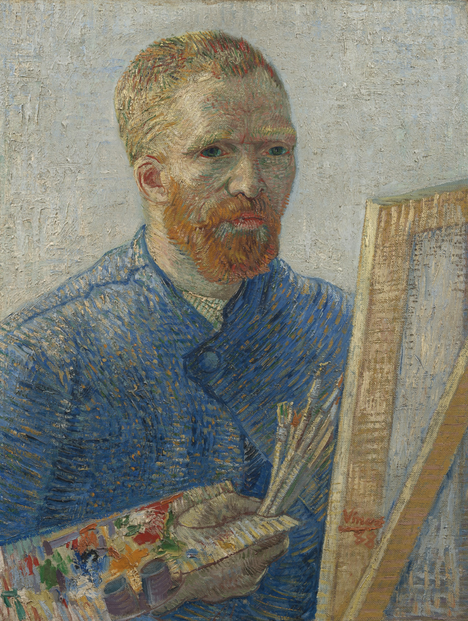 Self Portrait as a Painter, by Vincent van Gogh (Netherlands) 1887-88 I You pulled me through the crowd, Vincent, your wild eyes. Tugging at my soul like the moon at tides. The smell of paint on your hands. The anguish of your linen shirt. Startling. Coarse. We stare at each other. Breathing. In bold brush strokes. Unholy hues. The passion of our faces. The secrets of Paris, Arles, and Saint-Rémy. The infinity. Of infinitesimal splashes of truth. Of sun and wheat in different golds. Of gray-green skies. Of deepness. Everywhere in us. 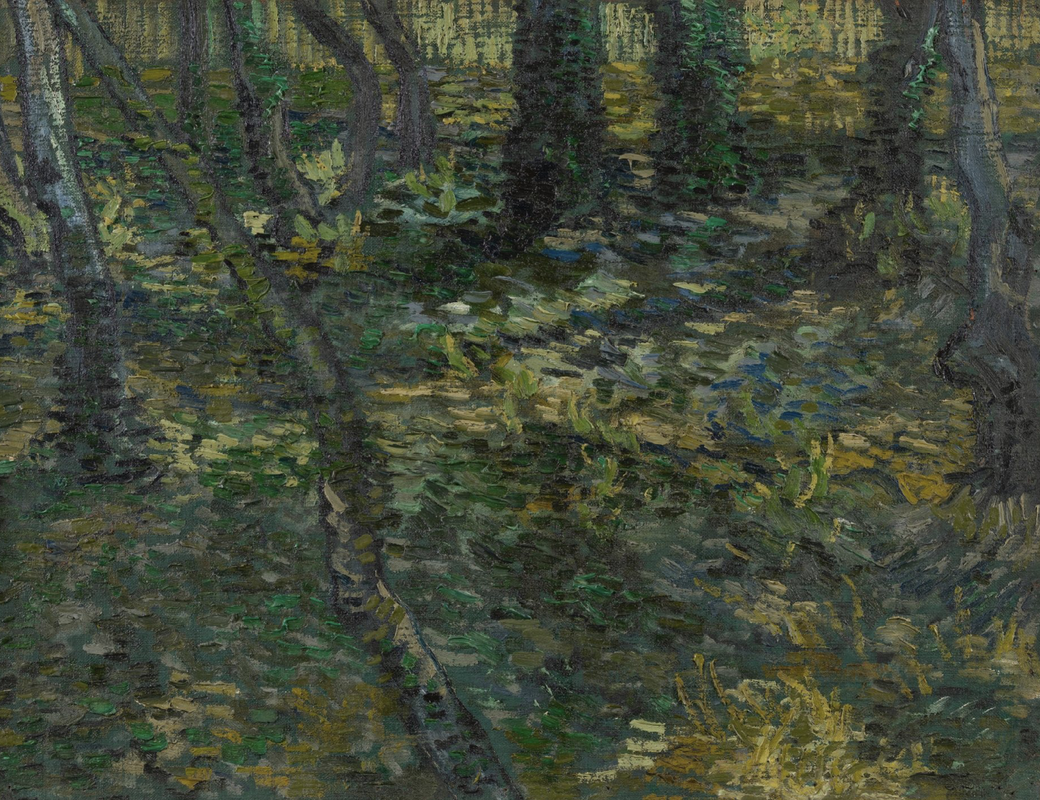 Undergrowth, by Vincent van Gogh (Netherlands) 1889 II Draw me into the forest. Deep. Where trees and undergrowth capture me. Like a madness. Where lavenders and grays jump out of the bark. Gently. Where greens beckon with mysterious mouths. Where we see only a hint of a path. Only a whisper of beyond. And the calm. The penetrating calm. The unexpected light we brush into the leaves to save ourselves. 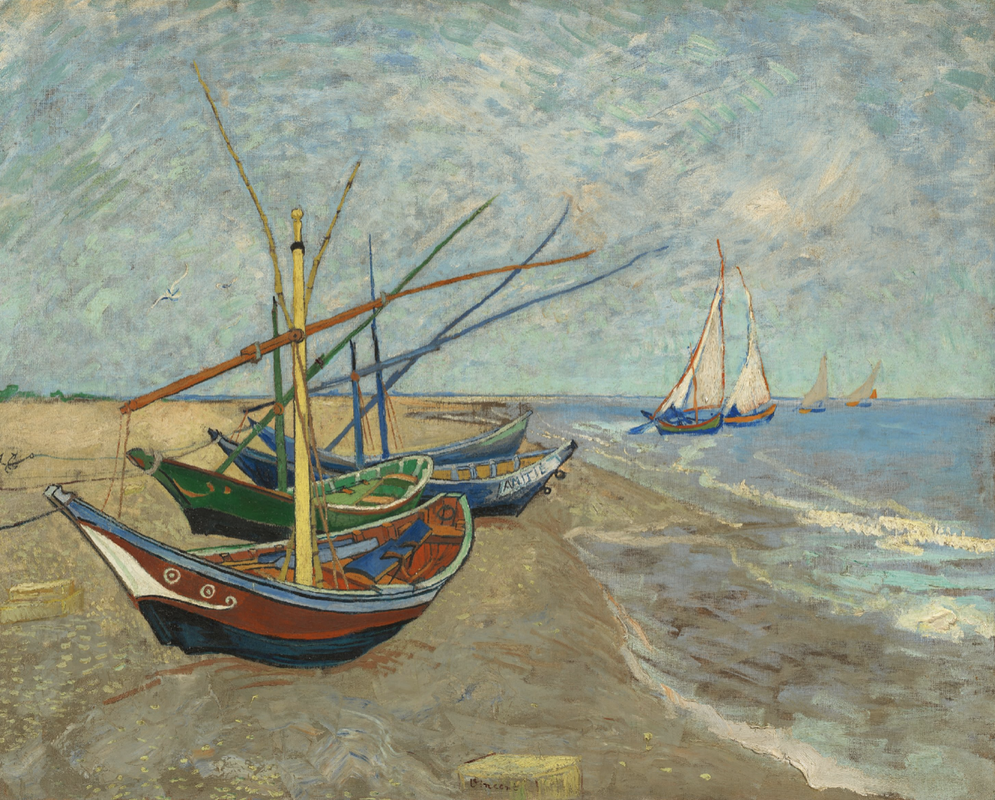 Fishing Boats on the Beach at Les Saintes-Maries-de-la-Mer, by Vincent van Gogh (Netherlands) 1888 III Take me to the sea. In four boats we float as one. Huddled. Brave. Waiting on the beach. Sand scrubbing our painted bows. Waiting for fishermen to fill us with life. For the steely blue water to lap at our sides like brushstrokes. Like blessings that drip from chalices into the mouths of peasants. 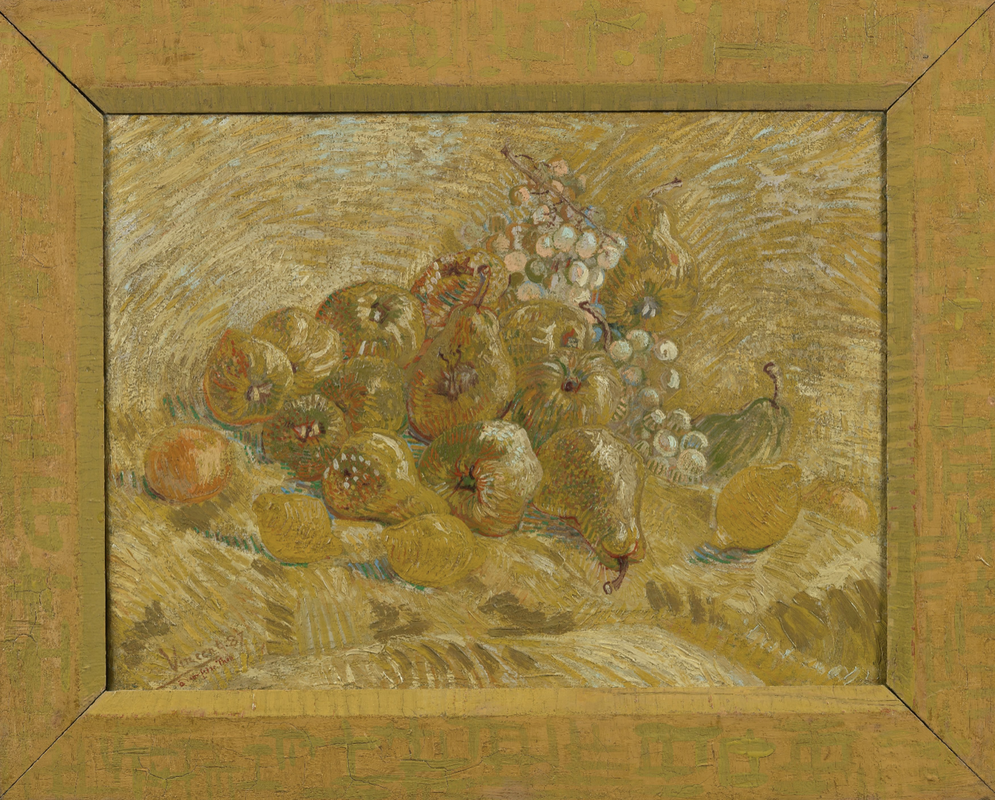 Quinces, Lemons, Pears, and Grapes, by Vincent van Gogh (Netherlands) 1887 IV Set me down. Like a bowl of quinces and lemons, pears and grapes, we are of singular hue. And yet many intensities. In our yellowness we outlast the putrid smell of rotting fruit in harvest fields. Shine in the bowl like perpetual sun. Roll like the roundness of the planet. 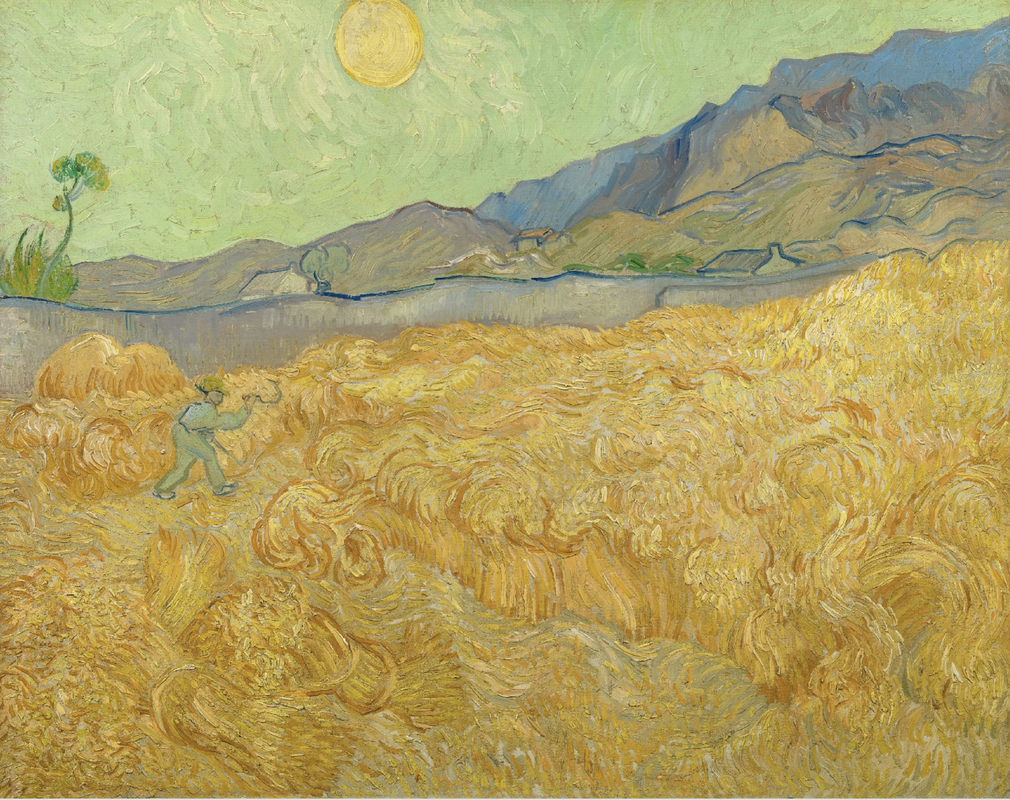 Wheatfield with a Reaper, by Vincent van Gogh (Netherlands) 1889 V In the end, make me the wheat. Boiling and churning. You and I, we feel, we live. We swallow the reaper whole. In gulps of amber, waves of truth. Linda Holmes Linda Holmes has been writing poetry for years, but is new to the publication arena. Her poetry has been accepted at the Monterey Poetry Review, Spank the Carp, and The Avocet, and she has won several first place and other awards in the Tennessee Mountain Writers annual poetry contests. She is also the author of a non-fiction book about the experiences of an ancestor who fought and died in the Civil War. The book, If I Am So Lucky: A Portrait of a Man in Perilous Times, 1862-1865, was published by Heritage Books, Inc. in 2023. |
The Ekphrastic Review
COOKIES/PRIVACY
This site uses cookies to deliver your best navigation experience this time and next. Continuing here means you consent to cookies. Thank you. Join us on Facebook:
Tickled Pink Contest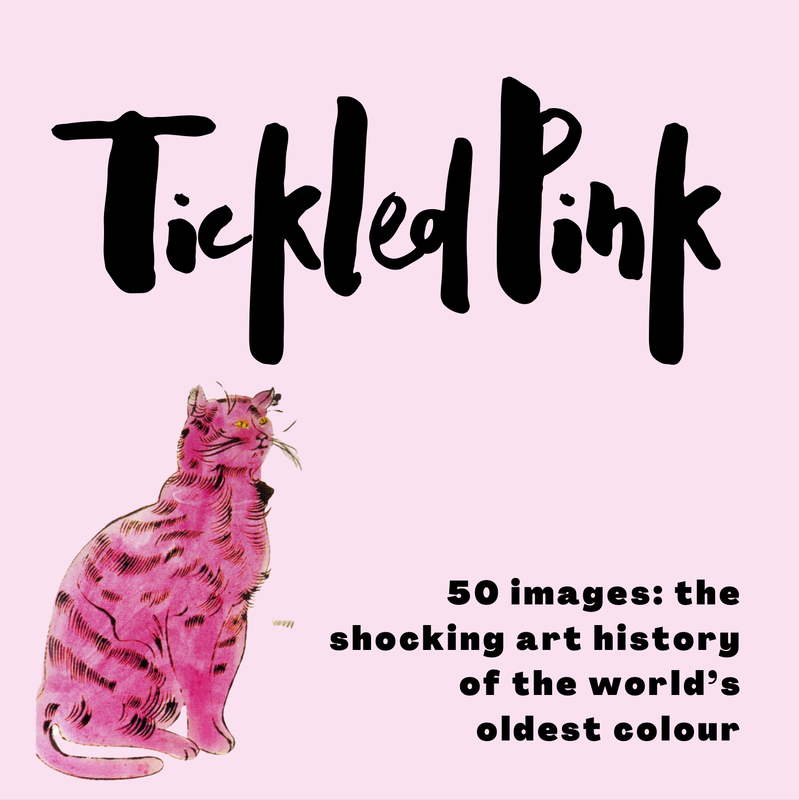

April 2024
|
||